Don't miss our holiday offer - up to 50% OFF!

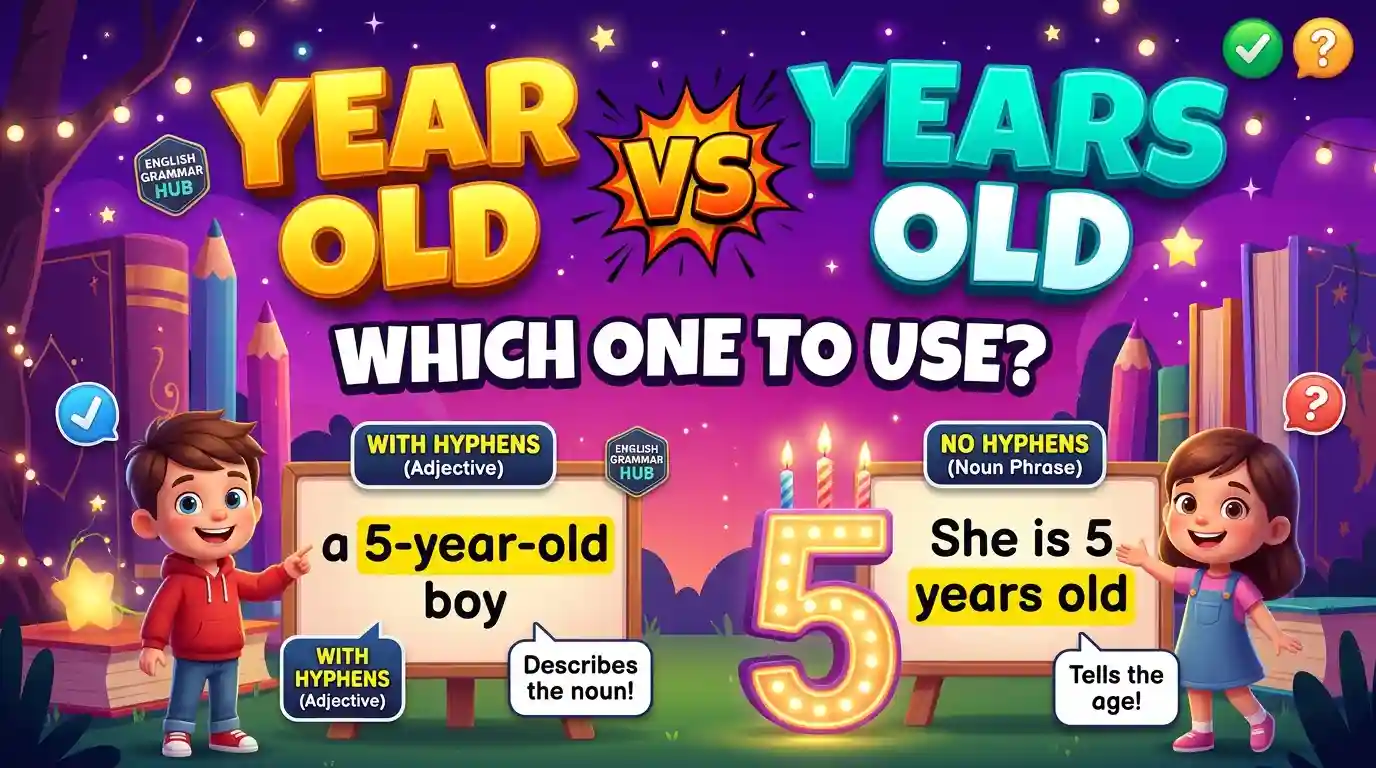
Year Old vs Years Old: Make Your English More Accurate

Imagine writing a birthday invitation that says, “Join us to celebrate our 5 years old daughter.” The meaning is clear, but the grammar sounds awkward. A small change makes the sentence correct: “Join us to celebrate our 5-year-old daughter.” Knowing when to use Year Old vs Years Old helps you describe someone’s age naturally and avoid common writing mistakes. Although both forms are correct, they serve different grammatical purposes.
Quick Answer
The difference between Year Old vs Years Old depends on how you use the age phrase in a sentence. Use years old after a verb to describe someone’s age, such as “My nephew is six years old.” Use year-old before a noun as a compound adjective, such as “My six-year-old nephew.”
What Each Term Means
Both expressions describe age, but their grammatical roles are different. Understanding their meaning makes it easier to choose the right form in everyday conversations, emails, school assignments, and professional writing.
What Does Year Old Mean?
The expression year-old usually works as a compound adjective when it appears before a noun. It describes the age of a person, animal, object, or something else.
For example:
- A three-year-old puppy needs regular care.
- She bought a ten-year-old laptop.
- The museum displayed a 200-year-old painting.
Notice that year stays singular, even when the age is greater than one. The hyphens connect the words and show that they work together as one description.
You can also find this construction in phrases such as different word combinations and spelling choices, where the position of a word affects its grammatical function.
What Does Years Old Mean?
Years old is an expression used after a linking verb to tell someone or something’s age. It normally appears after verbs such as is, am, are, and was.
For example:
- My cousin is eight years old.
- The building is 75 years old.
- Their youngest child was two years old last summer.
Here, years is plural because the age refers to more than one year. Unlike the compound adjective, this expression does not need hyphens.
It is common in everyday speech, personal descriptions, biographies, and formal writing.
The Core Rule, Explained Once
The main difference between Year Old vs Years Old comes down to the position of the age expression in a sentence.
When an age appears directly before a noun and describes it, use a singular noun with hyphens. When the age appears after a linking verb and completes the description, use the plural form without hyphens.
Compare these sentences:
- He is a four-year-old student.
- The student is four years old.
Both sentences communicate the same age, but their structures are different.
There are three parts to remember:
- Before a noun: Use a number, singular year, and hyphens.
- After a linking verb: Use a number, plural years, and no hyphens.
- With one year: The expression one year old remains singular when used after a verb.
This distinction is similar to other English spelling and usage questions. For example, writers sometimes compare different forms of compound expressions to understand how word placement and hyphens affect meaning.
Examples in Context
The following examples show how Year Old vs Years Old works across different real-life situations, including family conversations, education, shopping, travel, and professional writing.
- Family conversation: My little brother is seven years old and loves playing football.
- School report: The teacher welcomed a nine-year-old student into her classroom.
- Shopping: We purchased a two-year-old washing machine at a reasonable price.
- Travel: The historic hotel is 120 years old and still welcomes visitors.
- Medical discussion: The patient is three years old and needs a routine checkup.
- Technology: I recently replaced my five-year-old smartphone with a newer model.
- Workplace: The company celebrated its 25th anniversary with a special event.
- Pet care: Their golden retriever is six years old and enjoys long walks.
- History: The library contains a 300-year-old handwritten document.
- Birthday invitation: Everyone is invited to celebrate our daughter, who is four years old.
These examples show why sentence structure matters more than the number itself. The same age can appear in two different grammatical forms.
Common Mistakes
Writers often mix these expressions because they look similar. The following mistakes explain what to avoid when applying the Year Old vs Years Old rule.
1. Wrong: My daughter is five year old.
Right: My daughter is five years old.
Reason: Use the plural form after a linking verb when describing an age greater than one.
2. Wrong: He is a six years old boy.
Right: He is a six-year-old boy.
Reason: A compound adjective before a noun uses a singular year and hyphens.
3. Wrong: She owns a ten years old car.
Right: She owns a ten-year-old car.
Reason: The age phrase describes the car directly.
4. Wrong: My grandfather is eighty-year-old.
Right: My grandfather is eighty years old.
Reason: The expression after the linking verb does not require hyphens.
5. Wrong: We adopted a one-years-old kitten.
Right: We adopted a one-year-old kitten.
Reason: The compound adjective always uses the singular year, including ages beginning with one.
Tricky or Edge Cases
Some age expressions require extra attention because they appear in different sentence positions or use alternative grammatical structures. These cases are worth understanding if you want your writing to sound natural.
When the Age Appears at the Beginning of a Sentence
An age can begin a sentence when it functions as a compound adjective.
For example:
- Ten-year-old children can participate in the activity.
- Twenty-year-old traditions continue in the village.
The singular form remains necessary because the entire expression describes the noun that follows it.
When Describing Someone Who Is Exactly One
The number one is a special case because it already refers to a single year.
Consider these examples:
- My niece is one year old.
- We adopted a one-year-old rabbit.
Both forms are correct. The first describes age after a verb, while the second describes a noun.
When Using Approximate Ages
You can also describe age without giving an exact number.
Examples include:
- The child is around five years old.
- They purchased a nearly ten-year-old vehicle.
- The castle is more than 500 years old.
These expressions follow the same grammatical patterns, even when words such as around, nearly, and more than appear.
How to Remember It
Remember this simple trick when deciding between Year Old vs Years Old: look at the word that comes after the age.
If a noun follows the age directly, use singular year and connect the expression with hyphens. If a linking verb completes the age description, use plural years without hyphens.
Think of these two examples:
- A six-year-old dancer.
- The dancer is six years old.
Reading both sentences aloud can help you recognize the difference naturally. Similar spelling questions become easier when you understand how words function in a sentence, rather than memorizing isolated rules.
Which Is More Correct or More Common?
Neither form is universally better than the other. Both are grammatically correct, but they cannot always replace each other.
Years old is common in ordinary conversations because people often describe their age directly. You might hear someone say, “I am 28 years old,” during an introduction or personal discussion.
On the other hand, year-old is especially useful in descriptive writing. Newspapers, websites, reports, and everyday articles use it to keep sentences concise.
For example:
- The athlete is 19 years old.
- The 19-year-old athlete won the competition.
Both sentences are natural and correct.
The same principle applies to other English usage questions, including spelling differences between related words. Some variations depend on grammar, while others depend on accepted spelling conventions.
In professional writing, consistency is more important than choosing one expression for every situation. Follow the grammatical structure of each sentence instead of treating one version as the only correct option.
Quick Reference Table
This table provides a simple comparison to help you choose the right expression without second-guessing your grammar.
| Expression | Correct Usage | Example |
| Year old | Usually incomplete without a number or context | One year old |
| Years old | After a linking verb | He is ten years old. |
| Year-old | Before a noun | A ten-year-old boy |
| Years-old | Generally incorrect for an ordinary age description | A ten-years-old boy |
| One year old | After a linking verb | She is one year old. |
| One-year-old | Before a noun | A one-year-old puppy |
FAQs
1. Is It Year Old vs Years Old?
Both are correct, but their usage depends on sentence structure. Use years old after a linking verb and year-old before a noun.
2. Should I Write 10 Year Old or 10 Years Old?
Write 10 years old when describing someone’s age after a verb. Use 10-year-old when the phrase comes before a noun, such as “a 10-year-old child.”
3. Does Year Old Need a Hyphen?
Yes, when the expression comes before a noun as a compound adjective. For example, “a seven-year-old student” is correct. When used after a verb, as in “the student is seven years old,” no hyphen is needed.
4. Is It Correct to Say One Years Old?
No. The correct expression is one year old because the number one refers to a single year. Before a noun, write one-year-old, as in “a one-year-old baby.”
5. Can I Write 5 Years Old Child?
No. The correct version is 5-year-old child. When an age directly describes a noun, use a singular year and hyphens to connect the compound adjective.
Conclusion
Understanding Year Old vs Years Old makes everyday English writing clearer and more accurate. Both expressions are correct, but their grammatical positions determine which form you should choose. Use year-old with hyphens when describing a noun, and use years old when stating someone’s age after a linking verb. These small details can make a noticeable difference in your writing. Keep practicing with real sentences, and the correct form will soon become second nature. For more help with English usage, explore these helpful word distinctions and grammar explanations to continue improving your language skills.
[…] similar editing habit helps with other common usage questions, including year old or years old, where a small wording choice can change grammatical […]