Don't miss our holiday offer - up to 50% OFF!

Concurrent vs Simultaneous: Simple Ways to Understand Both Words

Have you ever wondered whether two meetings happening at the same time are concurrent or simultaneous? Both words describe events that occur during overlapping periods, but they do not always communicate the same idea. Understanding Concurrent vs Simultaneous can help you choose the right word in conversations, emails, academic writing, and professional settings. Although the terms are often interchangeable, each has a slightly different emphasis. Let’s explore their meanings, grammatical uses, differences, and examples to make the distinction easy to remember.
Quick Answer
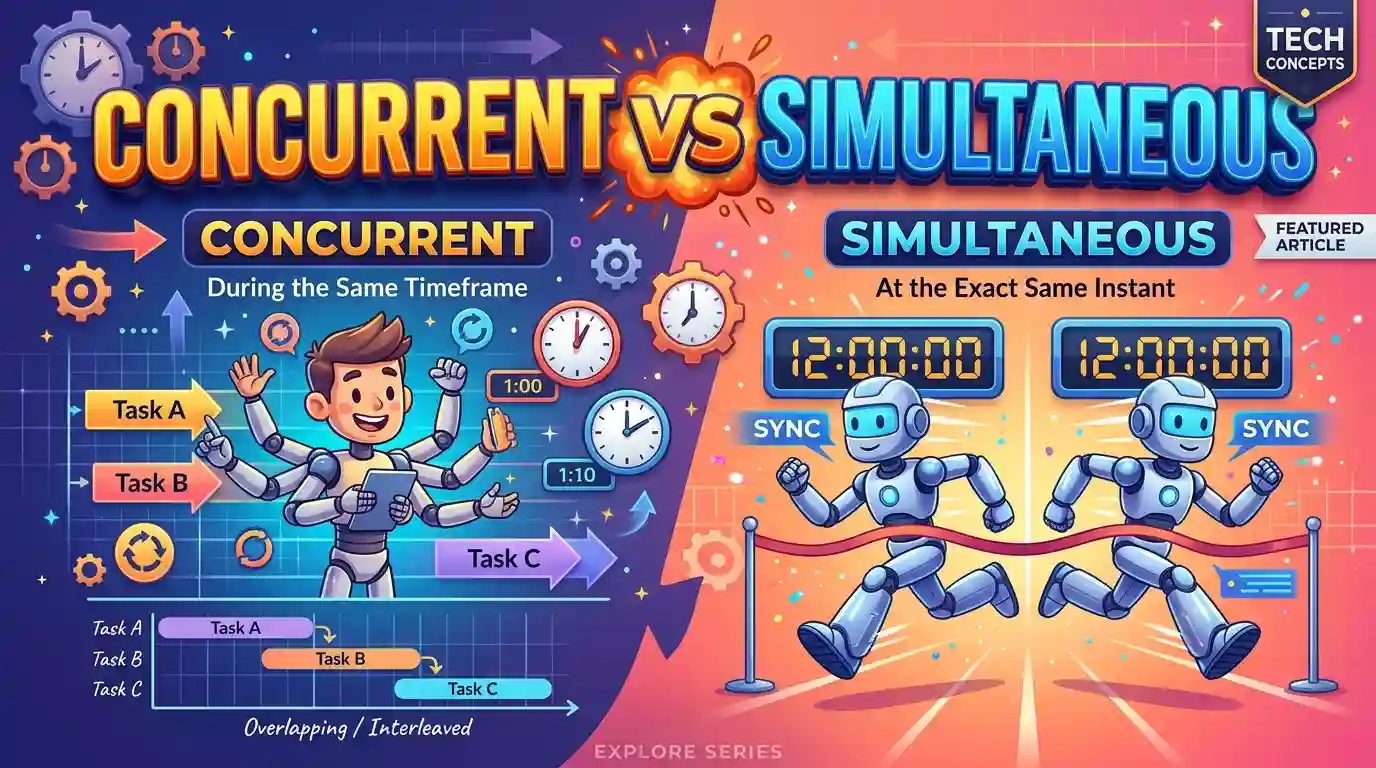
Concurrent describes two or more events that happen during the same period, even if they do not start or finish at the exact same moment. Simultaneous usually describes events that happen at precisely the same time. In short, concurrent focuses on overlapping periods, while simultaneous emphasizes shared timing.
What Each Term Means
Both words describe a relationship between events in time. However, their meanings have slightly different shades, much like other English word pairs that express different time relationships.
1. What Does Concurrent Mean?
Concurrent is an adjective that describes two or more events, activities, or situations that exist or happen during the same period.
These events do not need to begin or end together. Their time periods simply overlap. For example, a student may attend a training course while completing a part-time internship. Both activities are concurrent because they happen during the same general period.
The word is common in professional, academic, legal, and technical writing.
Examples:
- The company managed two concurrent projects.
- She is taking concurrent courses in biology and chemistry.
- The city experienced concurrent construction projects.
- Several investigations are currently concurrent.
Concurrent can also describe conditions or responsibilities that exist together. It does not always suggest that people perform two actions at the exact same second.
2. What Does Simultaneous Mean?
Simultaneous is an adjective that describes two or more events happening at the same time. It places greater emphasis on timing than on the overall duration of an activity.
For example, two phones may receive the same notification at precisely 9:00 a.m. Their notifications are simultaneous because both arrive at the same moment.
This word often appears in science, technology, communication, and everyday descriptions of events.
Examples:
- The audience gave a simultaneous response.
- Two alarms went off simultaneously.
- The machines started their operations at the same moment.
- Both teams made simultaneous announcements.
Simultaneous can also describe actions performed together. It highlights a shared moment rather than simply showing that two activities overlap.
The Core Rule, Explained Once
The main distinction between Concurrent vs Simultaneous comes from the way we describe time. Concurrent refers to activities that take place during overlapping periods. Simultaneous refers to activities that occur at the same moment or nearly the same moment.
Consider two employees working on separate assignments throughout the same week. Their tasks are concurrent, even if one person works in the morning and the other works in the afternoon.
Now imagine two musicians striking their instruments at exactly 3:00 p.m. Their actions are simultaneous because they happen together at one particular moment.
The words are adjectives, so they can describe nouns such as events, activities, sessions, operations, and processes. Their forms do not change according to singular or plural nouns.
For example:
- A concurrent activity.
- Two concurrent activities.
- A simultaneous announcement.
- Several simultaneous announcements.
The same attention to grammatical structure helps with other subject-and-verb questions, such as whether anyone has or anyone have.
Another useful detail is that simultaneously is the adverb form of simultaneous. It describes how an action happens.
For example:
- The two speakers answered simultaneously.
- The lights flashed simultaneously.
Similarly, concurrently is the adverb form of concurrent.
For example:
- The departments worked concurrently.
- Both programs operated concurrently.
These adverbs help you describe actions without changing the basic meaning of their adjective forms.
Examples in Context
The following examples of Concurrent vs Simultaneous cover everyday situations, workplace activities, education, technology, travel, and communication. Each sentence shows how the two terms work naturally in different settings.
- Workplace: The marketing team handled three concurrent campaigns during the holiday season.
- Technology: Both computers received simultaneous software updates at noon.
- Education: Daniel completed two concurrent training programs while working part-time.
- Communication: The news channels made simultaneous announcements about the election results.
- Travel: Several concurrent road repairs affected traffic across the city.
- Shopping: The store launched two concurrent discount campaigns during its annual sale.
- Sports: The two runners crossed the finish line in a simultaneous photo finish.
- Weather: Heavy rain and strong winds caused concurrent problems across several coastal towns.
- Entertainment: The dancers performed simultaneous movements during the final scene.
- Scheduling: The manager arranged two concurrent appointments within the same afternoon time slot.
These examples show why context matters. The correct choice depends on whether you mean overlapping periods or events sharing the same moment.
Common Mistakes
Writers sometimes treat these words as perfect substitutes. Although they share a similar meaning, their different emphasis can affect sentence clarity. Here are five common mistakes to avoid.
- Wrong: The two projects started together and continued throughout the month, so they were simultaneous.
Right: The two projects were concurrent.
Reason: Their activities overlapped over a period rather than focusing on one shared moment. - Wrong: The two bells rang at different times, but their sounds were simultaneous.
Right: The two bells rang at different times.
Reason: Simultaneous requires events to happen at the same moment. - Wrong: She attended two simultaneous courses scheduled for different hours.
Right: She attended two concurrent courses.
Reason: The courses overlapped during the same term but did not happen together in each session. - Wrong: The workers performed concurrent actions at precisely the same second.
Right: The workers performed simultaneous actions.
Reason: Simultaneous is the clearer choice when exact timing matters. - Wrong: The two words always mean exactly the same thing.
Right: Their meanings overlap, but their emphasis differs.
Reason: Context determines whether overlapping duration or shared timing is more important.
A similar editing habit helps with other common usage questions, including year old or years old, where a small wording choice can change grammatical accuracy.
Tricky or Edge Cases
Some situations make the distinction less obvious because an event can have both an overlapping duration and a shared starting point. In these cases, either word may be appropriate, depending on the intended meaning.
For example, two online classes may begin at 10:00 a.m. and continue for one hour. They are simultaneous because they start together. They are also concurrent because they operate during the same period.
However, if two research projects run throughout the summer but have different starting dates, concurrent is more suitable.
Another tricky situation involves near-simultaneous events. In everyday conversation, people sometimes use simultaneous for events that happen almost together. Strictly speaking, however, simultaneous suggests the same moment, while near-simultaneous makes room for a slight difference in timing.
In technical or scientific writing, precision matters even more. If the exact timing of an event is important, use simultaneous only when the evidence supports that description.
How to Remember It
A simple memory trick makes Concurrent vs Simultaneous easier to understand.
Think of concurrent as a calendar. Two activities can appear during the same week without happening at the same hour.
Think of simultaneous as a clock. Two actions happen at the same moment.
Remember these short clues:
- Concurrent = Overlapping periods
- Simultaneous = Same moment
- Concurrently = During the same period
- Simultaneously = At the same time
If you focus on duration versus exact timing, choosing between these words becomes much easier.
Which Is More Correct or More Common?
Neither word is more grammatically correct than the other. Both are standard English adjectives, and both are suitable for formal and informal communication.
The difference is mainly about meaning and context. Concurrent is often preferred when discussing projects, responsibilities, legal proceedings, courses, or processes that overlap over a period.
Simultaneous is more suitable when describing events that happen together at a particular moment. It is common in discussions about signals, announcements, movements, reactions, and coordinated activities.
There is also a slight difference in tone. Concurrent may sound more formal or technical, especially in business and academic writing. Simultaneous is widely understood in everyday English and formal communication alike.
Neither word is an outright error when used correctly. The real mistake happens when a writer chooses one without considering the timing being described.
This is similar to other vocabulary choices, such as resignate or resonate, where understanding the intended meaning matters more than choosing the word that sounds familiar.
Quick Reference Table
Use this table to review the main differences at a glance. It covers meaning, emphasis, grammar, and suitable examples.
| Feature | Concurrent | Simultaneous |
| Main meaning | Happening during overlapping periods | Happening at the same moment |
| Main focus | Duration and overlap | Exact timing |
| Part of speech | Adjective | Adjective |
| Adverb form | Concurrently | Simultaneously |
| Common use | Projects, courses, processes | Reactions, signals, announcements |
| Starting time | May be different | Usually the same |
| Ending time | May be different | May be the same or different |
| Example | Concurrent assignments | Simultaneous movements |
FAQs
1. Are concurrent vs simultaneous the same?
They have similar meanings, but they are not always interchangeable. Concurrent describes overlapping periods, while simultaneous emphasizes events happening at the same moment.
2. Can concurrent events happen at different times?
Yes. Concurrent events can begin or end at different times as long as their durations overlap. For example, two business projects may run during the same month but start on different dates.
3. Does simultaneous mean exactly at the same time?
Yes. Simultaneous generally means that two or more events happen at the same moment. In casual conversation, it can sometimes describe events that occur almost together.
4. What is the difference between concurrent and concurrently?
Concurrent is an adjective that describes a noun, such as concurrent activities. Concurrently is an adverb that describes an action, such as two teams working concurrently.
5. Which word should I use in formal writing?
Choose concurrent when you mean overlapping periods. Use simultaneous when you mean events happening at the same moment. Both words are appropriate for formal writing when their meanings fit the context.
Conclusion
Understanding Concurrent vs Simultaneous helps you describe events with greater accuracy. Although both words refer to activities happening around the same period, concurrent focuses on overlapping durations, while simultaneous highlights a shared moment. Neither word is automatically better or more correct; the right choice depends on what you want to communicate. Pay attention to the timing of the events, check whether their periods overlap, and select the word that expresses your meaning clearly. With regular practice, these small vocabulary distinctions will make your English writing more natural, precise, and confident. For more help with everyday grammar and word choices, explore this guide to time-slot spelling and usage.