Don't miss our holiday offer - up to 50% OFF!

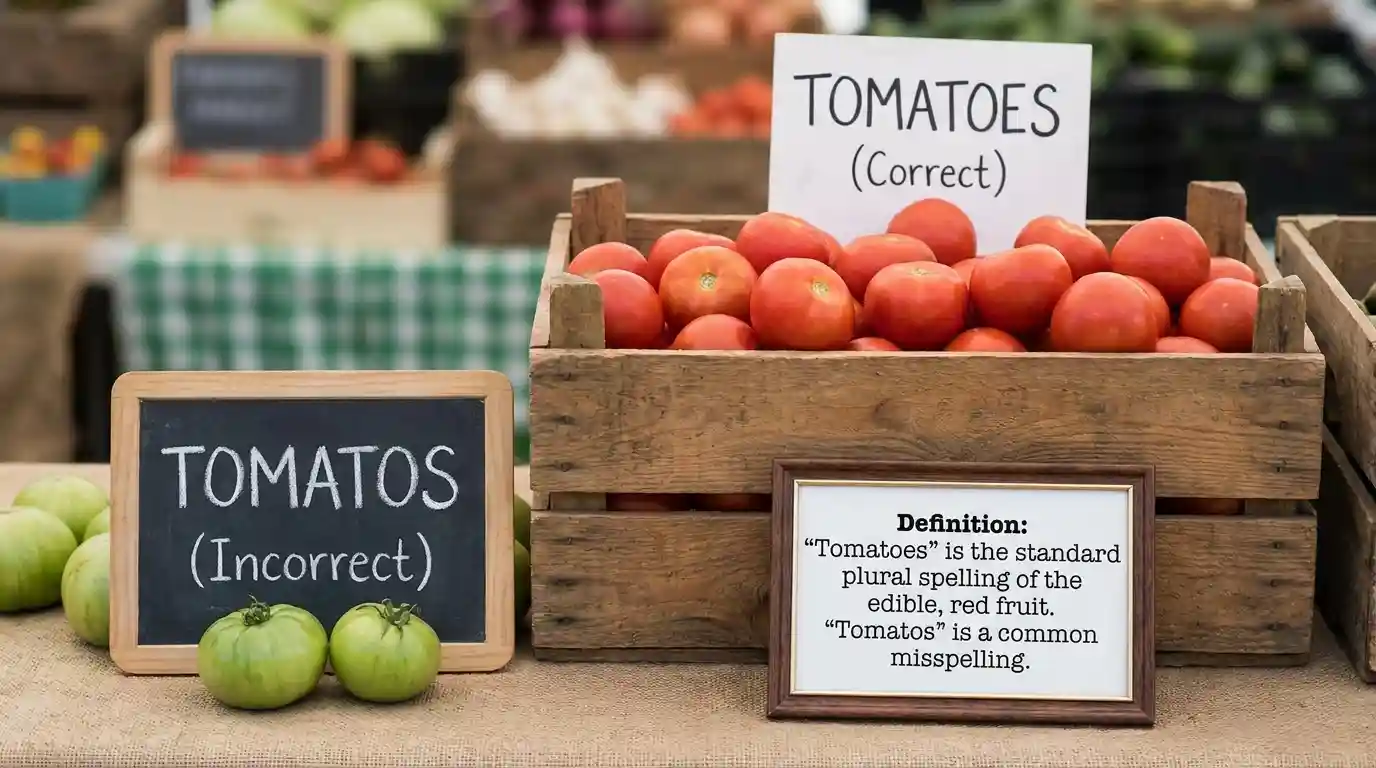
Tomatoes or Tomatos: The Simple Spelling Rule to Know

Introduction
Picture yourself typing a grocery list: “Buy six tomatos.” The meaning is obvious, but the spelling may make you pause. If you have ever searched for tomatoes or tomatos, the answer is straightforward: one spelling follows standard English, while the other is a common misspelling. A tiny difference in two letters can make the difference between polished writing and an avoidable spelling error.
Quick Answer
Tomatoes or tomatos has a simple answer: tomatoes is the correct standard spelling of the plural noun tomato. Tomatos is not the accepted standard plural form, so use tomatoes in school, work, publishing, recipes, and everyday writing.
Tomatoes or Tomatos: What Each Term Means
The two forms look almost identical, but only one belongs to standard written English. Understanding the word behind each spelling makes the difference easier to recognize, especially when writing quickly.
Tomatoes
Tomatoes is the plural of tomato, referring to more than one tomato. The spelling reflects the usual English plural pattern for certain nouns ending in -o. It is the form you should use when referring to two or more of the familiar red, yellow, orange, or green fruits.
Tomatos
Tomatos is a misspelling of the standard plural tomatoes. You may see it in informal messages, search queries, menus, social media posts, or online comments, but it is not the conventional form used in edited English.
When considering tomatoes or tomatos, remember that the difference is not about meaning. Both forms are intended to refer to more than one tomato, but only tomatoes has the accepted spelling.
The Core Rule, Explained Once
The tomatoes or tomatos question becomes easier when you look at how English forms plurals. Many nouns ending in a consonant followed by o take -es in the plural, especially established words such as tomato, potato, and echo. That gives tomato → tomatoes rather than tomato → tomatos.
English plural spelling is not completely predictable, because some words ending in o take only -s. For example, photo becomes photos, piano becomes pianos, and radio becomes radios. Because of these mixed patterns, simply remembering that every o-ending noun takes -es would create new errors. The useful approach is to learn common words individually, with tomato being one of the familiar -es examples.
This pattern is also why the spelling should not be based entirely on how the plural sounds. English spelling often preserves established word patterns that are easier to recognize visually than to work out phonetically.
The plural ending also affects pronunciation. Tomatoes is commonly pronounced with a final sound similar to “tohz,” rather than simply attaching the sound of s to tomato. Pronunciation can vary between English varieties, but the written form remains the same.
Examples in Context
These examples show how tomatoes or tomatos appear across different real-life settings, from shopping and cooking to school and casual communication.
- Grocery list: Please add tomatoes to the shopping list.
- Recipe: Roast the tomatoes with garlic before blending the sauce.
- Garden note: The tomatoes on the balcony need more support.
- Restaurant menu: Our salad includes fresh tomatoes, basil, and cucumber.
- School assignment: The student described how tomatoes develop from flowers.
- Text message: I bought the tomatoes you asked for.
- Farmers’ market: These tomatoes were picked early this morning.
- Cooking blog: Chopped tomatoes give the salsa a bright, fresh flavor.
- Gardening advice: Heavy rain can split ripe tomatoes.
- Product label: Store the tomatoes at room temperature for better flavor.
Common Mistakes
When people hesitate over tomatoes or tomatos, they often leave out the “e” because the shorter spelling seems natural. The following pairs show the correct form and explain the problem briefly.
- Wrong: I bought three tomatos.
Right: I bought three tomatoes.
Reason: The standard plural of tomato is tomatoes. - Wrong: These tomatos are very ripe.
Right: These tomatoes are very ripe.
Reason: Tomatos drops the -es ending used in the conventional plural. - Wrong: Add two sliced tomatos to the sandwich.
Right: Add two sliced tomatoes to the sandwich.
Reason: The noun needs its standard plural spelling. - Wrong: The recipe calls for four tomatos.
Right: The recipe calls for four tomatoes.
Reason: Recipe writing should use the established dictionary form. - Wrong: We grew several tomatos this summer.
Right: We grew several tomatoes this summer.
Reason: Several signals a plural noun, but it does not change the spelling of the noun.
Tricky or Edge Cases
There is no major grammar distinction between the two forms: the real issue is spelling. One potentially confusing point is that English contains other nouns ending in -o that form plurals with -s, which can make the spelling of tomato feel less obvious than it really is.
Words such as photos, radios, and pianos follow a different plural pattern. That does not make tomatos an alternative spelling; tomato has its own established plural form, tomatoes. In other words, the existence of photos does not provide a reason to write tomatos.
How to Remember It
A useful memory trick is to pair tomato with potato: tomato → tomatoes and potato → potatoes. Both common food words use -es in their standard plurals. If you are deciding between tomatoes or tomatos, remember that the longer spelling keeps the “e” before the final “s.” Thinking of the two food words together can make the spelling much easier to recall.
Which Is More Correct or More Common?
When choosing between tomatoes or tomatos, tomatoes is the standard and overwhelmingly preferred form in edited English. It appears in dictionaries, formal writing, educational materials, recipes, journalism, product descriptions, and ordinary communication.
Tomatos is not a competing regional or formal variant of the same plural. It is generally treated as a spelling error, even though readers can easily understand what the writer means. You might encounter it online because people type quickly, rely on phonetic intuition, or are unsure how an o-ending noun should be pluralized.
This distinction is therefore about correctness rather than a difference in meaning. Choosing tomatoes avoids an unnecessary spelling error and gives your writing a polished, reliable appearance. The same habit is useful whenever you are writing something that will be read by teachers, customers, editors, colleagues, or a wider audience.
Quick Reference Table
This table gives you the essential differences at a glance, including the singular form, plural form, and status of each spelling.
| Form | Use | Example |
| tomato | Singular | One tomato is on the counter. |
| tomatoes | Standard plural | Five tomatoes are in the basket. |
| tomatos | Misspelling | Avoid this form in standard writing. |
FAQs
These common questions cover the spelling, plural formation, pronunciation, and everyday use of the word.
Is tomatoes the correct spelling?
Yes. Tomatoes is the standard plural spelling of tomato, while tomatos is considered incorrect in standard English.
Why does tomato become tomatoes?
Tomato is one of the common English nouns ending in -o that traditionally forms its plural with -es. The established plural is therefore tomatoes.
Is tomatos ever acceptable?
Tomatos may appear in informal writing or online because of a spelling mistake, but it is not the standard plural form recommended for edited English.
How do you pronounce tomatoes?
In common English pronunciation, tomatoes usually has a final sound similar to “tohz.” Pronunciation can vary somewhat by English variety, but the written plural remains tomatoes.
Is tomato plural or singular?
Tomato is singular, meaning one fruit. Tomatoes is plural, meaning more than one.
Conclusion
When comparing tomatoes or tomatos, the practical choice is clear: tomatoes is the standard plural spelling, while tomatos is a misspelling. The extra “e” is easy to overlook, especially because English has several different plural patterns for words ending in o. Remembering tomato alongside potato can make the correct form much easier to recall.
Using the correct spelling helps your writing look polished and prevents a small mistake from distracting readers from your message. Whether you are writing a recipe, school assignment, shopping list, blog post, or professional document, tomatoes is the form to choose. Once you remember the -es ending, this common spelling question becomes much easier to handle confidently.
Spelling rules are full of surprises — disfunction vs dysfunction is another one worth knowing.