Don't miss our holiday offer - up to 50% OFF!

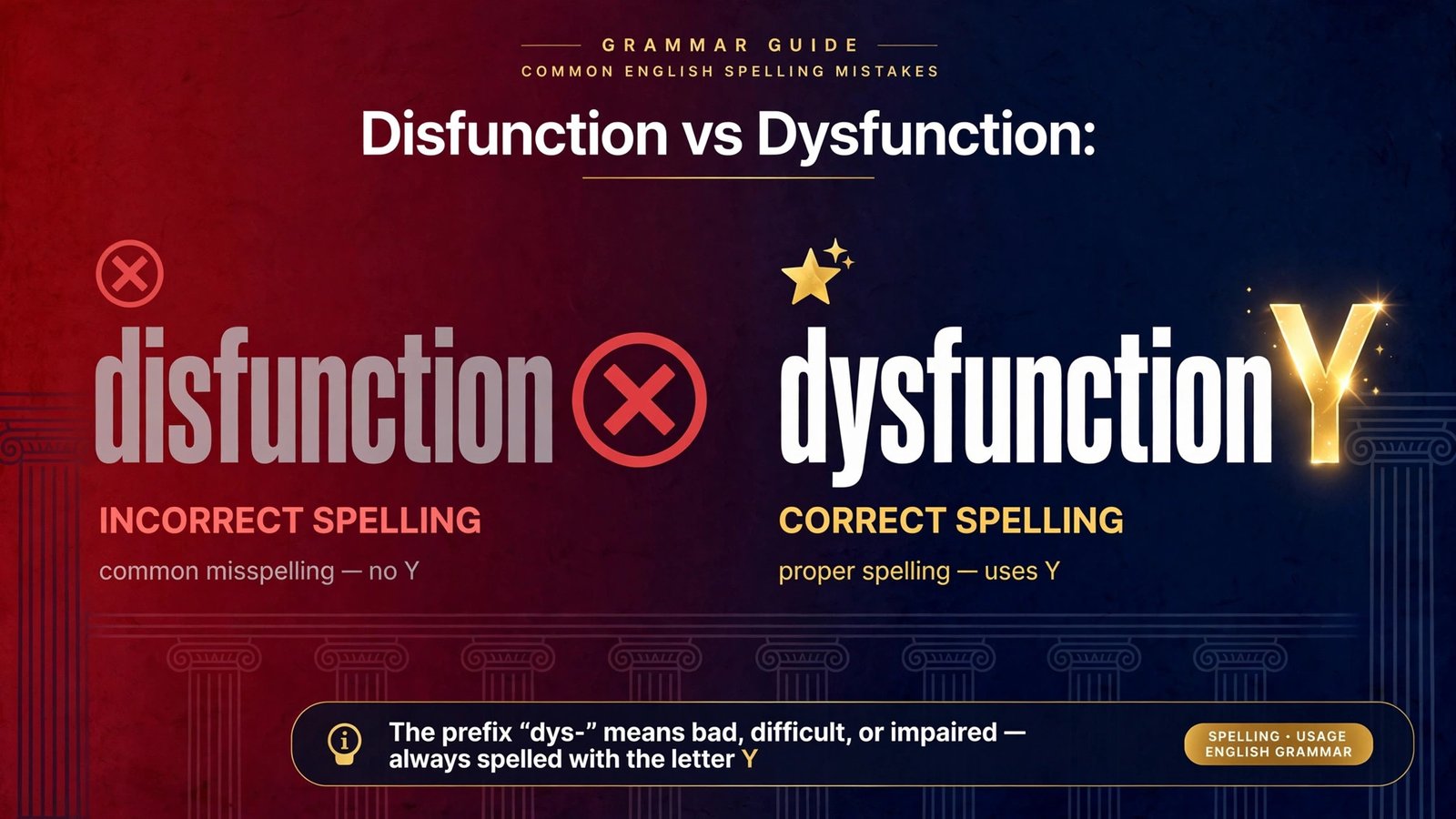
Disfunction vs Dysfunction: Common English Spelling Mistakes

Spell it with an "i" and spellcheck waves it through; spell it with a "y" and it looks almost exotic. The disfunction vs dysfunction standoff is one of English's sneakiest — because "dis-" is a perfectly real prefix (disagree, disappear), your brain happily accepts the wrong version. But only one spelling survives the dictionary test, and the reason traces back to ancient Greek.
It's also a reminder that spellcheck is a safety net with holes: "disfunction" passes most checkers because "dis-" and "function" are both valid pieces. Only knowledge of the Greek root catches it. Writers from students to executives make this error, which tells you it's a logic trap rather than a carelessness problem.
The error is also remarkably democratic — students, professionals, even published authors produce it, which tells you it's a design flaw in English rather than a carelessness problem. Two live prefixes, one plausible-looking wrong answer, and a spellchecker that shrugs: it's a perfect trap. Understanding the trap is what springs it.
There's a final irony worth savoring: the people most likely to misspell 'dysfunction' are often the most careful writers — because careful writers reason about prefixes, and this is a case where reasoning from 'dis-' leads exactly wrong. The lesson isn't to stop reasoning; it's to check the word's family first. Read on, and the disfunction vs dysfunction doubt will never slow you down again.
Quick Answer
Here's the short version: dysfunction — with a "y" — is the correct spelling, meaning impaired or abnormal functioning. Disfunction with an "i" is a common misspelling, not a recognized variant. In the disfunction vs dysfunction choice, the "y" wins.
What Each Term Means
The disfunction vs dysfunction confusion looks like a prefix choice, but it's really a history lesson in one letter. Once you know the history, the spelling stops being a guess. Think of it as etymology doing practical work — the past explaining the present spelling.
Dysfunction
Dysfunction is the standard noun meaning impaired, abnormal, or unhealthy functioning — a dysfunctional committee, family dysfunction, organ dysfunction. It joins the Greek prefix dys- ("bad, difficult, abnormal") to function, the same dys- found in dystopia and dyslexia. Doctors, therapists, and managers all reach for it when systems — bodily or organizational — stop working as they should. The word also forms the fixed phrase 'dysfunctional family,' popularized by psychology and now everyday language for a family with unhealthy dynamics. Fixed phrases like this are worth learning whole — they carry cultural meaning beyond their literal parts, and misspelling them ('disfunctional family') breaks the recognition instantly. The phrase shows up in therapy offices, novels, sitcoms, and everyday conversation — it's one of the most culturally loaded uses of the word.
Disfunction
Disfunction is a misspelling, full stop. The "dis-" prefix is real and common (dislike, disarm), which is exactly why the error feels plausible — but no dictionary recognizes "disfunction," and editors fix it on sight. Its persistence is a testament to how reasonable it looks; "dis-" does such honest work elsewhere that the eye forgives the impostor. What's notable is how the error clusters: it spikes in medical, academic, and business writing — exactly the contexts where precision matters most. The more formal the setting, the more the misspelling costs. Casual texts forgive it; term papers and diagnoses don't.
The Core Rule Behind Disfunction vs Dysfunction, Explained Once
The "y" isn't decorative — it's Greek. English borrowed dys- wholesale from Greek dys- ("bad, ill"), and the prefix kept its spelling across every word it touched: dysfunction, dystopia, dyslexia, dyspepsia. Meanwhile dis- is Latin ("apart, not"), living in disagree, disappear, and disqualify. The two prefixes never mix: a word's origin picks its prefix, and "function" in this medical and technical sense arrived via the Greek route. So disfunction vs dysfunction isn't a coin toss between two live prefixes — it's one Greek word wearing its original spelling. Learn the dys- family and the "i" version stops looking tempting.
Here's the practical payoff: once you own the dys- family, you also nail every word in it — dysfunctional, dystopian, dyslexic — without memorizing them one by one. One prefix, many words, zero future errors. That's the best kind of spelling rule: learn once, apply everywhere.
A useful contrast sharpens the point: 'dis-' words describe separation or reversal — disassemble (take apart), disconnect (unplug), disapprove (not approve). If 'disfunction' were real, it would suggest something like taking function apart — which isn't quite the medical meaning of impaired function. The Greek 'dys-' (bad, abnormal) captures 'working badly' far better. The prefixes aren't just different letters; they carry different ideas, and only one idea fits. Keep that contrast handy: 'dis-' pulls apart, 'dys-' works badly. Two ideas, two spellings, zero overlap. The identical logic settles inaccessible vs unaccessible — same prefix families, same payoff. Prefixes trip writers up constantly — emasculate vs demasculate is another de- puzzle.
Examples in Context
Watching disfunction vs dysfunction land correctly across real contexts burns the right spelling in — ten snapshots. Pay attention to how naturally the correct spelling fits each sentence — that's the feeling to internalize. Treat it as a drill: each correct sighting strengthens the pattern a little more.
- Workplace: "The committee's dysfunction stalled every decision for months."
- Family: "Holiday dinners always exposed the family's cheerful dysfunction."
- Medicine: "Thyroid dysfunction can masquerade as simple fatigue."
- Tech: "A single corrupted file caused system-wide dysfunction."
- Sports: "The team's dysfunction showed in their third straight loss."
- Politics: "Pundits blamed legislative dysfunction for the shutdown."
- Relationships: "They laughed about their early-relationship dysfunction."
- Education: "Chronic underfunding bred institutional dysfunction."
- Business: "The merger exposed deep cultural dysfunction."
- Everyday: "My sleep schedule is in complete dysfunction this week."
Tricky Cases
A few related distinctions are worth getting straight. Each of these reinforces the same disfunction vs dysfunction lesson: check the word's family, not just its letters.
Dysfunction versus malfunction. Both describe things working badly, but 'malfunction' (from French mal-, 'bad') typically means a specific breakdown — 'engine malfunction' — while 'dysfunction' suggests systemic or ongoing impairment. They're near-synonyms with different flavors; in medical and organizational contexts, 'dysfunction' is the standard pick.
'Dysfunctional' as a compliment? Occasionally you'll see 'dysfunctional' used affectionately — 'our dysfunctional book club' — meaning charmingly chaotic rather than truly impaired. The irony depends on everyone knowing the literal meaning, so the correct spelling matters even more here; the joke collapses if the word itself is wrong.
The 'dis-' words that look Greek. 'Dyslexia,' 'dyspepsia,' 'dystrophy' — the dys- family is bigger than people realize. Meanwhile genuinely Greek-derived words with 'dis-' are rare in English. When you face a 'dis-' versus 'dys-' choice, bet Greek ('y') for medical and technical terms. Sound-alike prefixes strike elsewhere too — annunciate vs enunciate fools even careful speakers.
Common Mistakes
The disfunction vs dysfunction slip has a few favorite hiding spots — five to watch. Each one is the same root error in different clothing. Learn to recognize every hiding spot and the error has nowhere left to hide. Here's where it hides most often.
- The straight misspelling. Wrong: "The disfunction of the board was obvious." Right: "The dysfunction of the board was obvious." Greek dys-, not Latin dis-. The 'y' is doing etymological work.
- The adjective form. Wrong: "They come from a disfunctional home." Right: "They come from a dysfunctional home." Fix the root; the "-al" follows. Adjectives never change the root's spelling.
- The technical document. Wrong: "Renal disfunction requires monitoring." Right: "Renal dysfunction requires monitoring." In medical or academic writing the error costs you credibility — proofread terms of art twice. Terms of art are exactly where readers judge you hardest. Precision is the price of admission in technical fields.
- The prefix analogy. Wrong: "It's a clear case of disfunction." Right: "It's a clear case of dysfunction." "Disagree" and "disappear" don't license "disfunction" — prefixes belong to their roots. Analogies across different roots are how this error was born.
- The plural. Wrong: "The report lists several disfunctions." Right: "The report lists several dysfunctions." Same root, same "y," in every form. Plurals, adjectives, adverbs — the 'y' never leaves.
How to Remember It
Think dystopia: a bad place, spelled with a "y." Dysfunction is its cousin — bad functioning, same Greek "y." The next time the disfunction vs dysfunction wobble hits, picture a dystopia and let the "y" carry over. One vivid anchor beats ten minutes of second-guessing. Stick the two words on a mental flashcard — dystopia on one side, dysfunction on the other — and review it once. Anchors like this outlast rote memorization by years. For a second anchor, pair it with 'dyslexia' — difficulty with reading, same Greek 'y,' same 'bad/difficult' idea. Two dys- words, one shared meaning, zero doubt. Say both words aloud once — 'dysfunction' with its bright 'y' sound — and let pronunciation reinforce spelling. Read the section once more tomorrow — spaced repetition locks it in for good.
Disfunction vs Dysfunction: Which Is More Correct?
Only one survives scrutiny, and the disfunction vs dysfunction verdict is unanimous: dysfunction. "Disfunction" isn't informal, regional, or "becoming accepted" — it's a misspelling, period. The "dis-" prefix is doing honest work elsewhere in English, which makes this particular error feel reasonable, but plausibility isn't correctness. Every dictionary, style guide, and medical text agrees: it's "dysfunction" with a "y," everywhere, every time. Think of it this way: a misspelling doesn't become a variant through popularity. Until dictionaries list it, it's simply wrong. Popularity never promotes an error; only dictionaries do that, and they haven't. File this one under 'settled science' and spend your proofreading energy elsewhere. If you need a tiebreaker in the moment, remember: medical and technical terms love Greek roots, and Greek roots keep their 'y.'
Quick Reference Table
In short — the correct spelling and the misspelling, side by side:
| Spelling | Status | Meaning | Example |
|---|---|---|---|
| Dysfunction | Correct | Impaired or abnormal functioning | "The engine showed signs of dysfunction." |
| Dysfunctional | Correct adjective form | Impaired in functioning | "A dysfunctional process wastes everyone's time." |
| Disfunction | Misspelling | — | ✗ "The engine showed signs of disfunction." |
FAQs
The questions this spelling raises most — with straight answers:
Is "disfunction" ever correct? No. Standard English recognizes only "dysfunction." Its absence from every major dictionary is the whole story. If it were ever acceptable, it would appear in at least one.
Why a "y" and not an "i"? The dys- prefix comes from Greek (as in dystopia and dyslexia) and kept its original spelling when English borrowed it. Greek kept the 'y' in English borrowings as a kind of etymological fingerprint. English kept the "y" as a small monument to the word's origin.
Is it "dysfunctional" or "disfunctional"? "Dysfunctional" — the adjective follows the noun's spelling. The same rule covers 'dysfunctioning' — the root never changes.
Do people actually write "disfunction"? Often. The genuine "dis-" prefix makes it feel right, which is why it's such a persistent error. Errors that feel logical are the hardest to kill, because the brain files them as 'probably fine.'
What's the difference in meaning? None to debate: only "dysfunction" has a meaning (impaired functioning); "disfunction" has no standing at all. That's precisely why the misspelling is dangerous: it has no meaning to catch it, so only spelling knowledge stops it.
Conclusion
The disfunction vs dysfunction question is really a question about where words come from. Greek gave us "dys-," Latin gave us "dis-," and knowing which family a word belongs to settles the spelling instantly. That's the deeper win here: etymology isn't trivia — it's a practical tool that prevents whole categories of errors. File "dysfunction" alongside "dystopia" and "dyslexia," and the "y" will never feel strange again. One Greek prefix, learned properly, quietly fixes a whole shelf of words. That's the kind of knowledge that compounds. And the next time a 'dis-' versus 'dys-' choice appears, you'll know to ask about the word's family before its spelling. That's the mark of someone who doesn't just spell well but understands why — and understanding is what makes the knowledge permanent. Teach someone else the disfunction vs dysfunction rule today — explaining it cements it. Keep going: impatient vs inpatient is another one-letter pair that rewards careful readers. Keep the Greek "y" in mind and this spelling will never wobble again. Small roots, big confidence.
[…] another tricky pair, disfunction vs dysfunction breaks down a Greek-versus-Latin spelling […]