Don't miss our holiday offer - up to 50% OFF!
That’s vs Thats: Apostrophe Rules Made Simple

Have you ever typed a quick message, paused over a word, and wondered whether an apostrophe belongs there? The difference between that’s and thats may look like a tiny spelling issue, but it can affect the accuracy of your writing. One form is the standard contraction of two words, while the other is generally a spelling mistake in formal and edited English. Understanding the rule will help you write clearer emails, school assignments, social media posts, and everyday messages without second-guessing your punctuation.
Quick Answer
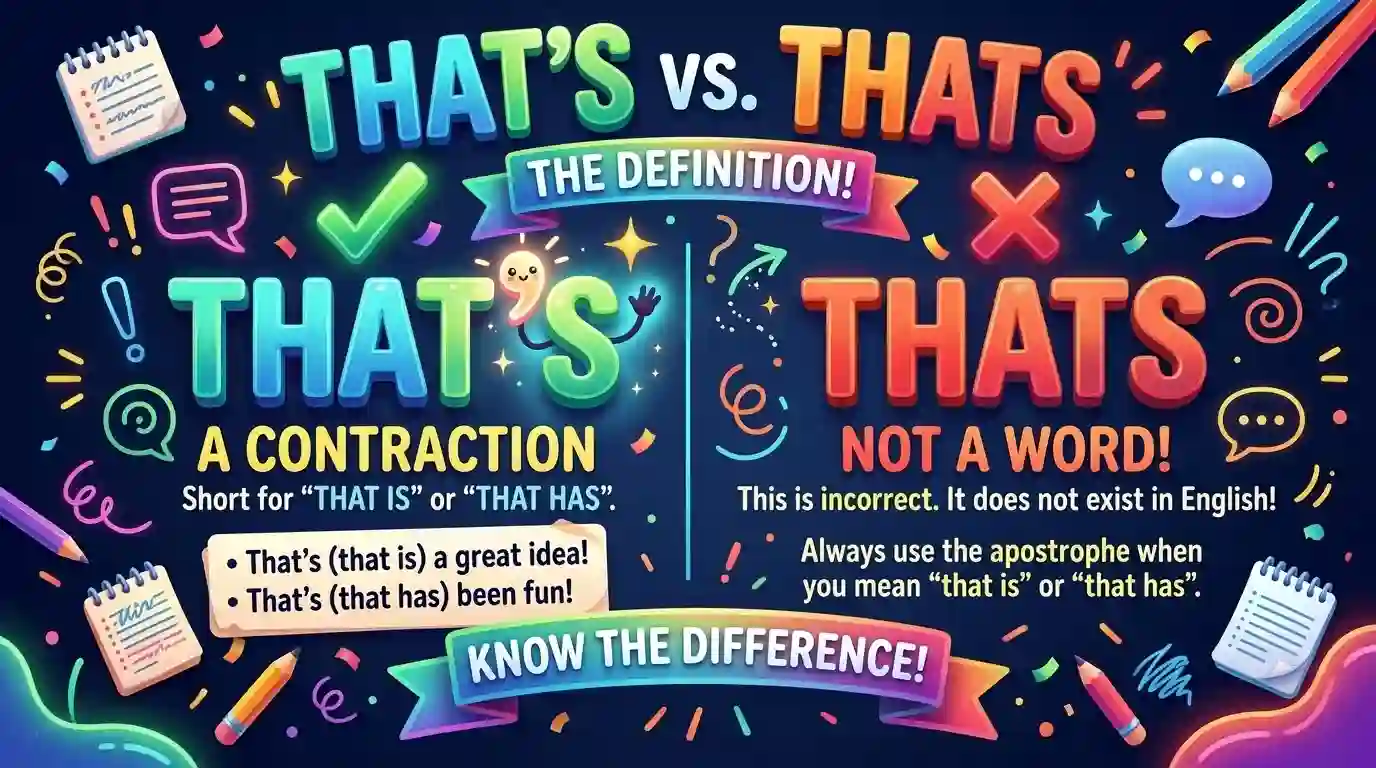
When comparing that’s or thats, that’s is the correct standard spelling because it combines “that” with “is” or “has.” The spelling thats, without an apostrophe, is generally incorrect in standard English because it does not follow the conventional spelling of the contraction.
What Each Term Means
The difference becomes easier to understand when you look at how each spelling works in a sentence. One has a recognized grammatical function, while the other usually appears because someone omitted necessary punctuation.
What Does “That’s” Mean?
“That’s” is a contraction of two words: “that is” or “that has.” Writers use it to make sentences sound natural and conversational without changing their essential meaning.
For example, “That’s a beautiful painting” means “That is a beautiful painting.” Similarly, “That’s been a difficult journey” means “That has been a difficult journey.”
The apostrophe marks the missing letters in the contraction. Instead of writing both words separately, English allows speakers and writers to combine them into one shorter form.
You will commonly encounter this spelling in conversations, text messages, emails, informal articles, and dialogue. It also appears in formal writing when the contraction suits the intended tone.
What Does “Thats” Mean?
“Thats” is generally a misspelling of “that’s” in standard English. It does not serve as the accepted contraction of “that is” or “that has,” and removing the apostrophe does not create a different standard grammatical form.
For instance, writing “Thats an excellent suggestion” leaves out the punctuation needed for the contraction. The corrected sentence is “That’s an excellent suggestion.”
You might see the unpunctuated version in usernames, brand names, hashtags, search queries, or casual online posts where people deliberately omit punctuation. Such uses do not make “thats” the standard spelling in ordinary prose.
The Core Rule, Explained Once
The grammar behind this distinction is straightforward: an apostrophe in a contraction indicates that letters have been omitted. In “that’s,” the apostrophe represents the missing letters in either “that is” or “that has.”
Consider these two expanded forms:
- That is → That’s
- That has → That’s
The surrounding sentence tells you which expansion makes sense. In “That’s my favorite book,” the contraction means “That is my favorite book.” In “That’s already happened twice,” it means “That has already happened twice.”
This rule is different from the use of apostrophes to show possession. For example, “the teacher’s desk” uses an apostrophe to indicate that the desk belongs to the teacher. By contrast, “that’s” does not indicate ownership; it joins two words into a contraction.
You can also write “that is” or “that has” in full whenever you prefer a more formal or deliberate tone. Both expanded forms are grammatically correct when they fit the sentence.
One useful distinction is that “that’s” should not replace every expression containing the word “that.” In a sentence such as “I know that the concert starts at seven,” the word “that” introduces a clause and does not need an apostrophe. The contraction is appropriate only when the intended meaning supports “that is” or “that has.”
Examples in Context
These examples show how that’s or thats works across different real-life settings, including conversations, work, travel, shopping, and technology. Each sentence uses the standard spelling in a natural context.
- Text message: “That’s exactly what I wanted to hear.”
- Work email: “That’s a helpful suggestion for our next meeting.”
- Travel planning: “That’s the hotel we booked for Saturday.”
- Shopping: “That’s a great price for a winter coat.”
- School assignment: “That’s the main argument presented in the article.”
- Weather conversation: “That’s been the coldest morning of the month.”
- Technology support: “That’s fixed the connection problem.”
- Relationship conversation: “That’s one of the reasons I trust you.”
- Restaurant review: “That’s a delicious combination of flavors.”
- Sports discussion: “That’s the third goal our team has scored.”
Notice that the contraction can describe something in the present or refer to an action that has already occurred. The sentence itself determines whether “that’s” stands for “that is” or “that has.”
Common Mistakes
Many spelling errors happen when writers type quickly, rely on autocorrect, or overlook punctuation during editing. When deciding between that’s or thats, check the intended meaning and make sure the apostrophe appears in the correct position.
- Leaving out the apostrophe. Wrong: “Thats a wonderful opportunity.”Right: “That’s a wonderful opportunity.”Reason: The contraction requires an apostrophe to mark the omitted letters.
- Confusing contraction with possession. Wrong: “Thats color looks unusual.”Right: “That color looks unusual.”Reason: This sentence needs the demonstrative word “that,” not the contraction “that’s.” Neither spelling expresses possession in this context.
- Using the contraction when the full word is needed. Wrong: “I believe that’s the answer will work.”Right: “I believe that the answer will work.”Reason: The sentence requires “that” to introduce the clause, not “that is” or “that has.”
- Adding an apostrophe unnecessarily. Wrong: “I prefer that’s option.”Right: “I prefer that option.”Reason: The sentence identifies an option, so the simple word “that” is sufficient.
- Assuming informal online spelling is always acceptable. Wrong: “Thats my final decision.” in a professional report.Right: “That’s my final decision.”Reason: Informal typing habits do not replace standard spelling conventions in polished writing.
Tricky or Edge Cases
Although the basic spelling rule has few exceptions, a couple of situations can make the distinction less obvious. Recognizing them helps you avoid changing the meaning of a sentence while correcting its punctuation.
When “that’s” means “that has”
The contraction can represent “that has” when “has” functions as an auxiliary verb in a perfect-tense construction.
For example, “That’s disappeared from the schedule” can mean “That has disappeared from the schedule.” However, “That’s a difficult decision” uses “that is” instead.
When “thats” appears in names or digital text
A website address, username, product name, or social media handle may intentionally contain “thats” without punctuation. Names and web identifiers can follow their own formatting choices, so do not automatically change a registered name or URL when reproducing it.
Outside those special contexts, standard edited English calls for the apostrophe in the contraction.
How to Remember It
A simple way to remember that’s or thats is to expand the contraction before you finish your sentence. If you can replace the word with “that is” or “that has” and preserve the intended meaning, write “that’s.”
You can also use the apostrophe as a visual reminder that part of the original wording has disappeared. When neither expansion fits, consider whether you need the ordinary word “that” instead.
For example, “That’s impressive” becomes “That is impressive,” while “That idea sounds promising” needs no contraction. A quick mental substitution can catch most errors before you publish or send your writing.
Which Is More Correct or More Common?
“That’s” is the accepted spelling in standard English, and it is widely used in both speech and writing. “Thats” may appear in informal digital communication, but readers generally interpret it as a missing apostrophe rather than as a separate grammatical form.
The choice between “that’s” and “that is” is largely a matter of style and sentence structure. Contractions often make writing sound relaxed and conversational, whereas the expanded form can provide a more formal tone or extra emphasis. For example, “That’s the point” sounds natural in conversation, while “That is the point” may sound more deliberate.
There is no standard British-versus-American spelling difference here. Both varieties of English use “that’s” as the conventional contraction. If you are writing for a school, workplace, publication, or professional website, use the apostrophe unless you are reproducing a name or identifier that intentionally omits it.
Quick Reference Table
Use this table as a quick guide whenever you need to decide which form belongs in your sentence.
| Form | Correct in standard English? | Meaning or use | Example |
|---|---|---|---|
| That’s | Yes | Contraction of “that is” or “that has” | That’s my suitcase. |
| Thats | Generally no | Usually a misspelling of the contraction | Correct it to “That’s.” |
| That | Yes | Demonstrative word or conjunction, depending on context | That jacket fits perfectly. |
| That is | Yes | Full form of the contraction | That is a useful feature. |
| That has | Yes | Full form when the sentence uses the auxiliary “has” | That has changed recently. |
FAQs
These frequently asked questions address common spelling, grammar, punctuation, and editing concerns related to the contraction.
Is “thats” ever correct?
“Thats” is generally incorrect in standard English when you intend to write the contraction. It may appear intentionally in a brand name, username, or web address, where the spelling follows a naming choice rather than ordinary grammar.
Why does “that’s” need an apostrophe?
The apostrophe indicates that letters have been omitted from the original words “that is” or “that has.” Without it, the contraction loses its standard written form.
Is “that’s” short for “that is” or “that has”?
It can mean either expression. The surrounding words determine the intended meaning, as in “That’s exciting” for “That is exciting” and “That’s changed everything” for “That has changed everything.”
Is “that’s” formal or informal?
“That’s” is acceptable in both formal and informal writing, although some highly formal documents favor expanded forms. Follow your publication or organization’s style guide when one applies.
How can I check whether I should write “that” or “that’s”?
Try replacing “that’s” with “that is” or “that has.” If neither expansion works, you probably need the plain word “that” instead.
Conclusion
Choosing between that’s or thats becomes much easier when you understand the purpose of the apostrophe. “That’s” is the standard contraction for “that is” or “that has,” while “thats” is generally a spelling error in ordinary English writing. Remember that the plain word “that” also has an important role, so consider the meaning of your sentence before adding punctuation. With a quick substitution test and a careful proofreading habit, you can write more accurately and communicate your ideas with greater confidence.
Correct the misleading “that’s” exampleClarify “that” versus “that’s” examples
[…] choices affect presentation. Questions about apostrophes, for instance, often arise when comparing that’s and thats. Checking the intended grammatical function is a useful habit in both […]
[…] also helpful to understand how small word changes affect meaning in other expressions. For example, that’s or thats shows why correct spelling and punctuation matter when choosing between similar […]