Don't miss our holiday offer - up to 50% OFF!

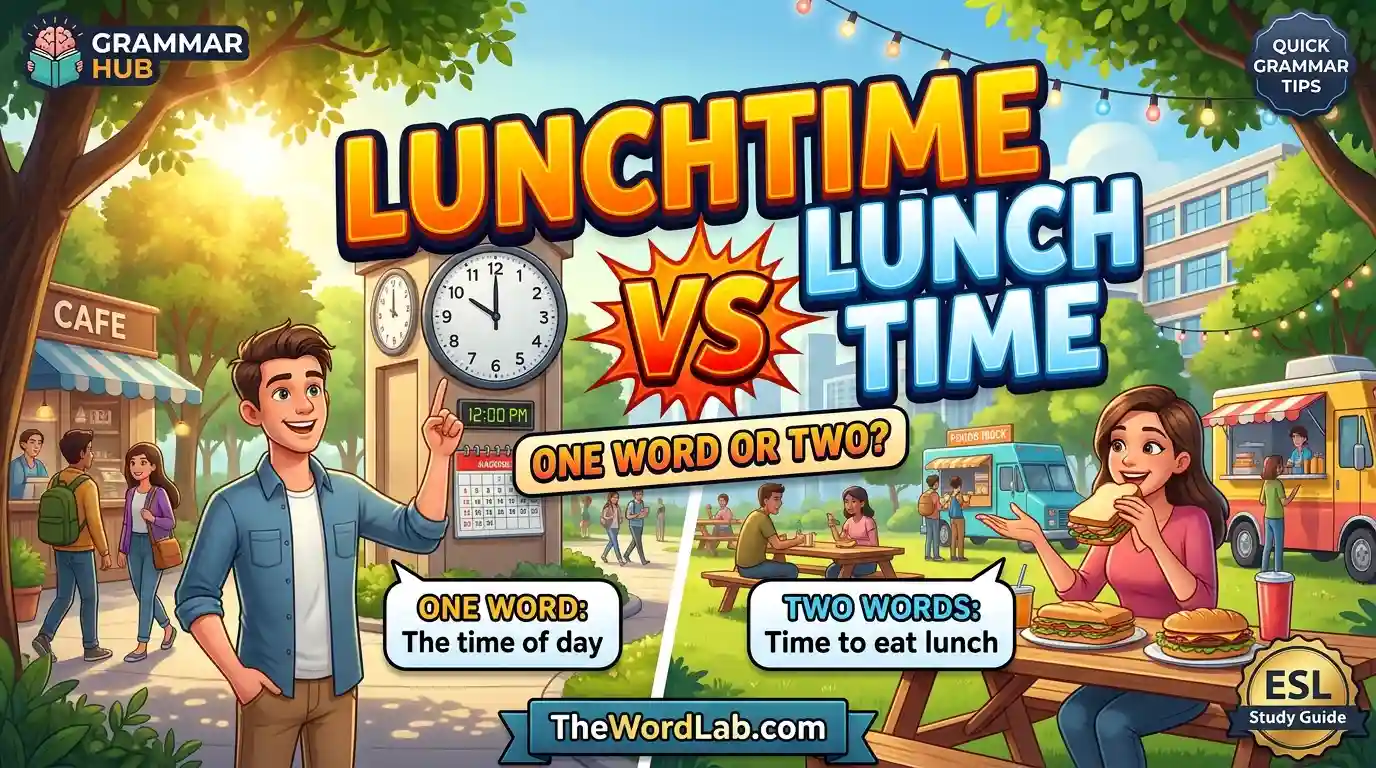
Lunchtime vs Lunch Time: How to Use Each Word Correctly

Have you ever paused while writing an email to decide whether to type “lunchtime” or “lunch time”? Both forms look correct, and you may see them used in everyday writing. However, there is a small difference in how they work. Understanding lunchtime vs lunch time will help you choose the right form and write with greater confidence.
Quick Answer
Lunchtime is the standard one-word form for the middle of the day when people usually eat lunch. Lunch time is also correct when you want to emphasize a particular period or the time set aside for eating. The best choice depends on the sentence and the meaning you want to express.
What Each Term Means
Although these expressions refer to the same general part of the day, their grammatical roles can differ slightly. Looking at each form separately makes the distinction easier to understand.
What Does Lunchtime Mean?
Lunchtime is a compound noun that refers to the usual period when people eat their midday meal. It is commonly used in conversations, articles, workplace messages, and everyday writing.
The word can also describe activities or events that happen around noon. For example, a school may organize a lunchtime activity, or a restaurant may offer a special lunchtime menu.
Here are a few examples:
- We usually take a short walk during lunchtime.
- The library gets busy around lunchtime.
- My favorite café offers fresh sandwiches at lunchtime.
- She enjoys listening to music during lunchtime.
This spelling is widely accepted in modern English and is often the most natural choice when referring to the general lunch period.
What Does Lunch Time Mean?
Lunch time is an open compound consisting of two separate words. It refers to the time allocated for lunch or a specific period when someone can eat.
Writers often use this form when they want to emphasize the time available for a meal rather than the general daily occasion.
Consider these examples:
- Our lunch time has been moved to 1 p.m.
- I only have thirty minutes for lunch time.
- The manager changed the employees’ lunch time.
- Please finish your shopping before lunch time.
Both words have their own meaning, and together they describe a particular period associated with eating lunch.
The Core Rule, Explained Once
The main distinction between lunchtime vs lunch time comes down to how the expression functions in a sentence. The closed compound, lunchtime, is generally preferred when you mean the usual midday meal period. It works naturally as a noun and can also appear before another noun to describe something associated with lunch.
For example, you might write, “The children enjoy lunchtime activities.” Here, the word describes activities that take place during the lunch period.
The open form, lunch time, places more emphasis on the period itself. It can be useful when discussing schedules, allotted breaks, or changes to a person’s daily routine.
For instance, “My lunch time starts at 12:30” clearly identifies a scheduled break.
However, these meanings overlap. English does not have a strict grammatical rule that makes one spelling correct and the other incorrect in every situation. Context, readability, and the intended meaning help determine which form sounds most natural.
This is similar to other English spelling and usage questions. For example, writers sometimes compare goodbye and good-bye because both forms have appeared in written English. The same attention to spelling and context helps when choosing between closed and open compounds.
Examples in Context
The following examples show how lunchtime vs lunch time can appear in different real-life situations, including school, work, travel, shopping, and everyday conversations.
- Workplace: Our team usually discusses weekly goals during lunchtime.
- School: Students can visit the playground after finishing their meals at lunchtime.
- Travel: We reached the airport just before lunchtime, so we stopped for sandwiches.
- Shopping: The supermarket becomes crowded around lunchtime on Saturdays.
- Family: Dad asked everyone to come home before lunch time.
- Technology: My phone automatically switches to silent mode during lunchtime.
- Appointments: The dentist scheduled my consultation just after lunch time.
- Restaurants: This hotel serves a special buffet during lunchtime.
- Daily Routine: I prefer to finish important tasks before lunch time.
- Office Schedule: Employees can request a different lunch time if their duties require it.
Each sentence uses the form that fits its context without changing the basic meaning of the expression.
Common Mistakes
Writers sometimes confuse these spellings because they sound identical when spoken. Understanding lunchtime vs lunch time helps prevent several common writing mistakes.
- Using a hyphen unnecessarily
Wrong: We will meet at lunch-time.
Right: We will meet at lunchtime.
Reason: The standard closed form is generally preferred for the usual midday meal period. The open form may also work when referring to a scheduled break. - Assuming the open form is always incorrect
Wrong: Lunch time is never acceptable in English.
Right: My lunch time changes every Friday.
Reason: The two-word form is a valid English expression, especially when discussing a specific schedule. - Joining the words in every situation
Wrong: My lunch break begins at 12:00 lunchtime.
Right: My lunch break begins at 12:00.
Reason: Adding another reference to the same period can make a sentence unnecessarily repetitive. - Confusing a spelling preference with a grammar rule
Wrong: You must always write lunchtime, regardless of context.
Right: We have a fixed lunch time every afternoon.
Reason: Both spellings are accepted. The sentence determines which expression is more suitable. - Using inconsistent spelling in the same document
Wrong: The report uses lunchtime in one section and lunch time in another without a clear reason.
Right: Choose a preferred form and apply it consistently where the meaning is the same.
Reason: Consistent spelling makes professional writing easier to read.
A similar problem can occur with other expressions that look or sound alike. Exploring soo vs so can help readers recognize why standard spelling matters in clear communication.
Tricky or Edge Cases
Some sentences make the distinction less obvious because both forms can communicate nearly identical ideas. These situations are worth considering before making a final spelling choice.
When describing an activity: Use lunchtime when the word describes something associated with the midday meal. For example, “The company organized a lunchtime presentation.” This sounds natural because the presentation takes place during the lunch period.
When discussing a schedule: The open form can make the allocated period more noticeable. For example, “Your lunchtime is listed on the employee schedule.” The emphasis is on the scheduled break.
When using a time expression: A sentence such as “We will leave at lunchtime” identifies a general period rather than an exact clock time. If you know the precise hour, writing “We will leave at 12:15” is clearer.
When editing formal documents: Follow the spelling preference used by the publication, company, or style guide. Consistency matters more than forcing one acceptable form into every sentence.
English has many expressions where small spelling choices affect presentation. Questions about apostrophes, for instance, often arise when comparing that’s and thats. Checking the intended grammatical function is a useful habit in both cases.
How to Remember It
A simple way to remember lunchtime vs lunch time is to think about whether you mean a general daily occasion or a particular scheduled period.
Use lunchtime when referring to the usual midday meal period. Choose lunch time when the sentence places more emphasis on the time allocated for eating.
You can also remember that lunchtime is the common dictionary-style spelling. When in doubt, this one-word form is usually a safe and natural choice.
Which Is More Correct or More Common?
Both forms are correct English, but they are not equally common in every context. Lunchtime is generally the more familiar spelling when referring to the midday meal period. It is widely used in newspapers, websites, books, workplace communication, and everyday conversations.
The two-word version, lunch time, is also established English usage. It often appears in sentences about working hours, school schedules, employee breaks, and specific meal arrangements.
Neither spelling is automatically a grammatical error. The difference is mainly about usage, emphasis, and writing style rather than a strict grammar rule.
Regional preferences and editorial guidelines can also influence spelling choices. Some publications prefer closed compounds, while others retain open forms in certain expressions. You may notice similar spelling variations when reading about hola or ola, although those words have different meanings and language origins.
For general writing, choosing lunchtime is a practical option because it is concise and widely recognized. However, there is no need to change a clear instance of lunch time simply because the words are separate.
Quick Reference Table
This table highlights the main differences between lunchtime vs lunch time and shows when each one is a suitable choice.
| Feature | Lunchtime | Lunch Time |
| Spelling | One word | Two words |
| Word type | Compound noun | Open compound |
| Main meaning | General midday meal period | Time allocated for lunch |
| Common usage | Everyday writing and conversation | Schedules and specific breaks |
| Correctness | Correct | Correct |
| Example | We met at lunchtime. | My lunchtime starts at noon. |
| General preference | More common | Useful in specific contexts |
Both expressions are acceptable, so consider the sentence’s meaning before choosing one.
FAQs
1. Is lunchtime one word or two?
Lunchtime is commonly written as one word. However, lunch time is also correct when referring to a particular period set aside for eating.
2. Is lunch time grammatically correct?
Yes, lunch time is grammatically acceptable. It is an open compound that can describe a scheduled meal break or a specific period during the day.
3. Should I write lunchtime vs lunch time in formal writing?
Lunchtime is usually the safest choice when referring to the general midday meal period. However, lunch time is suitable when discussing a specific schedule or allocated break.
4. Is lunchtime a noun or an adjective?
Lunchtime is primarily a noun. It can also function as a modifier before another noun, as in “lunchtime meeting” or “lunchtime menu.”
5. Is lunch-time with a hyphen correct?
The hyphenated spelling is not the usual modern choice. In most situations, use lunchtime or lunch time instead.
Conclusion
Understanding the difference between lunchtime vs lunch time makes everyday writing easier and helps you avoid unnecessary spelling mistakes. Both forms are correct, but lunchtime is generally the more common choice for describing the usual midday meal period. Meanwhile, lunch time works well when discussing a specific break or scheduled period. The best approach is to consider your sentence, choose the form that communicates your meaning clearly, and remain consistent throughout your writing. With this simple distinction in mind, you can use both expressions confidently in emails, articles, school assignments, and everyday conversations.
[…] distinction is similar to other confusing English expressions. For instance, lunchtime vs lunch time involves a difference in word formation and usage, while reflexive pronouns follow their own […]
[…] where spacing, word choice, or verb forms affect correctness. For example, understanding the difference between one-word and two-word expressions can make everyday writing more […]
[…] additional practice, explore differences between words and expressions that look similar but serve different purposes. Reading examples in context will help you recognize […]
[…] expression follows the same kind of compound-word pattern found in terms such as lunchtime and lunch time, where spacing can affect standard […]