Don't miss our holiday offer - up to 50% OFF!

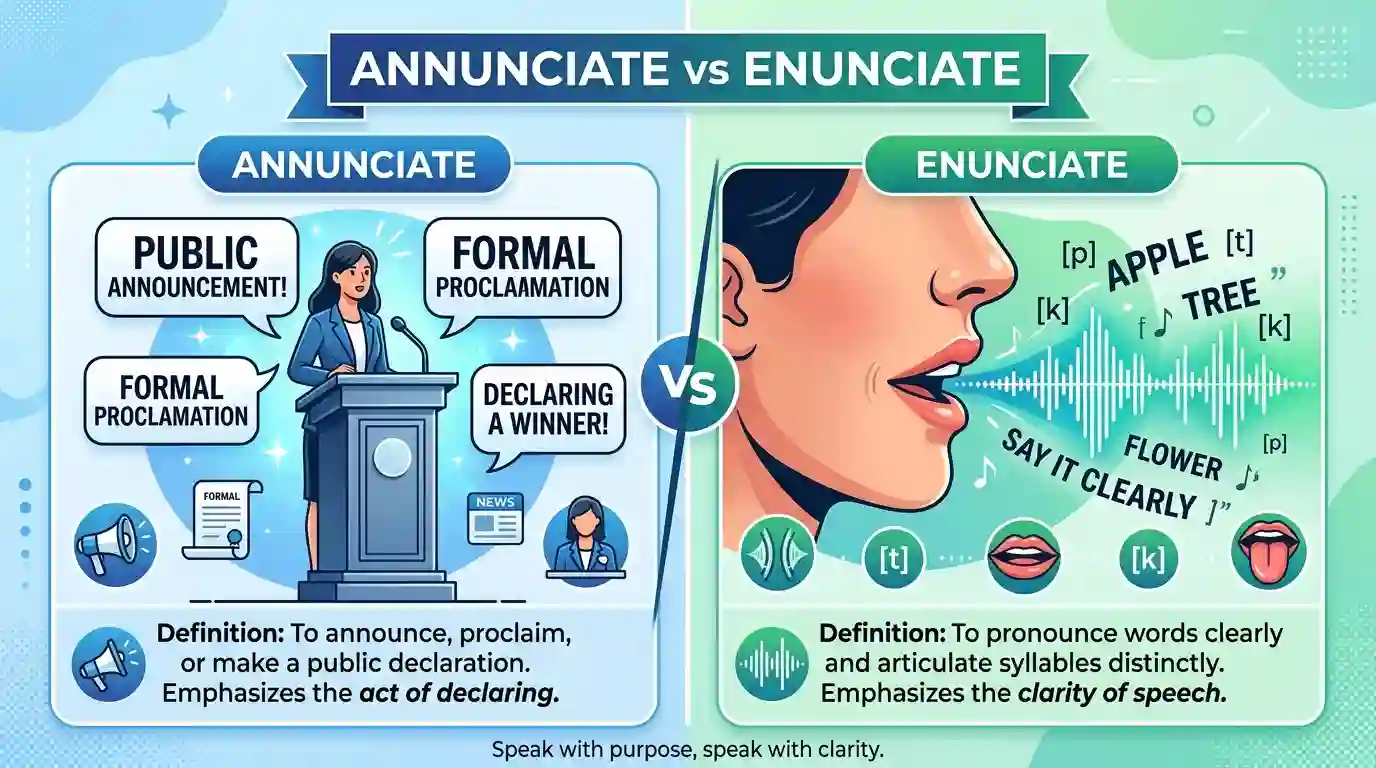
Annunciate vs Enunciate: Easy Rules to Know the Difference

Introduction
A speaker can have a perfectly good message and still lose listeners if the words come out unclear. That is why the distinction in annunciate vs enunciate matters: both words relate to speaking, but they describe different aspects of how a message is delivered.
Quick Answer
Annunciate vs enunciate comes down to meaning and emphasis. Annunciate means to announce or proclaim something, while enunciate means to pronounce words clearly and distinctly. In everyday English, enunciate is the word you usually want when talking about clear speech.
Annunciate vs Enunciate: What Each Term Means
The two verbs overlap because both can appear in contexts involving spoken language, but their core meanings are not interchangeable. The easiest way to separate them is to ask whether you are talking about making something known or making speech easy to understand.
Annunciate
Annunciate means to announce, proclaim, or declare something formally or publicly. It is a relatively uncommon word in modern everyday English, and it can sound formal or specialized.
For example, a ceremonial speaker might annunciate a formal declaration, meaning that the speaker announces or proclaims it. The focus is on the act of making information known rather than on the speaker’s pronunciation.
Enunciate
Enunciate means to pronounce or articulate words clearly and distinctly. Someone who enunciates carefully makes individual sounds and words easier for other people to hear and understand.
A teacher may ask a student to enunciate during a presentation, or an actor may work on enunciation so every line can be understood from the back of a theater. Here, clarity of pronunciation is the central idea.
Annunciate vs Enunciate: The Core Rule, Explained Once
The key distinction in annunciate vs enunciate is the difference between announcing an idea and articulating speech. Annunciate is connected with declaring or proclaiming something, whereas enunciate concerns the clear formation of spoken words and sounds. The words look and sound similar because they share related Latin roots and both can occur in communication contexts, but their modern meanings have developed in different directions.
Think of the action being performed. If the speaker is bringing news, a decision, a statement, or a formal declaration to an audience, annunciate can fit. If the speaker is shaping sounds carefully so listeners can distinguish each word, enunciate is the natural choice.
The distinction also helps explain why a person can do one without necessarily doing the other. Someone might announce a decision while speaking too quickly to enunciate clearly. Conversely, a person can enunciate every word beautifully while simply reading an ordinary sentence rather than making an announcement.
Examples in Context
These annunciate vs enunciate examples move through different real-life settings so you can see how the meanings work without relying on one repeated situation.
- Public speaking: The presenter was asked to enunciate each phrase so the audience could follow the technical explanation.
- Ceremony: The official proceeded to annunciate the new honor before the guests.
- Theater: The director reminded the cast to enunciate the final consonants during the performance.
- Workplace: The spokesperson had to annunciate the company’s formal decision to the assembled staff.
- Classroom: The language teacher encouraged the learner to enunciate unfamiliar vocabulary more slowly.
- Broadcasting: The newsreader practiced how to enunciate names from different countries.
- Formal announcement: The chairperson was expected to annunciate the resolution in front of the committee.
- Voice training: Daily exercises helped the singer enunciate lyrics without rushing through the syllables.
- Ceremonial speech: The host carefully annunciated the winner’s name before handing over the award.
- Recorded instructions: The technician was told to enunciate the safety directions clearly for the audio guide.
Common Mistakes
The most common errors in annunciate vs enunciate happen when a writer chooses the similar-looking verb simply because both words are associated with speaking. These four corrections show where the distinction matters.
- Wrong: “Please annunciate your words more clearly.”
Right: “Please enunciate your words more clearly.”
The sentence asks for clearer pronunciation, so enunciate is the appropriate verb. - Wrong: “The mayor enunciated the new policy to the city.”
Right: “The mayor announced the new policy to the city.”
The intended meaning is making information public; enunciated does not normally carry that sense. - Wrong: “The actor needed to annunciate every syllable.”
Right: “The actor needed to enunciate every syllable.”
Clear articulation is the issue, not proclamation. - Wrong: “The spokesperson enunciated the official declaration.”
Right: “The spokesperson announced the official declaration.”
If the point is that the spokesperson made the declaration public, announce is more natural than enunciate. - Wrong: “The host enunciated the winner before the applause.”
Right: “The host announced the winner before the applause.”
The intended action is revealing the result, while enunciate would shift attention toward pronunciation.
Tricky or Edge Cases
There is one useful complication: annunciate is much less common than announce, and some dictionaries treat it as a formal or uncommon synonym related to announcing. That means a sentence can be grammatically possible yet still sound unusual to many modern readers.
Another point is that enunciate can refer to expressing an idea clearly, not only producing individual sounds. For example, someone can enunciate a principle or position, with the emphasis on stating it clearly and distinctly. Even in that broader use, the idea of clear expression remains central.
How to Remember It
A simple memory trick for annunciate vs enunciate is to connect annunciate with an announcement and enunciate with exact pronunciation. The extra “a” in annunciate can remind you of “announce,” while enunciate points you toward carefully articulated speech.
If you are correcting someone who is mumbling, swallowing sounds, or speaking too quickly, enunciate is almost certainly the word you need. If the situation involves formally declaring something, announce will usually sound more natural than annunciate in contemporary English.
Which Is More Correct or More Common?
Annunciate vs enunciate is not a case where one spelling is simply the correct version and the other is wrong. They are separate verbs with different meanings, although annunciate is considerably less common in ordinary modern English.
For everyday writing, announce is generally the natural choice when you mean “make something known.” Enunciate is standard when you mean “pronounce or articulate clearly.” Because annunciate is relatively uncommon, replacing it with announce will often make a sentence sound more natural without changing the intended meaning.
This difference matters especially in editing. A reader may recognize both forms but still pause when an uncommon word appears where a familiar one would communicate the idea more directly.
Quick Reference Table
Use this quick reference to separate the two verbs at a glance.
| Word | Main meaning | Typical context | Commonness |
| Annunciate | Announce, proclaim, or declare | Formal or ceremonial statements | Uncommon |
| Enunciate | Pronounce or articulate clearly | Speech, acting, teaching, broadcasting | Commoner |
| Announce | Make something known | News, decisions, events, public information | Very common |
FAQs
These frequently asked questions address the points that most often cause confusion when choosing between the two verbs.
Is “annunciate” a real word?
Yes. Annunciate is a real English verb meaning to announce or proclaim, although it is uncommon in everyday modern usage. In many ordinary contexts, announce is the more familiar choice.
Is “enunciate” the same as “pronounce”?
They are closely related, but not identical. Pronounce can refer generally to producing a word’s sounds, while enunciate emphasizes clear, distinct articulation.
Should I say “annunciate” or “enunciate”?
Choose according to the intended meaning. Use enunciate for clear speech and articulation; for making information public, announce is usually more natural, while annunciate is a formal or uncommon alternative.
Can you enunciate an idea?
Yes. Enunciate can also mean to express or state something clearly and distinctly, especially a principle, argument, or position. The emphasis remains on clear expression rather than simply making an announcement.
Why do people confuse “annunciate” and “enunciate”?
They look and sound similar, both relate to communication, and their Latin origins are connected. That surface similarity makes it easy to select one when the context actually calls for the other.
Conclusion
Understanding annunciate vs enunciate becomes much easier once you separate announcing from articulating. Annunciate relates to proclaiming or making something known, while enunciate focuses on clear, distinct speech; in everyday writing, announce is often preferable to the uncommon annunciate. Keeping those meanings separate can make your editing more precise and prevent an awkward word choice from distracting the reader. When in doubt, ask whether the sentence is about revealing information or shaping speech clearly, and the right verb will usually become obvious.
For another tricky pair, disfunction vs dysfunction breaks down a Greek-versus-Latin spelling trap.
[…] main difference between these words is not a change in meaning. It is a difference in standard usage and acceptance. English has […]