Don't miss our holiday offer - up to 50% OFF!

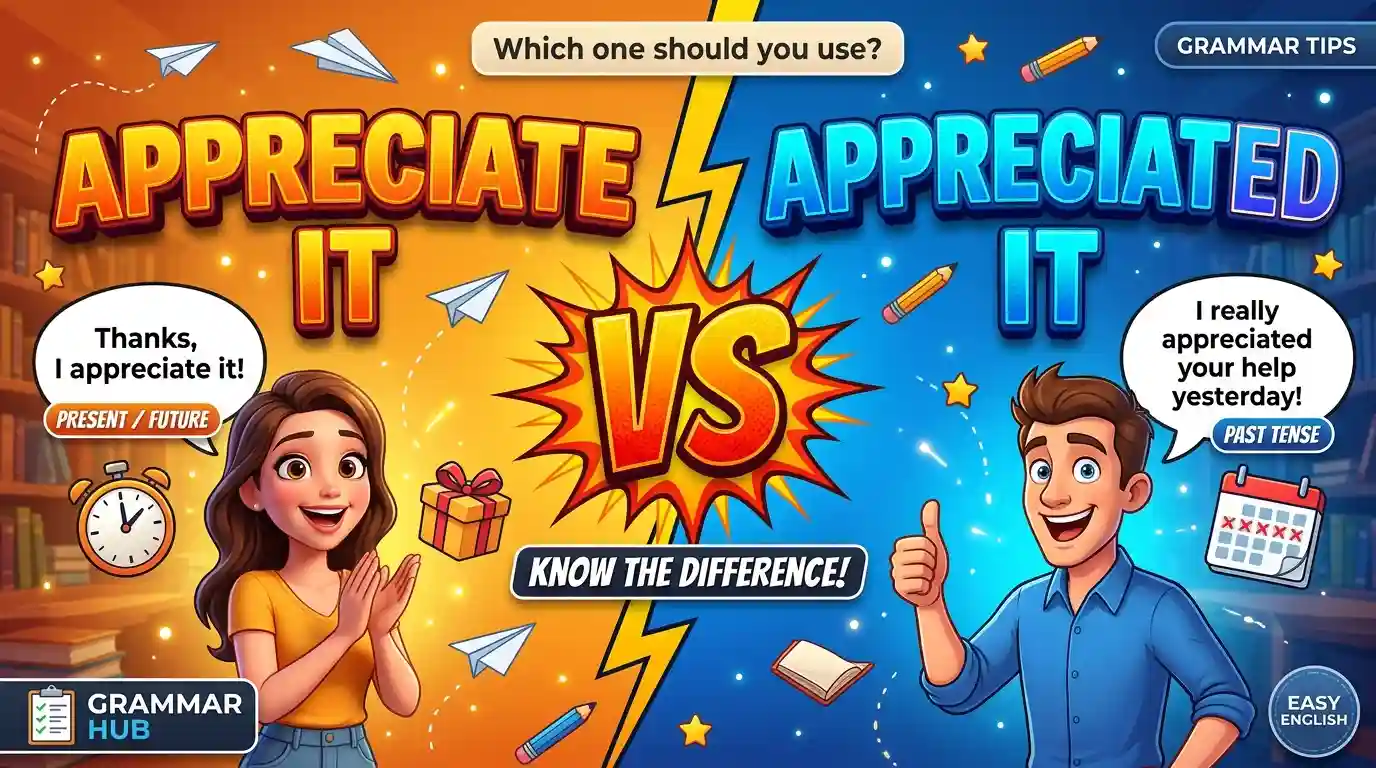
Appreciate It vs Appreciated It: Which One Is Correct?

Have you ever received a thoughtful gift, helpful advice, or a kind message and wondered whether to say “I appreciate it” or “I appreciated it”? Both expressions are correct, but they communicate slightly different meanings. Understanding appreciate it vs appreciated it helps you choose the right tense and express gratitude naturally.
Quick Answer
Both appreciate it vs appreciated it are grammatically correct. Use “I appreciate it” when you feel thankful now or want to express present gratitude. Use “I appreciated it” when you are talking about something you felt grateful for in the past.
For example, “I appreciate your support” expresses current gratitude, while “I appreciated your support yesterday” refers to an experience.
What Each Term Means
The expressions have similar meanings, but their verb tenses change the time and context of the message. Knowing what each form communicates makes it easier to use the right one in everyday conversations.
1. What Does “Appreciate It” Mean?
“Appreciate it” uses the simple present tense. It expresses gratitude for something someone does, gives, or provides. You can use it when someone helps you, offers advice, or shows kindness.
It can also communicate that you recognize the value of someone’s effort. The expression works well in casual conversations, professional emails, and friendly messages.
Examples:
- I appreciate your honest feedback.
- We appreciate your continued support.
- I really appreciate the invitation.
- They appreciate everything you do.
In everyday English, “I appreciate it” is a polite way to say thank you. It can sound warmer and more personal than a simple “thanks.”
2. What Does “Appreciated It” Mean?
“Appreciated it” uses the simple past tense. It describes gratitude you felt at an earlier time or in response to a completed experience.
Use this expression when discussing a previous favor, thoughtful gesture, or helpful action. It is especially useful when reflecting on something that happened yesterday, last week, or at another point in the past.
Examples:
- I appreciated your advice during the meeting.
- She appreciated the surprise party.
- We appreciated your patience last Friday.
- He appreciated the opportunity to participate.
The expression focuses on a past feeling of gratitude rather than what you feel right now.
The Core Rule, Explained Once
The main difference between appreciate it vs appreciated it comes down to verb tense. “Appreciate” is the base form used in the simple present tense with subjects such as I, you, we, and they. “Appreciated” is the past-tense form used when describing gratitude connected to an earlier situation.
English uses verb tenses to show when an action, feeling, or state happens. Gratitude is no exception.
Consider these two sentences:
- I appreciate your encouragement.
- I appreciated your encouragement during the competition.
The first sentence expresses gratitude in the present. The second describes how you felt about encouragement received during a past event.
There is another useful detail: the word “it” acts as an object pronoun in both expressions. It refers to something already mentioned or understood from the conversation.
For instance:
- Your kindness means a lot. I appreciate it.
- Your kindness meant a lot. I appreciated it.
The surrounding sentence often helps readers understand the intended time.
You should also remember that the simple present does not always mean something is happening at this exact second. It can describe a continuing attitude or general feeling. Someone might say, “I appreciate your friendship” because their gratitude remains true over time.
Likewise, the past tense does not mean the speaker is no longer grateful. Someone can say, “I appreciated your help last month” while still feeling thankful today. The sentence simply places that particular experience in the past.
Examples in Context
These examples of appreciate it vs appreciated it cover different real-life situations, including workplace communication, personal relationships, shopping, education, and everyday conversations.
1. Text message: “Thanks for checking on me. I really appreciate it.”
2. Work email: “I would appreciate it if you could review the attached document.”
3. Travel: “We appreciated it when the hotel staff helped us with our luggage.”
4. Education: “I appreciate it when my teacher explains difficult topics clearly.”
5. Shopping: “I appreciated it when the cashier helped me find the right size.”
6. Friendship: “I always appreciate it when you make time for me.”
7. Technology: “I appreciated it when the technician fixed my laptop so quickly.”
8. Family: “We appreciate it when everyone helps prepare dinner.”
9. Weather: “I appreciated it when the rain finally stopped during our picnic.”
10. Customer service: “I appreciate it that your team responded so quickly.”
Notice that context can make the intended tense clear even without a specific time expression.
Common Mistakes
Writers sometimes confuse these expressions because both communicate gratitude. Here are five common errors to avoid when using appreciate it vs appreciated it.
1. Wrong: I appreciated it when you help me every day.
Right: I appreciate it when you help me every day.
Reason: The sentence describes a repeated or ongoing situation.
2. Wrong: I appreciate it when you helped me yesterday.
Right: I appreciated it when you helped me yesterday.
Reason: The sentence refers to a completed past situation.
3. Wrong: I appreciated it tomorrow.
Right: I will appreciate it tomorrow.
Reason: Future gratitude requires a future-tense construction.
4. Wrong: I am appreciate it.
Right: I appreciate it.
Reason: The simple present verb does not need “am” before it.
5. Wrong: I did appreciated it.
Right: I did appreciate it.
Reason: The auxiliary “did” takes the base form of the main verb.
One helpful way to avoid these mistakes is to check the time reference before choosing your verb form.
Tricky or Edge Cases
Some situations make the choice less obvious because the speaker may be discussing past events while expressing present feelings. These cases require attention to the meaning of the complete sentence.
1. Can you use “appreciate it” when discussing a past event?
Yes. You can still express present gratitude for something that happened earlier.
For example:
“I appreciate what you did for me last weekend.”
The action happened in the past, but your gratitude remains current.
2. Can you use “appreciated it” without mentioning a specific time?
Yes. The time can be understood from the conversation.
For example:
“Your recommendation was excellent. I appreciated it.”
The past context makes the meaning clear.
3. Can you use both forms in one conversation?
Absolutely. You might say:
“I appreciated your help during the interview, and I appreciate your continued guidance.”
This sentence naturally connects past gratitude with present appreciation.
For more examples of choosing the right expression, you can also explore common English word differences.
How to Remember It
A simple memory trick can help you choose between appreciate it vs appreciated it without thinking too hard.
Remember:
- Appreciate = Present: You feel thankful now.
- Appreciated = Past: You felt thankful about an earlier experience.
Think of the letter “D” at the end of “appreciated” as a reminder of something done in the past.
For example, if someone sends you a helpful message today, you can reply, “I appreciate it.” If you are describing how someone helped you last year, say, “I appreciated it.”
Which Is More Correct or More Common?
Neither expression is automatically more correct than the other. Both follow standard English grammar, and the best choice depends on the intended meaning.
“I appreciate it” is generally more common in everyday conversations because people frequently use it to thank others for something happening now or for a recent action. It is also a popular expression in professional communication.
For example, a manager might write, “I appreciate your flexibility with the schedule.” This sounds polite, direct, and professional.
“I appreciated it” is more common when telling stories, discussing completed experiences, or reflecting on previous acts of kindness. It works naturally in personal conversations and formal writing.
For example, someone might say, “I appreciated the chance to work with your team last summer.” The speaker is looking back on a completed experience.
Neither expression is more formal simply because of its tense. Both can work in casual and professional settings. Your choice should depend on the timeline rather than how formal you want to sound.
If you are writing a business email, “I appreciate your assistance” is a useful way to express current gratitude. When discussing previous assistance, “I appreciated your assistance during the project” is more suitable.
English has several expressions that look or sound similar but serve different purposes. Learning distinctions such as goodbye vs good-bye can also improve your everyday writing.
Quick Reference Table
This table summarizes the differences between the two expressions so you can quickly choose the correct form.
| Feature | Appreciate It | Appreciated It |
| Verb tense | Simple present | Simple past |
| Main meaning | Current gratitude | Past gratitude |
| Best use | Ongoing or present feelings | Previous experiences |
| Time reference | Now or generally | Earlier |
| Example | I appreciate your kindness. | I appreciated your kindness. |
| Tone | Polite and thankful | Reflective and thankful |
| Grammar | Correct | Correct |
Both expressions are suitable for everyday English. The surrounding context determines which one communicates your meaning accurately.
FAQs
Here are answers to common questions about these expressions, including their grammar, everyday usage, and suitability in professional communication.
1. Is “I appreciate it” grammatically correct?
Yes, “I appreciate it” is grammatically correct. It uses the simple present tense to express gratitude for something you value or feel thankful for.
2. Is “I appreciated it” correct English?
Yes, “I appreciated it” is also correct English. It uses the simple past tense to describe gratitude connected to a previous event or experience.
3. Should I say “I appreciate it vs appreciated it in an email?
Use “I appreciate it” when thanking someone for current or ongoing support. Choose “I appreciated it” when referring to assistance or kindness from a completed past situation.
4. Can I say “I really appreciated it”?
Yes, “I really appreciated it” is a natural and polite expression. It is especially useful when thanking someone for a previous favor, gift, or thoughtful action.
5. Is “Much appreciated” the same as “I appreciate it”?
They have similar meanings, but their structures differ. “Much appreciated” is a shortened expression of gratitude, while “I appreciate it” is a complete sentence with a subject and verb.
Conclusion
Understanding appreciate it vs appreciated it makes everyday English communication easier and more accurate. Both expressions are grammatically correct, but they serve different purposes depending on when you feel or felt grateful. Use “I appreciate it” for present gratitude and “I appreciated it” when reflecting on an experience. Paying attention to verb tense will help you write clearer emails, send more natural messages, and avoid common grammar mistakes. Keep practicing these expressions in real conversations, and choosing the right one will soon become second nature. You can also strengthen your vocabulary by learning related distinctions, such as hola vs ola.
[…] has many expressions where a small verb change affects meaning. A similar point appears in appreciate it vs appreciated it, where the verb form helps show the time and context of an […]