Don't miss our holiday offer - up to 50% OFF!

Passerbyers vs Passersby vs Passerby: Easy Examples to Improve Your Grammar

Have you ever written about someone walking past a shop, park, or busy street and wondered whether to use passerby or passersby? The spelling can be confusing because English does not always form plurals by adding an -s at the end. Understanding passerbyers vs passersby vs passerby will help you choose the correct form, avoid common spelling mistakes, and make your writing sound more natural.
Quick Answer
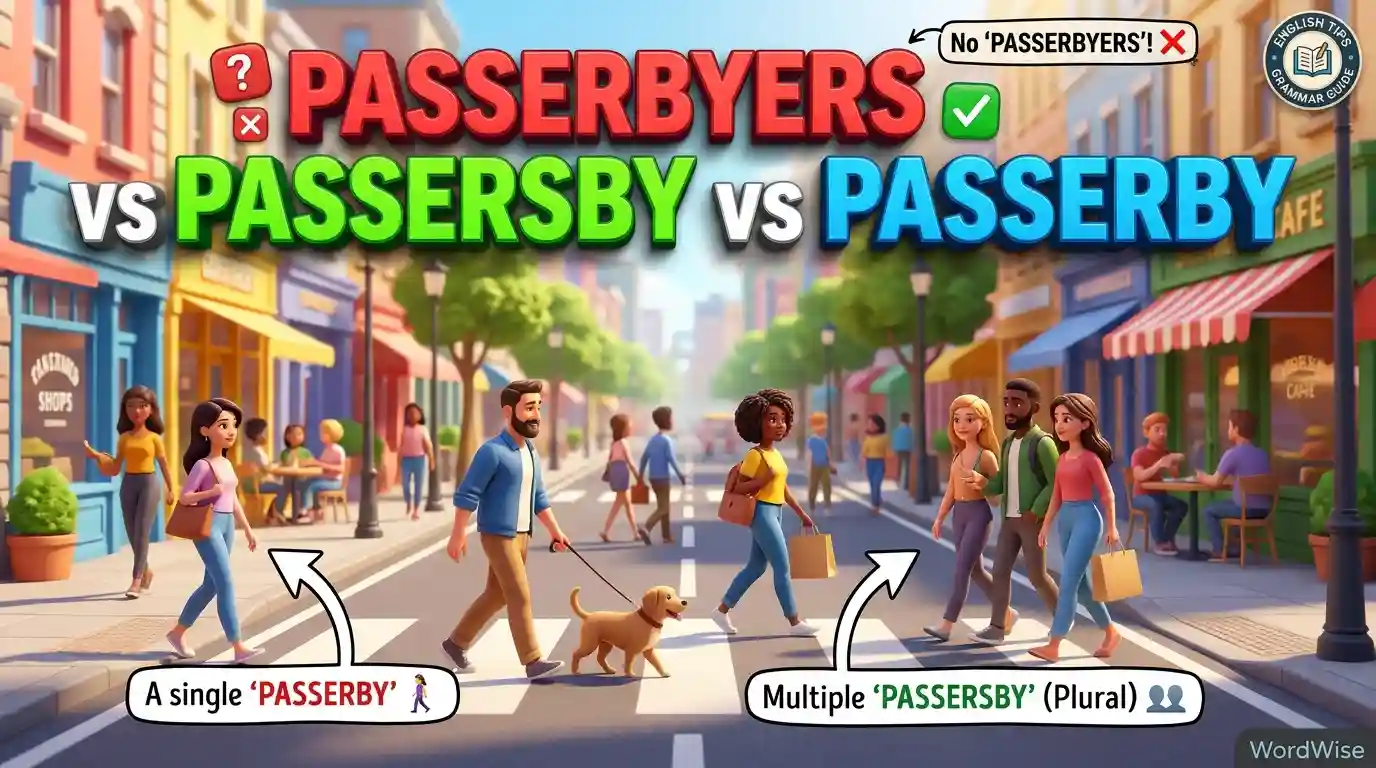
Passerby is the correct singular form, while passersby is the correct plural form. Passerbyers is incorrect and should not be used in standard English. The word passerby follows an unusual plural pattern in which the main noun changes from passer to passers, while by stays the same.
What Each Term Means
Understanding passerbyers vs passersby vs passerby starts with recognizing how each spelling works. Although all three forms may look similar, only two are accepted in standard English.
1. Passerby: The Singular Form
Passerby refers to one person who walks past a particular place without necessarily stopping. The word describes someone who happens to be nearby while an event takes place.
For example, a passerby might notice a lost wallet on the pavement, hear a street musician playing, or see someone asking for directions.
Examples:
- A passerby helped the elderly woman cross the road.
- One passerby stopped to admire the street painting.
- The police officer questioned a passerby about the accident.
- A friendly passerby showed us the way to the station.
The word is common in everyday conversations, news reports, stories, and formal writing.
2. Passersby: The Plural Form
Passersby means two or more people walking past a place. It is the standard plural of passerby.
The interesting part is its spelling. Instead of adding an s to the end of the entire word, English places the plural ending after passer. This pattern also appears in certain other compound words.
Examples:
- Several passersby watched the street performance.
- The sudden noise attracted many passersby.
- Passersby gathered around the open-air exhibition.
- A few passersby offered help to the injured cyclist.
Use this form whenever you are referring to a group of people passing through an area.
3. Passerbyers: The Incorrect Form
Passerbyers is not a recognized standard English plural. It results from adding an unnecessary plural ending to a word that already has an established plural pattern.
Writers sometimes create this spelling because they assume every singular noun becomes plural by adding -s or -es to its ending. However, English has several irregular compound nouns that follow different rules.
Incorrect: Three passerbyers stopped outside the bookstore.
Correct: Three passersby stopped outside the bookstore.
For reliable writing, avoid using passerbyers in emails, articles, school assignments, and professional documents.
The Core Rule, Explained Once
The grammar behind passerbyers vs passersby vs passerby becomes easier when you understand the structure of the compound noun.
Passerby consists of two elements: passer and by. The word passer identifies someone who passes a place, while by describes the act of moving past it.
In standard usage, the plural ending is added to the main noun, passer, rather than to the final element, by. Therefore, the spelling changes from passerby to passersby.
Here is the basic pattern:
- One passerby
- Two passersby
- Several passersby
- Many passersby
Notice that by never changes. The plural marker appears after passer.
This type of construction is known as an open or compound noun with an established plural pattern. English has other compounds that follow a similar structure. For instance, mother-in-law becomes mothers-in-law, not mother-in-laws.
If you enjoy learning how English word forms work, you can also explore these differences between similar grammatical forms.
Examples in Context
The following examples show how passerbyers vs passersby vs passerby works in different real-life situations, including travel, shopping, public events, and everyday conversations.
- Street incident: A passerby noticed smoke coming from the apartment building and called the fire department.
- Shopping area: Several passersby stopped to look at the handmade jewelry displayed outside the store.
- Public transport: A passerby helped the tourist carry a heavy suitcase onto the bus.
- Community event: The colorful parade attracted hundreds of passersby throughout the afternoon.
- School environment: A passerby found a student’s notebook near the playground entrance.
- Weather conditions: A few passersby hurried into nearby buildings when the heavy rain began.
- Photography: The photographer waited until the passersby had cleared the narrow pathway.
- Restaurant setting: A passerby noticed the new bakery’s window display and decided to enter.
- Safety situation: The injured dog received attention from a concerned passerby.
- Local news: Witnesses said several passersby had seen the vehicle before it disappeared.
These examples also show that the word can describe people regardless of their age, occupation, or reason for being in a particular location.
Common Mistakes
When comparing passerbyers vs passersby vs passerby, writers often make spelling and number-related errors. These five mistakes are worth avoiding.
- Adding an extra plural ending
Wrong: Several passerbyers reported the incident.
Right: Several passersby reported the incident.
Reason: Passersby is already the established plural form. - Using the plural for one person
Wrong: A passersby offered to carry the package.
Right: A passerby offered to carry the package.
Reason: The article a requires a singular noun. - Using the singular for multiple people
Wrong: Many passerby gathered near the fountain.
Right: Many passersby gathered near the fountain.
Reason: The quantity word many needs a plural noun. - Adding an apostrophe to form a plural
Wrong: The passerby’s watched the concert.
Right: The passersby watched the concert.
Reason: Apostrophes do not normally create plural nouns. They usually indicate possession or contraction. - Changing the final word instead of the main noun
Wrong: The passerbys waited near the entrance.
Right: The passersby waited near the entrance.
Reason: The plural ending belongs after passer, not at the end of the complete compound.
Correct word forms matter just as much as correct verb forms. Similar questions arise when choosing between appreciate it and appreciated it, especially when the surrounding sentence changes the intended meaning.
Tricky or Edge Cases
Although the basic rule is simple, a few situations can make the word slightly more challenging. These cases involve possession, sentence structure, and the difference between a person passing by and the compound noun itself.
Possessive singular: When something belongs to one person passing by, add an apostrophe and s.
Example: The passerby’s umbrella was left beside the bench.
Possessive plural: When something belongs to several people passing by, add an apostrophe after the plural ending.
Example: The passersby’s comments were included in the report.
As part of a sentence: The expression passing by can also describe an action rather than name a person.
Example: Several people were passing by when the lights suddenly went out.
The last example uses a verb phrase, not the compound noun passerby. This distinction helps prevent unnecessary spelling changes.
How to Remember It
Remember passerbyers vs passersby vs passerby with one simple trick: the word passer receives the plural ending, while by remains unchanged.
Think of the pattern as one passerby and many passersby. You can also remember that passerbyers adds an unnecessary ending, so it does not belong in standard English.
A little practice with these forms will make the spelling easier to recall whenever you write about people walking past a place.
Which Is More Correct or More Common?
There is no regional or formal difference between passerbyers vs passersby vs passerby that changes their grammatical roles. Both are correct, but they serve different purposes.
Passerby is the accepted singular spelling. It appears when a sentence refers to one person who happens to walk past a location. For instance, a news report might mention that a passerby witnessed an unusual incident.
Passersby is equally correct when the sentence describes multiple people. Newspapers, novels, academic writing, and everyday communication all use this plural form.
On the other hand, passerbyers is not an accepted alternative. You may occasionally encounter it in informal online writing or as a spelling error, but that does not make it grammatically correct.
The same principle applies to many English vocabulary questions: a familiar-looking spelling is not always the correct one. Some expressions have established forms that must be learned rather than created by adding a regular ending. For more practice with confusing English word choices, see this guide to accumulative and cumulative.
Quick Reference Table
This table provides a simple comparison of the three spellings, passerbyers vs passersby vs passerby their grammatical roles, and their correct usage.
| Word | Correctness | Meaning | Example |
| Passerby | Correct | One person walking past | A passerby found the keys. |
| Passersby | Correct | Two or more people walking past | Passersby noticed the display. |
| Passerbyers | Incorrect | Not a standard English form | Avoid this spelling. |
Keep this comparison handy when writing articles, messages, stories, or other everyday content. It makes the correct choice easy to identify.
FAQs
1. Is passerbyers a real word?
No. Passerbyers is not accepted as a standard English word. The correct plural spelling is passersby.
2. What is the plural of passerby?
The plural of passerby is passersby. The plural ending is added to passer, while by remains unchanged.
3. Is passersby grammatically correct?
Yes. Passersby is the correct plural form of passerby. Use it when referring to two or more people walking past a particular location.
4. Should I write passerbyers vs passersby vs passerby?
Both passerby and passer-by have appeared in English usage. However, passerby is the widely used modern spelling in standard writing. Choose one form and remain consistent throughout your document.
5. How do you use passerby in a sentence?
You can use passerby when describing one person walking past a location. For example: “A passerby noticed the missing bicycle and informed the security guard.”
Conclusion
Understanding passerbyers vs passersby vs passerby does not require memorizing complicated grammar rules. You only need to remember that passerby refers to one person, while passersby describes two or more people. The spelling passerbyers is incorrect because it adds an unnecessary plural ending.
Using the correct form makes your sentences clearer and helps your writing look polished and professional. Whenever you are unsure, focus on whether you are describing one person or a group. With this simple habit, you can avoid the mistake and use the word confidently in everyday writing. For more help with confusing English expressions, explore other grammar and word-choice differences.