Don't miss our holiday offer - up to 50% OFF!
Its Self or Itself: Correct Spelling and Usage Guide

Have you ever stopped while writing an email or school assignment because you were unsure whether to write its self or itself? The difference looks small, but choosing the wrong form can make a sentence seem awkward or incorrect. English has many confusing word combinations, especially when a possessive word and a pronoun look similar.
Quick Answer
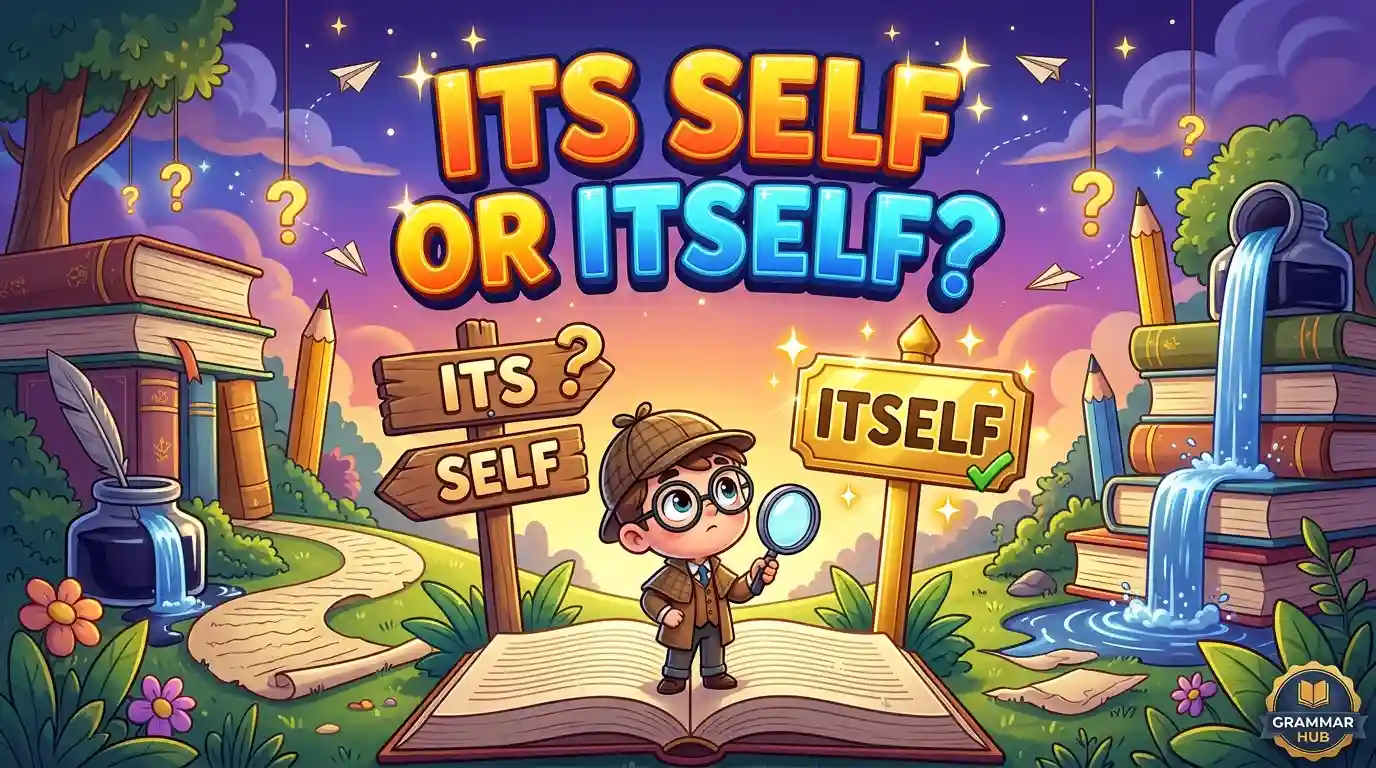
Itself is the correct and standard spelling when you need a reflexive or emphatic pronoun. The two-word form its self is rarely appropriate because it treats self as a separate noun rather than part of a pronoun. In almost all everyday writing, choose itself.
What Each Term Means
Although the two forms look almost identical, they serve different grammatical purposes. Understanding the role of its and self makes the distinction much easier.
1. Itself
Itself is a reflexive pronoun used when the subject and object of a sentence refer to the same thing, animal, organization, or idea. It can also add emphasis to a noun or pronoun.
For example:
- The puppy cleaned itself after playing outside.
- The application updated itself overnight.
- The museum itself is worth visiting.
- The door closed by itself.
In each sentence, the word connects back to the subject or gives that subject extra emphasis.
2. Its Self
The expression its self consists of two separate words:
- Its: A possessive determiner that shows ownership or association.
- Self: A noun that refers to an individual’s identity, nature, or essential being.
Together, they can form a noun phrase in a specific context. However, this construction is extremely uncommon in ordinary English.
For example:
“The novel explores the machine and its self as separate philosophical ideas.”
Here, self is being treated as a separate noun. The sentence has a specialized meaning rather than the usual reflexive meaning of itself.
In everyday writing, readers generally expect the single-word pronoun. If you want to discuss identity or inner nature, expressions such as its own identity or its true nature are usually clearer.
The Core Rule, Explained Once
The central rule behind its self or itself is based on grammatical function, not personal writing style.
Itself is a reflexive pronoun. Reflexive pronouns are used when the subject performs an action on itself or when the word emphasizes the subject. English has several similar pronouns, including myself, yourself, himself, herself, ourselves, and themselves.
For example, consider this sentence:
“The computer restarted itself after the update.”
The computer is both the subject and the receiver of the action. Therefore, itself is the appropriate pronoun.
On the other hand, its is a possessive determiner. It comes before a noun to show that something belongs to or is associated with an object, animal, or organization.
Consider these examples:
- The bird protected its nest.
- The restaurant changed its menu.
- The school improved its facilities.
Notice that its does not need an apostrophe. It already shows possession.
The word self can also function as a noun. However, when you need a reflexive pronoun, English combines the possessive form with self into one word.
This distinction is similar to other confusing English expressions. For instance, lunchtime vs lunch time involves a difference in word formation and usage, while reflexive pronouns follow their own grammatical pattern.
One more detail deserves attention: its and it’s are not interchangeable. Its shows possession, while it’s is a contraction of it is or it has. Neither form changes the spelling of the reflexive pronoun itself.
Examples in Context
The following examples show how its self or itself can be understood across different real-life situations, including technology, education, nature, business, and everyday communication.
- Technology: The smartphone turned itself off when the battery became empty.
- Education: The science experiment explains itself through a simple demonstration.
- Nature: The flower protects itself with sharp thorns.
- Business: The company introduced itself to potential investors during the meeting.
- Travel: The hotel itself offers beautiful views of the mountains.
- Shopping: The packaging itself attracted more attention than the product.
- Weather: The storm eventually disappeared by itself.
- Cooking: The sauce thickens itself as the ingredients heat up.
- Entertainment: The documentary speaks for itself through powerful images.
- Relationships: Sometimes, a thoughtful gesture explains itself without any extra words.
These examples demonstrate the most common uses of the reflexive and emphatic pronoun. You can apply the same pattern in professional documents, casual conversations, academic writing, and creative work.
Common Mistakes
Writers sometimes confuse possessive determiners, contractions, and reflexive pronouns. When deciding between its self or itself, watch out for these five mistakes.
- Wrong: The cat washed its self after dinner.
Right: The cat washed itself after dinner.
Reason: The cat acts on its own body, so a reflexive pronoun is needed. - Wrong: The machine repaired it’s self automatically.
Right: The machine repaired itself automatically.
Reason: It’s means it is or it has. It cannot replace a reflexive pronoun. - Wrong: The organization introduced its self at the conference.
Right: The organization introduced itself at the conference.
Reason: The organization is acting on its own behalf. - Wrong: The building protected itself’s original design.
Right: The building retained its original design.
Reason: Use its before a noun to express possession. A reflexive pronoun does not belong in this construction. - Wrong: The software created a backup of it’s data by itself’s.
Right: The software created a backup of its data by itself.
Reason: The sentence needs the possessive determiner before data and the reflexive pronoun after by.
A useful editing habit is to identify the job each word performs before checking its spelling. This small step can prevent several common errors.
Tricky or Edge Cases
There are a few situations where the distinction deserves extra attention, especially in formal writing and discussions about identity.
One unusual case involves self as an independent noun. In philosophical, literary, or psychological discussions, writers may use self to describe identity, individuality, or inner nature.
For instance:
“The researcher examined the animal’s self as a concept of individual identity.”
Here, self is a noun, not a reflexive pronoun. The possessive form before it is grammatically possible because the writer is discussing a concept.
However, such sentences are specialized and can sound unnatural without enough context. A clearer alternative might be:
“The researcher examined the animal’s individual identity.”
Another tricky situation involves emphatic usage. Consider:
“The garden itself needs very little maintenance.”
The word itself adds emphasis to the garden. It does not describe an action performed on the garden.
You may also see expressions such as by itself, in itself, and of itself. These are established phrases and always use the single-word form in standard English.
How to Remember It
A simple way to remember the spelling is to connect itself with other reflexive pronouns, such as myself and yourself. They are written as single words.
When you are unsure, replace the word with it alone or the thing itself and check whether the sentence still makes sense.
Also, remember that it usually comes before a noun, such as its color or its purpose. If you need a word that refers back to the subject, choose itself.
This quick check will help you avoid confusion without memorizing complicated grammar terminology.
Which Is More Correct or More Common?
In standard modern English, itself is overwhelmingly more common and is the correct choice in nearly every ordinary sentence requiring a reflexive or emphatic pronoun.
You will find it in newspapers, books, business reports, academic papers, websites, and everyday messages. It is accepted in both formal and informal English, so there is no need to change its spelling based on the audience or writing style.
The two-word expression its self is not a normal alternative spelling. It can appear when self is deliberately used as an independent noun, but that is a different grammatical construction.
This is not a regional difference between American and British English. Both varieties use itself as the standard reflexive pronoun.
For comparison, some English expressions have genuine differences in spelling or usage depending on context. Articles such as next Friday vs this Friday explain how wording can affect meaning. However, the distinction here is much simpler: use itself for the ordinary pronoun.
If you are writing an email, an essay, a website article, or a professional report, itself is the safest and most natural choice.
Quick Reference Table
This table provides a simple overview of the different forms its self or itself and their grammatical functions.
| Word or Phrase | Meaning | Correct Usage |
| Itself | Reflexive pronoun | The dog entertained itself. |
| Itself | Emphatic pronoun | The house itself is beautiful. |
| Its | Possessive determiner | The bird spread its wings. |
| It’s | Contraction of it is or it has | It’s getting late. |
| Its self | Rare noun phrase | The discussion explored the creature’s self. |
Keep this table handy when proofreading your work. It highlights the difference between possession, contraction, and reflexive usage.
FAQs
1. Is it its self or itself?
Itself is the correct form when you need a reflexive or emphatic pronoun. The two-word form is rarely used and only works when self functions as a separate noun.
2. Why is itself written as one word?
English forms reflexive pronouns by combining a possessive form with self or selves. This creates established single-word pronouns, including myself, yourself, and itself.
3. Is itself a possessive word?
No. Itself is a reflexive or emphatic pronoun. The possessive determiner is its, as in “The company changed its policy.”
4. What is the difference between its and itself?
Its shows ownership or association and comes before a noun. Itself refers back to the subject or adds emphasis to it.
5. Can I use itself in formal writing?
Yes. Itself is completely acceptable in formal, academic, and professional writing. It is also the standard spelling in everyday communication.
Conclusion
Choosing between its self or itself becomes much easier when you understand the difference between a possessive determiner and a reflexive pronoun. In normal English sentences, itself is the correct spelling for referring back to an object, animal, organization, or idea. The two-word form has a very limited role when self is used as an independent noun, but it should not replace the standard pronoun.
Clear spelling helps your writing look polished and professional. It also makes your message easier for readers to understand. As you continue improving your grammar, explore other commonly confused expressions, such as agreed vs agree, to build stronger writing habits and communicate with greater confidence.