Don't miss our holiday offer - up to 50% OFF!

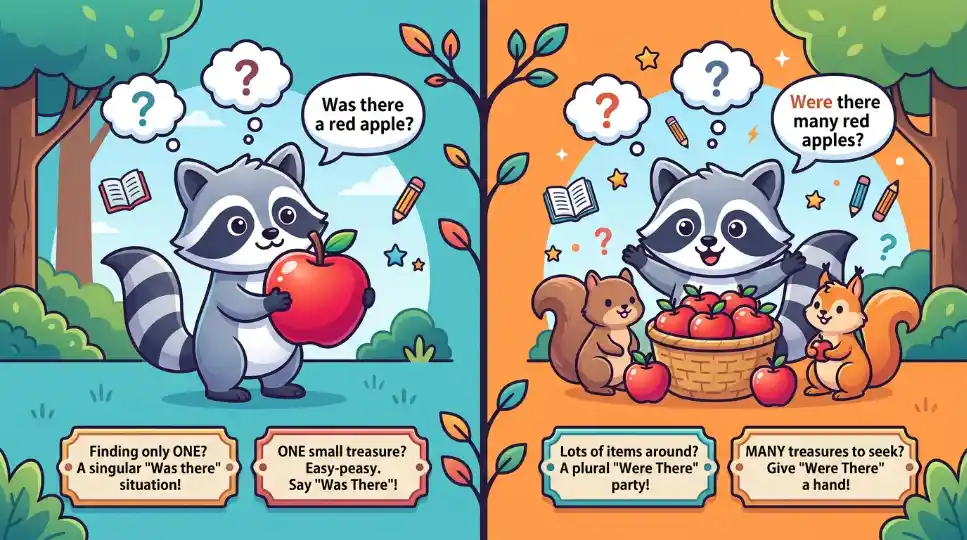
Was There or Were There? Easy Grammar Rules and Examples

Imagine checking an empty room before a meeting and asking, “Was there anyone inside?” Now imagine looking at several chairs and asking, “Were there enough seats?” The difference between was there or were there comes down to the number of the noun or subject you are talking about, but the pattern becomes especially useful when you ask questions about people, objects, events, and situations.
Quick Answer
Use was there when the noun that follows is singular or uncountable: “Was there a problem?” or “Was there enough time?” Use were there when the noun is plural: “Were there any problems?” or “Were there enough chairs?” The choice depends on the subject, not simply on the word that appears closest to the verb.
What Each Term Means
Both expressions are question forms built with the past tense of be and the introductory word there. They ask whether a person, thing, event, or condition existed, appeared, or was present at a particular time.
Was there
Was there is used when the thing being discussed is singular or when the noun is uncountable. It can refer to something physical, an event, a condition, or an amount that is treated as a single quantity.
For example, “Was there a message on your phone?” asks about one message, while “Was there enough information in the report?” treats information as an uncountable noun.
Were there
Were there is used when the noun being discussed is plural. It works naturally with people, objects, events, and other countable nouns that refer to more than one item.
For instance, “Were there three applicants?” asks about multiple people, while “Were there any delays?” refers to more than one possible delay.
The Core Rule, Explained Once
The basic pattern is straightforward:
- Was there + singular noun/uncountable noun?
- Were there + plural noun?
In these questions, there introduces the existence or presence of something, while was or were agrees with the noun that follows. This is why “Was there a problem?” is correct, but “Were there a problem?” is not.
The same pattern appears in statements as well. “There was a strange noise” becomes “Was there a strange noise?” Likewise, “There were several announcements” becomes “Were there several announcements?” The question structure simply moves the form of be before there.
Uncountable nouns also take was because they are grammatically singular. Words such as advice, equipment, furniture, traffic, money, and information do not normally take a plural -s in standard English. You would therefore say, “Was there enough equipment?” rather than “Were there enough equipment?”
The distinction remains the same when another word comes between there and the noun. Consider “Was there any reason to complain?” and “Were there any reasons to complain?” The word any does not determine the verb; the noun reason does.
Questions beginning with words such as why, where, when, or how follow the same agreement pattern. “Why was there so much noise?” and “Why were there so many visitors?” are both formed correctly because the following nouns require different forms of be.
Negative questions work in the same way. You might ask, “Wasn’t there a better option?” when referring to one option, but “Weren’t there other options?” when referring to several. The contraction changes the sound and appearance, but not the underlying agreement.
Examples in Context
The following examples show how the two forms appear naturally across everyday situations, from travel and work to shopping, school, and technology.
- Work: Was there a meeting scheduled for Friday?
- Travel: Were there any empty seats on the train?
- Shopping: Was there a discount on this jacket?
- School: Were there several students absent yesterday?
- Weather: Was there heavy rain overnight?
- Technology: Was there an update available for the app?
- Home: Were there fresh towels in the bathroom?
- Relationships: Was there a misunderstanding between them?
- Events: Were there many guests at the reception?
- Food: Was there enough soup for everyone?
These examples also show why context matters. A sentence can change from was to were simply because the noun changes from singular to plural: “Was there a reason?” becomes “Were there reasons?”
Common Mistakes
These errors are easy to make because there can distract you from the noun that controls the verb. Here are some of the most common patterns to watch for.
- Wrong: Were there a problem with the order?
Right: Was there a problem with the order?
Problem is singular, so the question needs was. - Wrong: Was there several options available?
Right: Were there several options available?
Options is plural, which calls for were. - Wrong: Were there enough information to continue?
Right: Was there enough information to continue?
Information is uncountable and normally takes singular agreement. - Wrong: Was there two packages at the door?
Right: Were there two packages at the door?
The noun packages is plural, even though the number appears later in the phrase. - Wrong: Was there many reasons for the delay?
Right: Were there many reasons for the delay?
The plural noun reasons determines the verb.
Tricky or Edge Cases
Some situations become less obvious because the noun after there is uncountable, part of a longer phrase, or separated from the verb by other words. These cases are worth understanding because they often cause mistakes in otherwise polished writing.
With measurements and amounts, the grammar depends on what the noun phrase represents. “Was there five minutes left?” is commonly heard in informal speech, but in careful standard English, were is generally expected when five minutes is treated as plural: “Were there five minutes left?” However, when an amount is treated as one single unit, singular agreement can sometimes appear, especially with expressions of distance, time, or money in other constructions.
Another useful distinction appears with collective or quantity expressions. “Was there enough furniture for the apartment?” is correct because furniture is uncountable. If you replace it with a countable plural, the verb changes: “Were there enough chairs for the apartment?”
The same principle applies to nouns that look as though they might be plural but are grammatically singular. “Was there any news about the project?” is standard because news is singular in English, despite ending in -s.
How to Remember It
Think about the noun after there, not the word there itself. One thing or an uncountable substance points to was; multiple countable things point to were.
A quick mental test can help: turn the question into a statement. If you would say “There was…” use was there. If you would say “There were…” use were there.
Which Is More Correct or More Common?
Neither form is automatically more correct than the other. Was there and were there are both standard English constructions, but they serve different grammatical purposes.
In everyday conversation, both forms are extremely common because questions about whether something existed or was present come up constantly. Native speakers may also shorten them in conversation, especially with contractions such as “Wasn’t there…?” and “Weren’t there…?”
The main issue is agreement rather than formality. Choosing was there for a plural noun or were there for a singular noun is a grammatical error in standard English. The distinction is not simply a matter of British versus American English or casual versus formal writing.
There can be variation in informal speech with certain expressions involving quantities, measurements, and collective ideas. When writing for school, professional communication, or published content, however, following standard subject-verb agreement is the safest approach.

Quick Reference Table
This table gives you a fast way to check which form fits the noun in your sentence.
| Structure | Use | Example |
| Was there + singular noun | One countable thing | Was there a mistake? |
| Was there + uncountable noun | An uncountable thing or substance | Was there enough water? |
| Were there + plural noun | More than one countable thing | Were there any mistakes? |
| Wasn’t there + singular noun | Negative singular question | Wasn’t there a better solution? |
| Weren’t there + plural noun | Negative plural question | Weren’t there other solutions? |
| Why was there + singular/uncountable noun | Asking for a reason | Why was there so much traffic? |
| Why were there + plural noun | Asking about multiple things | Why were there so many complaints? |
FAQs
These questions cover some of the most common ways people search for help with this grammar distinction.
Is it “was there” or “were there”?
Use was there with a singular or uncountable noun and were there with a plural noun. For example, “Was there a mistake?” and “Were there any mistakes?” are both correct.
Is “were there” grammatically correct?
Yes. Were there is the correct form when the noun that follows is plural, such as “Were there enough tickets?” or “Were there any changes?”
Is “was there” grammatically correct?
Yes. Was there is correct with singular and uncountable nouns, as in “Was there a problem?” or “Was there enough space?”
Do I say “was there any” or “were there any”?
Look at the noun after any. Use was with a singular or uncountable noun, such as “Was there any evidence?” Use were with a plural noun, such as “Were there any witnesses?”
What is the easiest way to know whether to use was or were?
Change the question into a statement in your head. “There was a problem” becomes “Was there a problem?” while “There were several problems” becomes “Were there several problems?” This quick transformation makes the correct form much easier to identify.
Conclusion
Understanding was there or were there becomes much easier once you focus on the noun that follows the expression. Singular and uncountable nouns take was, while plural nouns take were, and this pattern works across questions about people, objects, events, conditions, and amounts.
The distinction may seem small, but choosing the right form makes your writing sound polished and confident. It also helps prevent a common subject-verb agreement mistake, especially in longer questions where other words can distract you from the noun that controls the verb.
When you are unsure, turn the question into a statement and listen for there was or there were. With a little practice, that simple check becomes almost automatic, making both everyday writing and formal English much easier to handle.