Don't miss our holiday offer - up to 50% OFF!

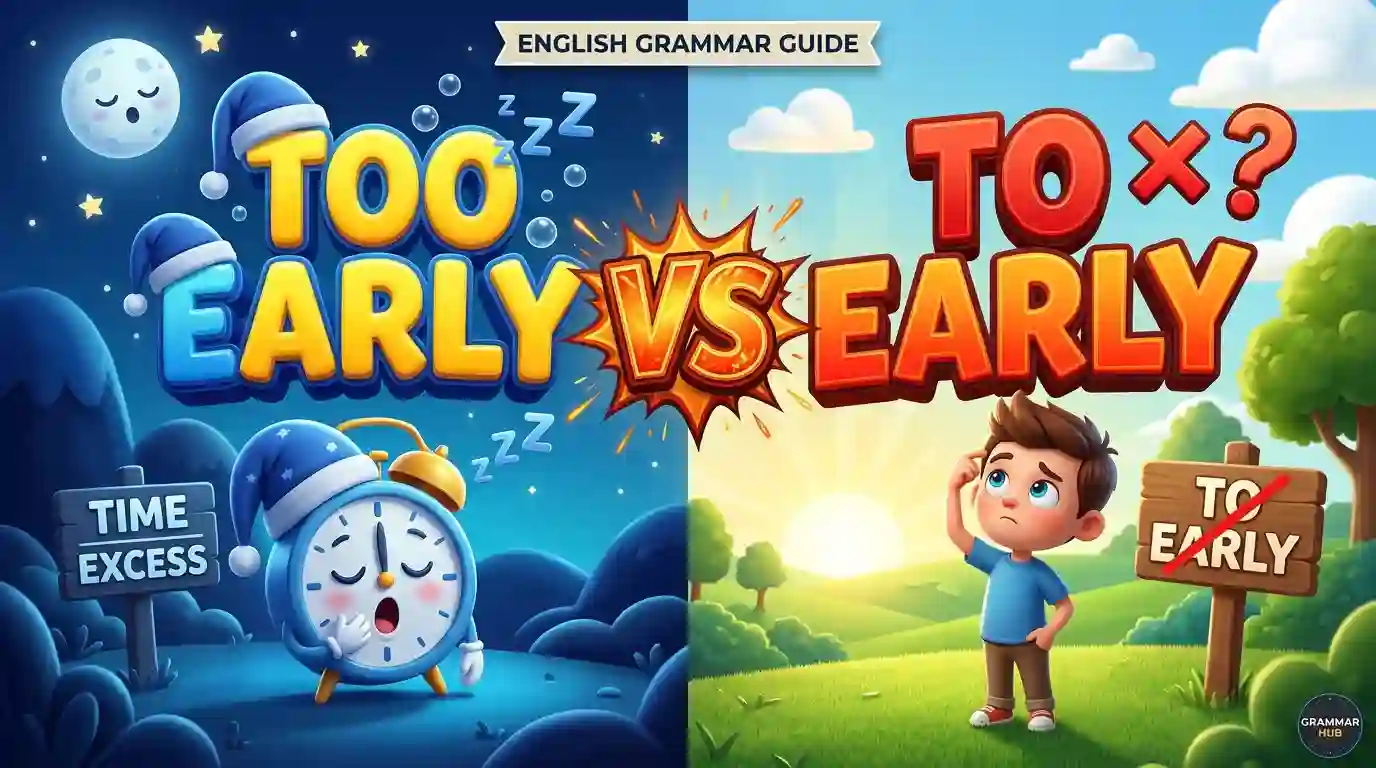
Too Early vs To Early: Easy Ways to Get It Right

Have you ever typed a message and paused because you were unsure whether to write “too early” or “to early”? Both expressions look similar, but only one is correct in standard English. Understanding Too Early vs To Early will help you avoid common spelling mistakes and make your writing clearer. The good news is that the rule is simple once you understand how the word “too” works.
Quick Answer
Too early is the correct expression when you mean before the expected, suitable, or planned time. To early is grammatically incorrect when used with this intended meaning. The word “too” means excessively or more than expected, while “to” usually introduces an infinitive verb or shows direction.
What Each Term Means
Understanding the difference starts with knowing how each word functions in a sentence. Similar timing expressions, such as pre and post, also show why small word differences can affect meaning.
1. Too Early: Meaning and Usage
“Too early” is a correct English expression. It describes something that happens before the right, expected, or appropriate time.
Here, “too” works as an adverb. It adds the idea of excess or an unsuitable degree. The word “early” describes a time that comes before the expected point.
Consider these examples:
- We arrived too early for the concert.
- It is too early to make a final decision.
- She woke up too early this morning.
- The shop closed too early for most customers.
In each sentence, the timing is earlier than expected or convenient.
You can use this expression in casual conversations, professional emails, academic writing, and everyday messages. It works naturally whenever you want to describe something that happens before the suitable time.
2. To Early: Meaning and Usage
“To early” is not a standard English expression when you want to describe something happening before the expected time. It is usually a spelling mistake caused by confusing “to” with “too.”
The word “to” has several grammatical functions. It can introduce an infinitive verb or indicate movement toward a place or person. However, it cannot replace “too” before “early” in the intended expression.
For example:
- Incorrect: We reached the airport to early.
- Correct: We reached the airport too early.
- Incorrect: It is to early to celebrate.
- Correct: It is too early to celebrate.
Remember that “to” is a real and useful English word. The problem is not the word itself. The mistake happens when writers use it in a place where the adverb “too” is required.
Too Early vs To Early: The Core Rule, Explained Once
The easiest way to understand Too Early vs To Early is to look at the grammatical role of “too.” English uses “too” to express an excessive amount, degree, or condition. It often appears before adjectives and adverbs.
For example, consider these common expressions:
- Too expensive
- Too difficult
- Too slowly
- Too late
- Too early
In these phrases, “too” adds the meaning of more than is suitable or expected.
On the other hand, “to” commonly introduces the base form of a verb. This structure is called an infinitive.
Examples include:
- To learn English
- To finish the project
- To visit London
- To improve your writing
The distinction becomes clear when you compare their sentence structures.
Correct: It is too early to leave.
In this sentence, the first “too” describes the timing, while the second “to” introduces the verb “leave.”
This example also shows that both words can appear in the same sentence without confusion. Their grammatical jobs are simply different.
Another useful point concerns subject-verb agreement. If you are studying how small grammatical words affect sentence structure, you may also find these subject-verb agreement rules helpful.
Examples in Context
The following Too Early vs To Early examples cover different everyday situations, including travel, work, education, shopping, and personal conversations. Each sentence demonstrates how the correct expression fits naturally into real communication.
- Travel: Our flight was delayed, but we still arrived too early at the terminal.
- Workplace: The manager said it was too early to discuss the new proposal.
- Education: The students submitted their assignments too early because the deadline had changed.
- Weather: It is too early in the season to expect heavy snowfall.
- Relationships: I think it is too early to talk about moving in together.
- Shopping: The store announced its holiday sale too early, surprising regular customers.
- Technology: My laptop restarted too early before the software update was complete.
- Sports: The referee stopped the match too early, leaving spectators confused.
- Entertainment: The audience arrived too early for the theater doors to open.
- Age and life stages: Is your child too old to start learning a new language?
Common Mistakes
Many writers make small spelling errors because “to” and “too” sound exactly alike. These mistakes are easy to fix once you recognize the context in which each word belongs.
- Using “to” before “early”
Wrong: The meeting started to early.
Right: The meeting started too early.
Reason: Use “too” to describe an unsuitable or excessive time. - Confusing “too early” with “too soon”
Wrong: It is to early to announce the winner.
Right: It is too early to announce the winner.
Reason: Both “too early” and “too soon” can describe something happening before the appropriate moment. - Using “to” in a negative statement
Wrong: You are not to early to learn something new.
Right: You are not too early to learn something new.
Reason: The sentence needs “too” to describe the timing or degree. - Forgetting the difference in longer sentences
Wrong: We decided to early because the weather was changing.
Right: We decided too early because the weather was changing.
Reason: The intended meaning determines which word belongs in the sentence. - Assuming every similar-sounding word has the same function
Wrong: I am to tired to continue.
Right: I am too tired to continue.
Reason: “Too” modifies the adjective “tired” and expresses an excessive degree.
Tricky or Edge Cases
Although the main rule is straightforward, a few sentence structures can make these words confusing. Looking at their position in a sentence can help you identify the intended meaning.
1. When both words appear together
Consider this sentence:
“We arrived too early to enter the building.”
The first “too” describes the arrival time. The second “to” introduces the verb “enter.” Both words are correct because they perform different grammatical functions.
2. When “to” introduces an infinitive
For example:
- I want to leave early.
- She needs to wake up early.
- They decided to travel early.
Here, “to” belongs to the infinitive verb structure. It does not describe an excessive degree.
3. When asking about an appropriate time
You might hear someone say:
“Is it too early to call?”
This is a perfectly correct question. It asks whether the current time is unsuitable for making a phone call.
How to Remember It
A simple memory trick can help you choose the correct word without checking a dictionary. Think of “too” as meaning “more than necessary.” If something happens earlier than expected or is too early, use “too early.”
You can also remember that “too” has an extra letter compared with “to.” That extra letter can remind you of an extra degree or amount.
For another spelling and word-choice comparison, explore common differences between similar English words. Practicing these distinctions will make your everyday writing more accurate.
Which Is More Correct or More Common?
There is no real competition between these Too Early vs To Early when the intended meaning is “before the expected time.” Too early is the standard and grammatically correct choice.
Native English speakers regularly use “too early” in conversations, text messages, articles, business communication, and formal writing. It is natural across different English-speaking regions.
“To early” is generally considered a spelling or usage error in this context. You may occasionally see it in informal online posts, comments, or messages, but that does not make it an accepted alternative.
It is also worth remembering that “too early” and “too soon” are closely related, but they are not always interchangeable. “Too early” often focuses on a particular time, while “too soon” can emphasize that an event or decision happens before someone is ready.
For example:
- It is too early for breakfast.
- It is too soon to discuss the results.
Both sentences are correct, but they place slightly different emphasis on timing.
When writing for a professional audience, choose the expression that communicates your intended meaning most clearly. You can apply the same attention to detail when deciding between compound forms such as timeslot and time slot.
Quick Reference Table
This table provides a simple comparison to help you remember the correct spelling, meaning, and grammatical use.
| Expression | Correct or Incorrect? | Meaning | Example |
| Too early | Correct | Before the suitable time | We arrived too early. |
| To early | Incorrect for this meaning | Not a standard expression | Avoid this spelling. |
| Too soon | Correct | Before the expected or suitable moment | It is too soon to decide. |
| To leave early | Correct | Infinitive verb structure | I want to leave early. |
| Too late | Correct | After the suitable time | The train was too late. |
FAQs
1. Is it too early or to early?
“Too early” is correct when describing something that happens before the expected or appropriate time. “To early” is incorrect for this meaning.
2. Why is too early correct?
“Too” is an adverb that expresses excess or a degree beyond what is suitable. It modifies “early” to describe timing that is earlier than expected.
3. Can I use too early in formal writing?
Yes. “Too early” is grammatically correct and suitable for formal documents, professional emails, academic writing, and everyday communication.
4. What is the difference between too early and too soon?
“Too early” generally refers to a time before something is expected or appropriate. “Too soon” often describes an event or action happening before someone is ready or before enough time has passed.
5. Is too early one word or two words?
“Too early” is always written as two separate words. “Too” and “early” work together as an adverb and the word it modifies.
Conclusion
Choosing the right expression becomes easy when you understand the difference between “to” and “too.” Too Early vs To Early is not a difficult grammar issue once you remember that “too” expresses an excessive degree, while “to” introduces infinitives and indicates direction. Always write “too early” when describing something that happens before the suitable or expected time.
Small spelling choices can make a big difference in clear communication. Keep practicing with everyday sentences, review similar word comparisons, and pay attention to how each word functions. With regular practice, you will recognize the correct expression naturally and write with greater confidence.