Don't miss our holiday offer - up to 50% OFF!

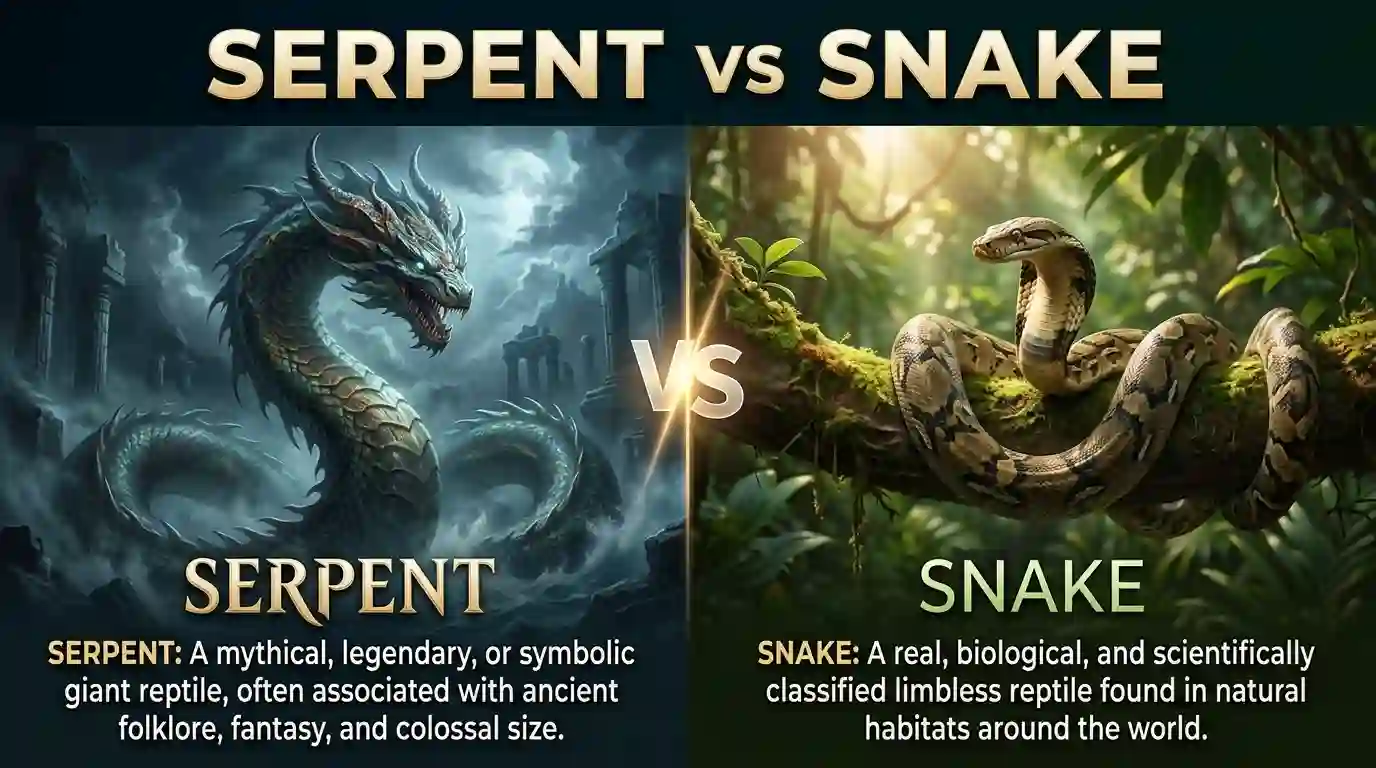
Serpent vs Snake: Understanding the Meaning of Each Word

Have you ever read a fantasy novel describing a mysterious serpent and wondered why the writer did not simply use the word snake? Both terms refer to the same general group of reptiles, yet they can create very different impressions. Understanding serpent vs. snake helps you choose the right word for everyday conversations, creative writing, scientific discussions, and descriptions of myths or legends.
Although the two words overlap in meaning, their tone, associations, and typical contexts are not identical. One sounds more formal or symbolic, while the other feels direct and familiar. Knowing when to use each term makes your writing more precise and natural.
Quick Answer
The main difference between serpent and snake is tone and usage, not the type of animal being described. Snake is the common, neutral word for a legless reptile, while serpent is a more formal, literary, or symbolic term often found in mythology, religion, and dramatic storytelling. Both words can describe the same animal, so the best choice depends on your context and intended meaning.
What Each Term Means
Both words refer to elongated, legless reptiles belonging to the suborder Serpentes. However, English speakers tend to use them in different ways, especially when the description involves science, storytelling, or symbolism.
What Does Snake Mean?
A snake is a legless reptile with a long body, flexible jaws, and scales. Snakes belong to a diverse group that includes harmless species, venomous species, constrictors, and many other varieties found in different habitats around the world.
The word snake is the everyday term most people use when discussing these animals. It works naturally in casual conversations, educational materials, wildlife reports, and scientific explanations.
For example, someone might say, “A snake crossed the hiking trail just before sunset.” The sentence communicates a straightforward observation without suggesting anything mysterious or symbolic.
The word also appears in familiar expressions, including “snake in the grass,” which describes a deceitful person, and “snake oil,” which refers to a fraudulent or ineffective remedy. These figurative meanings depend on the word’s established associations rather than its literal zoological definition.
What Does Serpent Mean?
A serpent is another word for a snake, but it often carries a more elevated, dramatic, or symbolic tone. Writers frequently choose it when they want to create an atmosphere of mystery, danger, grandeur, or ancient significance.
The term appears regularly in mythology, religious narratives, poetry, fantasy literature, and historical descriptions. For instance, a storyteller might describe a legendary serpent guarding a hidden temple or a giant serpent coiling around an enchanted tower.
Unlike snake, the word serpent can make an ordinary reptile sound more imposing or otherworldly. Nevertheless, it does not automatically mean that the animal is enormous, poisonous, supernatural, or aggressive.
In biological contexts, serpent may also appear in formal descriptions or specialized terminology. Its scientific significance, however, is not fundamentally different from that of snake in ordinary English.
The Core Rule, Explained Once
The central distinction between serpent vs snake concerns register, connotation, and context rather than a strict grammatical or biological separation. Both words are countable nouns, both can refer to the same reptile, and both follow the usual rules for singular and plural nouns.
Use snake when you want a clear, neutral description that readers will understand immediately. Choose serpent when the surrounding language calls for a literary, historical, mythological, or symbolic effect.
Consider the difference between these sentences:
- “The snake rested beneath a fallen branch.”
- “The ancient serpent guarded the entrance to the forgotten kingdom.”
The first sentence presents an ordinary animal in a natural setting. The second uses a more evocative word that suits a legendary scene. The distinction comes from the tone and setting, not from a difference in the animal’s anatomy.
The same principle applies to formal writing. A wildlife researcher would generally choose snake when explaining species behavior to a general audience. A poet might prefer serpent to create rhythm, atmosphere, or associations with ancient stories.
Neither term is inherently more grammatically correct than the other. Writers should select the word that fits their audience, purpose, and intended effect.
Examples in Context
The following examples show how serpent vs snake works across everyday conversations, education, travel, literature, and other real-life settings. Each sentence uses the term that best suits its particular context.
- Wildlife observation: A snake slipped between the rocks before the photographer could take a picture.
- School lesson: Our biology teacher explained how a snake detects vibrations through the ground.
- Travel experience: A snake appeared near the campsite, so the hikers moved away and contacted a park ranger.
- Fantasy novel: The golden serpent emerged from the underground chamber and spoke in an ancient voice.
- Mythology discussion: The legendary serpent represented chaos and transformation in the story.
- Museum exhibition: An illustration showed a winged serpent wrapped around a pillar in an ancient civilization’s artwork.
- Nature documentary: The narrator described how a snake uses its tongue to gather chemical information from its surroundings.
- Poetry: The poet compared the winding river to a silver serpent gliding through the valley.
- Religious studies: The class examined how the serpent appears in a biblical narrative and how different traditions interpret its role.
- Creative writing: Beneath the moonlit ruins, a serpent guarded the doorway to a forgotten kingdom.
These examples demonstrate that either word can be appropriate, but the surrounding context influences which one sounds more natural.
Common Mistakes
Confusion usually arises when writers treat the two terms as completely different animals or assume that one always sounds more correct. Avoid these five common errors when choosing between them.
- Mistake: “A serpent is always poisonous.”
Better: “Some serpents are venomous, while others are harmless.”
Reason: The word does not identify an animal’s venom status. - Mistake: “The word snake is incorrect in formal writing.”
Better: “The snake was identified by a wildlife specialist.”
Reason: Snake is standard English and works perfectly well in formal and scientific contexts. - Mistake: “A serpent must be a mythical creature.”
Better: “The serpent moved quietly through the tall grass.”
Reason: Although the term frequently appears in legends, it can also describe a real reptile. - Mistake: “Serpent and snake have completely separate biological meanings.”
Better: “The writer used serpent instead of snake to create a more dramatic tone.”
Reason: The terms overlap in their literal meaning; their main difference is conventional usage and connotation. - Mistake: “The more formal word is always the better choice.”
Better: “A snake rested beside the garden wall.”
Reason: Everyday language often communicates more clearly than an unnecessarily elevated word.
Understanding serpent vs snake as a difference in tone rather than a strict rule helps prevent these errors.
Tricky or Edge Cases
Although the basic distinction is straightforward, a few contexts deserve closer attention because the intended meaning can influence the most natural word choice.
Scientific and educational writing: Use snake as the default term for general explanations of reptile biology. Serpent may occur in formal or historical terminology, but it is not automatically more scientific.
Mythology and religion: Serpent is often the more natural choice when discussing a symbolic creature in an ancient narrative. However, translations and religious traditions may use snake instead, so follow the wording of the source when quoting or analyzing a particular text.
Figurative language: Both terms can carry symbolic meanings, but their associations differ. A “snake in the grass” commonly suggests betrayal, while a “serpent” may evoke temptation, wisdom, danger, or ancient power, depending on the story or cultural tradition.
Descriptions of fictional creatures: Fantasy writers can use either term for invented reptiles. The choice should match the creature’s role, the atmosphere of the scene, and the language used throughout the story.
How to Remember It
To remember serpent vs snake, think of snake as the everyday choice and serpent as the more literary alternative. If you are describing an animal you encountered in a garden, park, or forest, snake will usually sound natural. If you are writing about an ancient legend, a magical guardian, or a symbolic creature, serpent may create a stronger impression.
A useful memory trick is to associate serpent with stories, symbols, and solemn descriptions. Keep in mind that this is a guide to tone, not an absolute rule.
Which Is More Correct or More Common?
Neither word is universally more correct. Both are established English nouns, and both can describe the same type of reptile without creating a grammatical error.
Snake is generally more common in everyday English because people use it to discuss real animals, wildlife encounters, pets, safety concerns, and biological facts. It is also the more straightforward choice for general audiences.
Serpent appears more often in literary, poetic, mythological, religious, and symbolic contexts. Its associations can make a description feel older, more formal, or more dramatic, although the effect depends on the surrounding sentence.
For English learners, the safest approach is to use snake as the default term and learn serpent as a stylistic alternative. For experienced writers, the choice offers an opportunity to control tone and imagery. Neither word is automatically superior; effective writing depends on selecting the word that communicates the intended meaning.
Quick Reference Table
This table summarizes the main differences to help you choose the appropriate term quickly.
| Feature | Snake | Serpent |
| Basic meaning | A legless reptile | A snake or snake-like creature |
| Common usage | Everyday English | Literary, formal, or symbolic English |
| Tone | Neutral and familiar | Often elevated or dramatic |
| Scientific descriptions | Common and direct | Less common as a general term |
| Mythology and legends | Appropriate | Often preferred for a dramatic effect |
| Religious narratives | Depends on the source | Frequently used in traditional or symbolic descriptions |
| Implied danger | None automatically | None automatically |
| Best default choice | General conversation and clear explanations | Stories, symbolism, and elevated descriptions |
FAQs
These frequently asked questions address the differences in meaning, grammar, pronunciation, and everyday usage that readers often want to understand.
Is a serpent the same as a snake?
Yes. In ordinary English, serpent and snake can refer to the same reptile. The main difference lies in tone and context rather than biological classification.
Why do writers use serpent instead of snake?
Writers often choose serpent to create a formal, mysterious, poetic, or mythological atmosphere. The word can make a description feel more dramatic without changing the animal’s literal identity.
Is serpent a more formal word than snake?
Generally, yes. Serpent often sounds more literary or elevated, whereas snake is the standard everyday term. However, snake remains appropriate in formal reports and academic explanations.
Are serpents always dangerous or venomous?
No. The word serpent does not indicate whether a reptile is venomous, aggressive, or harmless. Those characteristics depend on the actual species being described.
Should I use snake or serpent in an essay?
For a general biology or wildlife essay, snake is usually the clearest option. For an essay about mythology, symbolism, poetry, or religious literature, serpent may be more suitable when it matches the source and intended tone.
Conclusion
Understanding serpent vs snake makes it easier to choose language that fits your message. Both words can describe the same reptile, but snake generally suits everyday communication, while serpent often adds a literary, symbolic, or dramatic quality. Neither term is inherently wrong, and the context should guide your decision rather than an assumption that one word is always better. The next time you write about a reptile, a mythical guardian, or an ancient story, consider the impression you want to create and choose the word that communicates it most clearly.