Don't miss our holiday offer - up to 50% OFF!

Respond vs Response: Easy Rules to Know the Difference

Have you ever paused while writing an email because you were unsure whether to say “please respond” or “send a response”? The words look closely related, but they perform different grammatical jobs. Understanding respond vs response becomes much easier once you recognize whether you need an action word or a thing that represents the answer.
Quick Answer
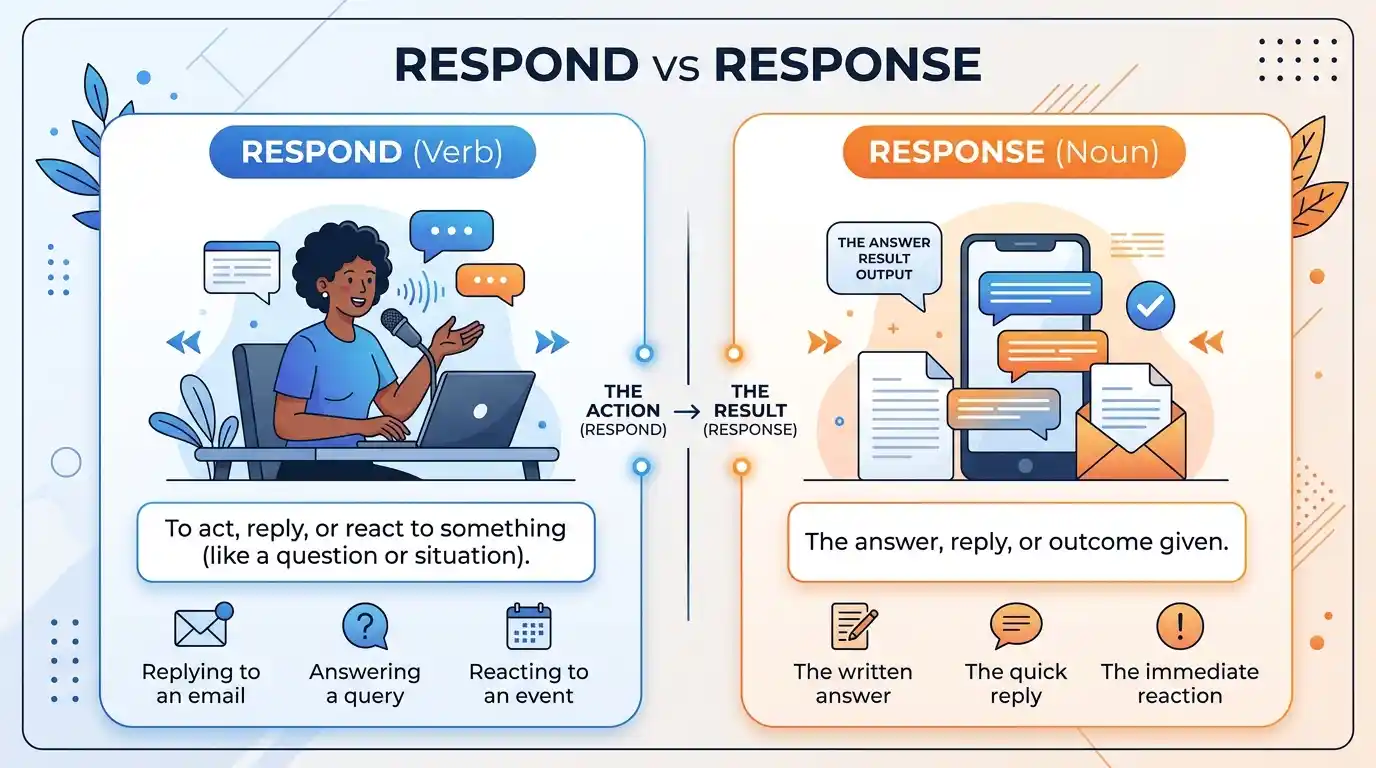
Respond vs response comes down to part of speech: “respond” is a verb, while “response” is a noun. Use “respond” when someone performs the action of answering or reacting, and use “response” when you are talking about the answer or reaction itself.
What Each Term Means
The difference becomes straightforward when you look at what each word does in a sentence. Although both words describe answering or reacting, they cannot normally occupy the same grammatical position.
Respond
“Respond” is a verb. It describes the act of answering, reacting, replying, or taking action after something happens.
You can respond to a question, message, request, invitation, complaint, situation, or comment.
Examples include:
- Please respond to the invitation by Friday.
- The manager will respond to your request tomorrow.
- How did the customer respond to the new policy?
The word can also describe a reaction to circumstances rather than a spoken or written answer. For example, a person may respond calmly to criticism, while a machine may respond to a command.
Response
“Response” is a noun. It refers to the answer, reaction, or action that results from something.
You can receive, write, expect, request, evaluate, or describe a response.
Examples include:
- We received a quick response from the supplier.
- Her response surprised everyone.
- The doctor carefully considered the patient’s response to treatment.
Because “response” names the thing rather than the action, it often appears after words such as “a,” “the,” “your,” “his,” or “their.”
The Core Rule, Explained Once
The central distinction in respond vs response is grammatical: “respond” functions as a verb, whereas “response” functions as a noun. A verb tells us what someone or something does; a noun identifies a person, place, thing, idea, event, or concept.
Consider the difference between these two patterns:
- Someone responds to something.
- Someone gives or provides a response to something.
The first construction focuses on the action. The second focuses on the resulting answer or reaction.
This distinction also explains why certain surrounding words make one choice sound natural and the other incorrect. After modal verbs such as “can,” “will,” “should,” and “may,” use the base verb: “She will respond.” After an article such as “a” or “the,” a noun is usually required: “We received a response.”
The forms can change with tense or agreement. “Respond” can become “responds,” “responded,” or “responding,” while “response” can become “responses” when you need the plural noun.
The related word “responsive” is an adjective, meaning quick or willing to react. That word belongs to the same word family but has a different grammatical role.
Examples in Context
These respond vs response examples cover different real-life settings so you can see how the two words work naturally in everyday writing.
- Work email: Please respond to the client’s questions before the meeting.
- Customer service: The company sent a detailed response to my complaint.
- School: Students should respond to each discussion question in complete sentences.
- Travel: We are waiting for the airline’s response about the canceled flight.
- Text message: I tried to respond while I was on the train.
- Shopping: The store offered a helpful response when I asked about the return policy.
- Technology: The application failed to respond after the update.
- Relationships: Her response to the invitation was warm and enthusiastic.
- Interview: The candidate paused before giving a thoughtful response.
- Weather: The plants responded quickly to the sudden change in temperature.
Notice how the context changes, but the grammatical distinction remains consistent. The verb describes an action, while the noun identifies an answer or reaction.
Common Mistakes
Most errors happen when writers recognize the relationship between these words but overlook their grammatical roles. Here are several mistakes worth watching for.
- Wrong: I sent a respond to your email.
Right: I sent a response to your email.
“Sent” requires the name of the thing that was sent, so the noun “response” fits. - Wrong: Please response as soon as possible.
Right: Please respond as soon as possible.
“Please” introduces a request for an action, so the verb is needed. - Wrong: We expect you to response today.
Right: We expect you to respond today.
The infinitive construction “to + verb” requires “respond.” - Wrong: She gave a quick respond.
Right: She gave a quick response.
The article “a” and adjective “quick” modify a noun here. - Wrong: The device did not response to the command.
Right: The device did not respond to the command.
After “did not,” use the base form of the verb.
Tricky or Edge Cases
Some situations can cause confusion because the words belong to the same word family and can appear close together. Their forms may also change depending on tense, number, or sentence structure.
For example, “respond” can appear as “responded” when discussing a completed action: “The technician responded within an hour.” Meanwhile, “response” can become plural: “We received several responses from readers.”
Another useful distinction involves the preposition “to.” Both constructions can use “to,” but their grammatical patterns differ:
- Please respond to the message.
- Please send a response to the message.
The preposition does not determine the choice by itself. The word’s grammatical function does.
How to Remember It
A simple memory trick for respond vs response is to connect “respond” with “do” and “response” with “thing.” If someone can perform the action, use “respond.” If you can receive, give, send, or describe the answer, use “response.”
Think of the pair as similar to other verb-and-noun relationships: “decide” and “decision,” “inform” and “information,” or “explain” and “explanation.” The endings differ because the grammatical jobs differ.
Which Is More Correct or More Common?
Neither word is inherently more correct. They are both standard English words, but they cannot freely replace one another because they serve different grammatical functions.
“Respond” is common when giving an instruction or describing an action: “Please respond by Monday.” “Response” is natural when referring to an answer, reaction, or reply as a noun: “We appreciated your response.”
In professional writing, both appear frequently. Choosing between them depends less on formality and more on the structure of the sentence. Replacing one with the other simply because the meanings are related can create a grammatical error.
Quick Reference Table
This table gives you a quick way to identify the correct form before you finish writing.
| Word | Part of Speech | Main Meaning | Example |
| Respond | Verb | To answer or react | Please respond to the request. |
| Response | Noun | An answer or reaction | We received a response. |
| Responded | Past-tense verb | Answered or reacted | She responded quickly. |
| Responding | -ing verb form | Answering or reacting | He is responding to the complaint. |
| Responses | Plural noun | Multiple answers or reactions | Several responses arrived. |
| Responsive | Adjective | Quick or willing to react | The support team is very responsive. |
FAQs
These frequently asked questions address some of the most common points of confusion about these closely related words.
Is “respond” a verb or a noun?
“Respond” is a verb. It describes the action of answering, replying, or reacting to something.
Is “response” a verb or a noun?
“Response” is a noun. It refers to the answer, reply, or reaction itself.
Can I say “give a respond”?
No. The natural phrase is “give a response” because “give” is followed by a noun in this construction.
Should I say “respond to” or “response to”?
Both are correct, but they create different sentence structures. Use “respond to” when “respond” is the verb, and “response to” when “response” is the noun.
How can I quickly choose between them?
Ask yourself whether you need an action or a thing. If the sentence needs an action, choose “respond”; if it needs an answer or reaction as a noun, choose “response.”
Conclusion
Understanding respond vs response gives you a simple way to avoid a surprisingly common grammar mistake. “Respond” functions as a verb for the act of answering or reacting, while “response” functions as a noun for the answer or reaction itself. Once you pay attention to the grammatical role required by the sentence, choosing between the two becomes much more natural.
The distinction is useful in emails, school assignments, workplace communication, customer service messages, and everyday conversations. Keep the verb “respond” connected with an action and the noun “response” connected with the resulting answer, and your writing will sound clearer and more confident.
Words that switch roles cause the most confusion — impatient vs inpatient is a classic example.