Don't miss our holiday offer - up to 50% OFF!

Recurring vs. Recurring: Easy Rules to Know the Difference

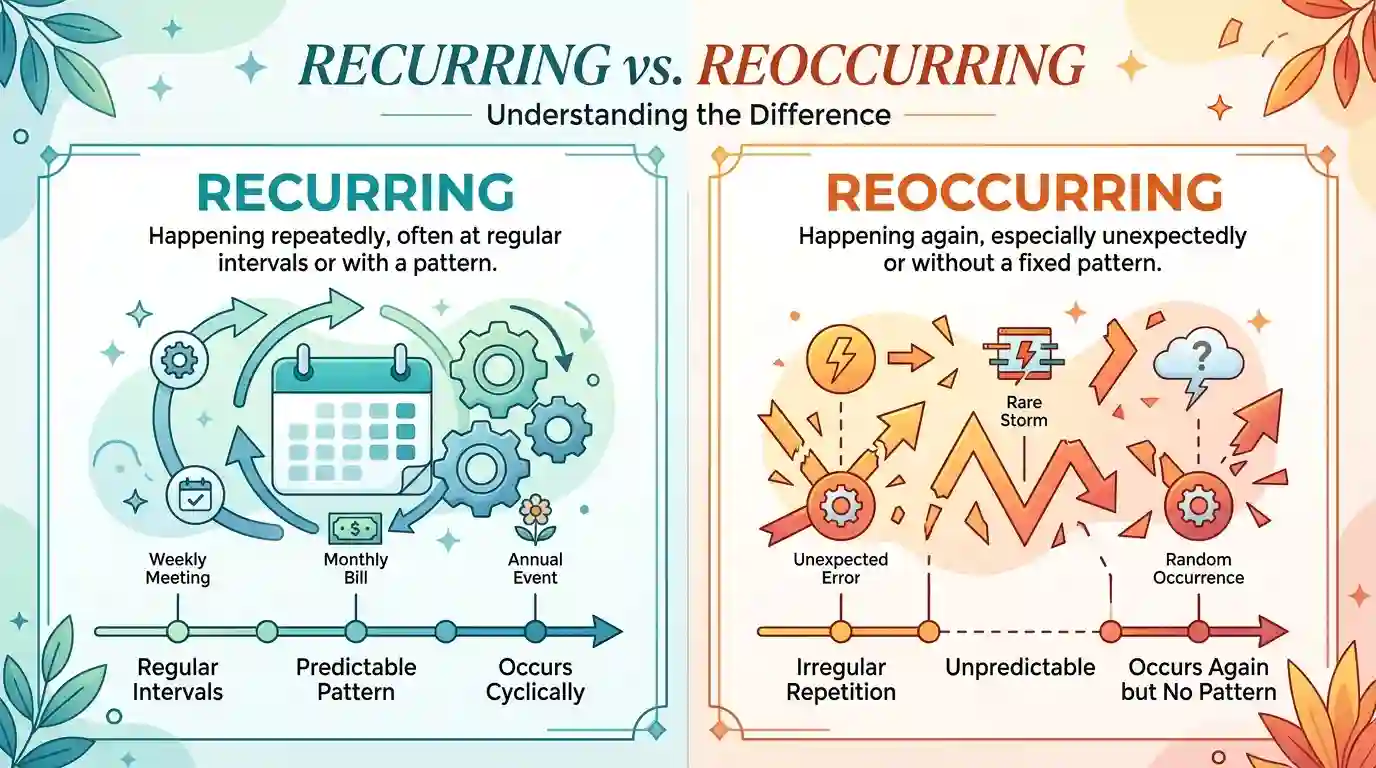
A payment shows up every month, a meeting appears on the calendar again and again, or the same problem suddenly returns after a long break. In each case, choosing between similar-looking words can make a sentence feel surprisingly tricky. Understanding recurring vs reoccurring becomes much easier once you see the difference between something that happens repeatedly as a pattern and something that happens again, especially after an interruption.
Quick Answer
The main difference between recurring vs reoccurring is that recurring usually describes something that happens repeatedly, regularly, or as an established pattern, while reoccurring emphasizes that something happens again. The two words overlap, but recurring is generally the more natural choice for scheduled or repeated events, whereas reoccurring often highlights a return after something has happened before.
What Each Term Means
Both words come from the idea of something happening again, so their meanings naturally overlap. The useful distinction is the emphasis each word places on repetition.
Recurring
Recurring describes something that happens repeatedly, often at regular intervals or according to a recognizable pattern. It is especially common for events, payments, appointments, problems, thoughts, and other situations that return over time.
For example, a recurring subscription charge is expected to appear every month. A recurring meeting may take place every Monday. A recurring issue with a website suggests that the same problem keeps appearing rather than being a one-time incident.
The word can also describe repetition without a perfectly fixed schedule. A recurring dream, for instance, may return several times without appearing on a predictable date.
Reoccurring
Recurring means happening again or appearing again. It comes from reoccur, which combines the idea of occurrence with the prefix re-, meaning again.
The word can suggest that an event has happened before and has now returned. It does not necessarily imply a regular schedule or predictable pattern.
For instance, if a strange noise disappeared after a repair and later returned, you might describe it as a recurring noise. The focus is on its happening again, rather than on a fixed cycle.
The Core Rule, Explained Once
The simplest way to understand recurring vs. reoccurring is to ask what kind of repetition you want to emphasize. Use recurring when something repeatedly comes back as a pattern, cycle, habit, or expected event. Use reoccurring when you mainly want to say that something occurred again.
Recurring often carries an expectation of repetition. A recurring bill, recurring appointment, recurring deadline, and recurring seasonal event all suggest that the event is part of an ongoing pattern.
Reoccurring is broader in another sense. It can describe something that returns without suggesting that the return follows a schedule. A problem might disappear for several weeks and then reoccur. In that situation, the important information is that the problem happened again.
There is also a useful stylistic point: recurring is considerably more established in many everyday expressions. You will commonly encounter phrases such as “recurring payment,” “recurring event,” “recurring theme,” and “recurring problem.” That does not make reoccurring incorrect; it simply means the surrounding context often determines which word sounds most natural.
Examples in Context
These examples of recurring vs reoccurring cover different real-life settings so you can see how the distinction works outside a grammar exercise.
- Banking: The customer canceled the recurring monthly payment.
- Work: Our team has a recurring meeting every Wednesday afternoon.
- Technology: The software has a recurring error that appeared again after the update.
- Health and habits: She noticed a recurring pattern in her sleep schedule.
- Travel: Heavy fog is a recurring issue during the winter months.
- School: The professor discussed a recurring theme throughout the novel.
- Home: The plumber finally fixed the recurring leak that had returned after several repairs.
- Shopping: The store offers a discount on recurring subscription orders.
- Relationships: They had a recurring disagreement about weekend plans.
- Weather: The unusual storm pattern was recurring after several quiet days.
Common Mistakes
The most common errors involve treating the two words as completely interchangeable or assuming that reoccurring is always wrong.
- Wrong: “I have a reoccurring appointment every Friday.”
Better: “I have a recurring appointment every Friday.”
A fixed weekly appointment describes an established schedule. - Wrong: “The recurring error returned after six months.”
Better: “The recurring error returned after six months.”
Here, the emphasis is on the error appearing again after an interval. - Wrong: “Recurring means exactly the same thing as reoccurring.”
Better: The meanings overlap, but recurring often emphasizes a repeated pattern, while reoccurring emphasizes another occurrence. - Wrong: “Reoccurring is not a real English word.”
Better: Reoccurring is a legitimate word formed from reoccur. It simply appears less often in some common expressions than recurring. - Wrong: “The annual festival is a reoccurring event.”
Better: “The annual festival is a recurring event.”
An event that returns according to a regular annual pattern is naturally described as recurring.
Tricky or Edge Cases
Some situations allow either word because the intended meaning depends on context. The distinction is one of emphasis rather than a rigid grammatical rule that makes one form universally correct.
Consider a technical problem. If a computer error repeatedly appears during normal operation, a recurring error highlights an ongoing pattern. If the error disappeared after troubleshooting and then appeared again unexpectedly, a recurring error can highlight its return.
The same flexibility appears with personal experiences. A thought that repeatedly enters someone’s mind may be called a recurring thought, while an old concern that returns after a period of absence may be described as reoccurring. Context determines which aspect of repetition matters most.
How to Remember It
A simple memory trick for recurring vs. reoccurring is to associate recurring with a routine and reoccurring with a return. If something keeps happening as part of a pattern, think recurring. If something happens again after it has already happened, think reoccurring.
You can also look at familiar combinations. “Recurring payment,” “recurring meeting,” and “recurring event” all sound natural because these expressions usually describe predictable repetition.
Which Is More Correct or More Common?
Neither word is automatically an error. Both recurring and reoccurring are accepted English words, but they are not equally common in every context.
Recurring is particularly common when discussing schedules, subscriptions, patterns, themes, habits, and repeated problems. It often sounds more concise and conventional when repetition is expected or ongoing.
Recurring places more attention on another occurrence. It can be useful when an event returns after an earlier occurrence, particularly when there is no clear schedule or established cycle.
In everyday writing, the choice should therefore depend on meaning rather than on the assumption that one word is always correct. If you mean “happening repeatedly as a pattern,” recurring will often be the clearest choice. If you mean “happening again,” reoccurring may communicate the intended nuance more precisely.
Quick Reference Table
This quick table summarizes the practical distinction between the two terms.
| Word | Main idea | Typical use | Example |
| Recurring | Repeatedly happening, often as a pattern | Payments, meetings, events, themes, habits | “The recurring meeting starts at 10 a.m.” |
| Reoccurring | Happening again | Returning problems or events without a necessary schedule | “The recurring fault appeared after the repair.” |
| Recurring | Expected repetition | Regular or ongoing situations | “She canceled the recurring subscription.” |
| Reoccurring | Another occurrence | Something that has returned | “The recurring issue needs investigation.” |
FAQs
These questions address some of the most common points of confusion about the two forms and their everyday usage.
Is recurring or reoccurring correct?
Both are correct English words. Recurring commonly describes repeated or patterned events, while reoccurring emphasizes that something has happened again.
Is reoccurring a real word?
Yes. Reoccurring is a standard English word meaning happening again. It is less common than recurring in some established expressions, but it is not inherently incorrect.
What is the difference between recurring and reoccurring?
Recurring usually emphasizes repetition or an ongoing pattern, while reoccurring focuses on another occurrence. Because their meanings overlap, context can sometimes make either word possible.
Is it a recurring problem or a reoccurring problem?
Both phrases can be used, but they can suggest slightly different ideas. Recurring problem commonly describes an issue that repeatedly comes back, while reoccurring problem can emphasize that the issue has appeared again.
Is a monthly payment recurring or reoccurring?
Recurring payment is the standard and more natural expression because the payment is scheduled to repeat at regular intervals.
Conclusion
The distinction between recurring vs reoccurring is mainly about the kind of repetition you want to emphasize. Recurring works especially well for regular, ongoing, or patterned events, while reoccurring highlights something happening again after an earlier occurrence. Neither word is automatically wrong, and context remains important when the meanings overlap. When you are describing a scheduled payment, meeting, event, or familiar pattern, recurring will usually be the natural choice; when you want to stress a return, reoccurring may better express the idea.