Don't miss our holiday offer - up to 50% OFF!

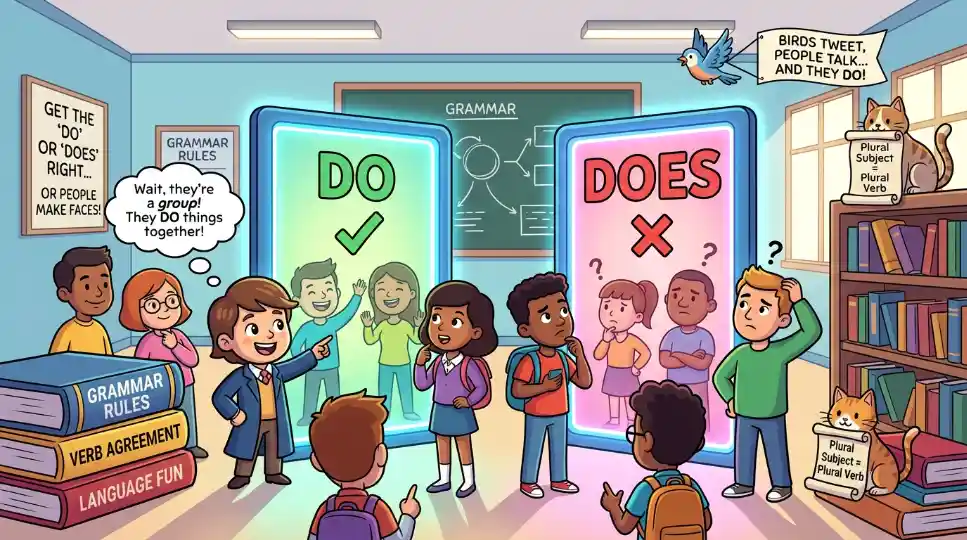
People Do, or People Does? Simple Grammar Rules and Examples

Imagine someone asks, “Why do people do this?” It may sound almost right because “people” refers to more than one person, but English grammar follows a different pattern here. Understanding people do or does becomes much easier once you connect the subject with the correct form of the verb.
Quick Answer
The correct form is “people do,” not “people does.” People is normally a plural noun, so it takes the plural verb do in the present tense. For example: “People do strange things sometimes.”
What Each Term Means
Before choosing between the two forms, it helps to understand what people, do, and does are doing in a sentence. The difference comes from subject-verb agreement in the present simple tense.
People
“People” is the plural form commonly used for “person.” It refers to two or more human beings and normally behaves as a plural subject.
For example, we can say:
- People are waiting outside.
- People have different opinions.
- People want better service.
Because “people” is plural, the verb that follows it should normally use the plural form as well.
Do and Does
Do is used with I, you, we, they, and plural nouns, while does is used with he, she, it, and singular third-person nouns.
Compare these:
- People do their homework.
- Students do their assignments.
- She does her homework.
- The teacher does the paperwork.
The same distinction applies when do works as an auxiliary verb in questions and negative sentences.
The Core Rule, Explained Once
In the present simple tense, English verbs must agree with their subjects. Singular third-person subjects generally take does, while plural subjects take do. Since people normally represents more than one person, it belongs with do.
This rule applies whether do is the main verb or a helping verb. As a main verb, it can describe an action: “People do their best.” As an auxiliary, it helps form questions and negatives: “Do people understand the instructions?” and “People do not always agree.”
People as a Plural Subject
When “people” means human beings in general or a group of individuals, it is grammatically plural. That means other present-tense verbs also need plural forms.
Consider the difference:
- People like music.
- People need information.
- People know the rules.
- People do what they think is right.
Notice that the plural form is not marked with -s in these examples. With regular present-tense verbs, the -s ending usually belongs to singular third-person subjects instead.
Questions and Negative Sentences
The difference becomes especially noticeable when do or does is used to create questions and negatives.
For a plural subject such as “people,” use do:
- Do people really read those reviews?
- Why do people leave comments?
- Do people understand the instructions?
- People do not always agree.
With a singular subject, the helping verb changes:
- Does your brother work here?
- Why does the manager need the report?
- The device does not connect automatically.
There is one useful detail to remember: when does is used as a helping verb, the main verb stays in its base form. We say “Does she like it?” rather than “Does she likes it?”
When “Do” Is the Main Verb
Sometimes “do” itself carries the main meaning of the sentence rather than simply helping another verb. Even then, “people” takes do.
Examples include:
- People do their jobs differently.
- People do enough research before buying.
- People do what they can.
Here, there is no second main verb after “do.” The word itself describes carrying out an activity or task.
Examples in Context
The following examples use different everyday settings so you can see how the rule works naturally in real sentences.
- Workplace: People do their best when expectations are clear.
- Travel: Do people usually arrive early for the train?
- Shopping: People do compare prices before making large purchases.
- School: Do people learn differently in online classes?
- Technology: People do rely on apps for everyday tasks.
- Relationships: Do people change their opinions over time?
- Weather: People do prepare differently for severe storms.
- Social media: Do people really notice every post?
- Community: People do care about what happens around them.
- Home: People do organize their kitchens in different ways.
Common Mistakes
These errors usually happen when writers focus on the word immediately before the verb rather than identifying whether the subject is singular or plural.
- Wrong: does not understand the policy.
Right: do not understand the policy.
Reason: “People” is plural, so the negative auxiliary is do. - Wrong: Why does people complain so much?
Right: Why do people complain so much?
Reason: The plural subject “people” requires do in the question. - Wrong: People does their work differently.
Right: People do their work differently.
Reason: “Does” is the third-person singular form. - Wrong: Do people likes this design?
Right: Do people like this design?
Reason: After the auxiliary do, the main verb returns to its base form. - Wrong: doesn’t always agree.
Right: don’t always agree.
Reason: “Doesn’t” means “does not” and is used with singular third-person subjects; “don’t” is appropriate with plural “people.”
Tricky or Edge Cases
Although the basic rule is straightforward, a few related constructions can cause confusion because the word “people” does not always appear in exactly the same grammatical role.
One useful distinction involves a people, which can refer to an ethnic, cultural, or national group as a collective noun in formal or historical writing. In that specialized use, the grammatical treatment can differ depending on the sentence and intended meaning. For ordinary references to human beings, however, people is plural.
Another potential source of confusion is person versus people. “Person” is singular, so it takes does:
- A person does not always know what others think.
Change the subject to “people,” and the verb changes:
- People do not always know what others think.
The important point is to identify the actual subject rather than choosing the verb based on the noun closest to it.

How to Remember It
A simple memory trick is to connect people with they. If you could replace “people” with “they,” use do: “Do they agree?” → “Do people agree?”
You can also remember the singular pair as he/she/it → does and the plural pair as they/people → do. This shortcut works particularly well when forming questions and negative sentences.
Which Is More Correct or More Common?
For ordinary English, “people do” is the grammatically correct construction when “people” means more than one person. “People does” is generally an agreement error in standard English.
This is not mainly a difference between formal and informal English, nor is it normally a regional variation. A speaker might occasionally produce “people does” in casual speech, a nonstandard dialect, or while learning English, but standard edited English uses do with the plural noun “people.”
The same pattern appears throughout English grammar. “Children do,” “students do,” “customers do,” and “workers do” all follow the plural pattern. Their singular counterparts—“a child,” “a student,” “a customer,” and “a worker”—take does when appropriate.
Quick Reference Table
This table gives you a fast way to check the correct form when writing or speaking.
| Subject | Correct form | Example |
| I | do | I do my work carefully. |
| You | do | You do enough preparation. |
| We | do | We do what is necessary. |
| They | do | They do their research. |
| People | do | People do things differently. |
| He | does | He does his job well. |
| She | does | She does the shopping. |
| It | does | It does the job quickly. |
| A person | does | A person does not always notice. |
| People | do | Do people understand the rule? |
FAQs
Here are answers to some common questions learners ask about choosing between do and does with “people.”
Is it “people do” or “people does”?
The correct standard form is “people do.” Because “people” is normally plural, it takes the plural verb form do.
Do we say “people do” in questions?
Yes. For example, “Do people enjoy this kind of music?” and “Why do people behave differently?” Both use do because the subject is plural.
Is “people does” ever correct?
In ordinary standard English, “people does” is not correct when “people” means more than one person. You may encounter it in nonstandard speech or writing, but it should be changed to “people do” in standard edited English.
Is it “people don’t” or “people doesn’t”?
The correct form is “people don’t.” “Don’t” is the negative form used with plural subjects such as “people,” while “doesn’t” is used with singular third-person subjects.
Why do we say “a person does” but “people do”?
“Person” is singular, so it takes does in the present tense. “People” is plural, so it takes do. The change in the noun changes the required verb form.
Conclusion
Choosing between people do or people does comes down to a basic subject-verb agreement rule: “people” is normally plural, so it pairs with do. This remains true when “do” is the main verb and when it acts as an auxiliary in questions or negative sentences. Once you connect “people” with the pronoun “they,” the correct form becomes much easier to recognize.
Getting this small distinction right can make everyday writing sound cleaner and more confident. When you are unsure, replace “people” with “they” and check whether it still sounds natural. With that quick habit, this common grammar problem becomes much easier to avoid.