Don't miss our holiday offer - up to 50% OFF!

Nighttime vs Night Time: Which One Is Correct? Easy Guide

Picture a text message that says, “I usually read at ___.” You know exactly what you mean, but the spelling suddenly feels less certain. The question of nighttime vs night time comes up because English sometimes turns familiar word combinations into closed compounds, while other combinations remain open.
Quick Answer
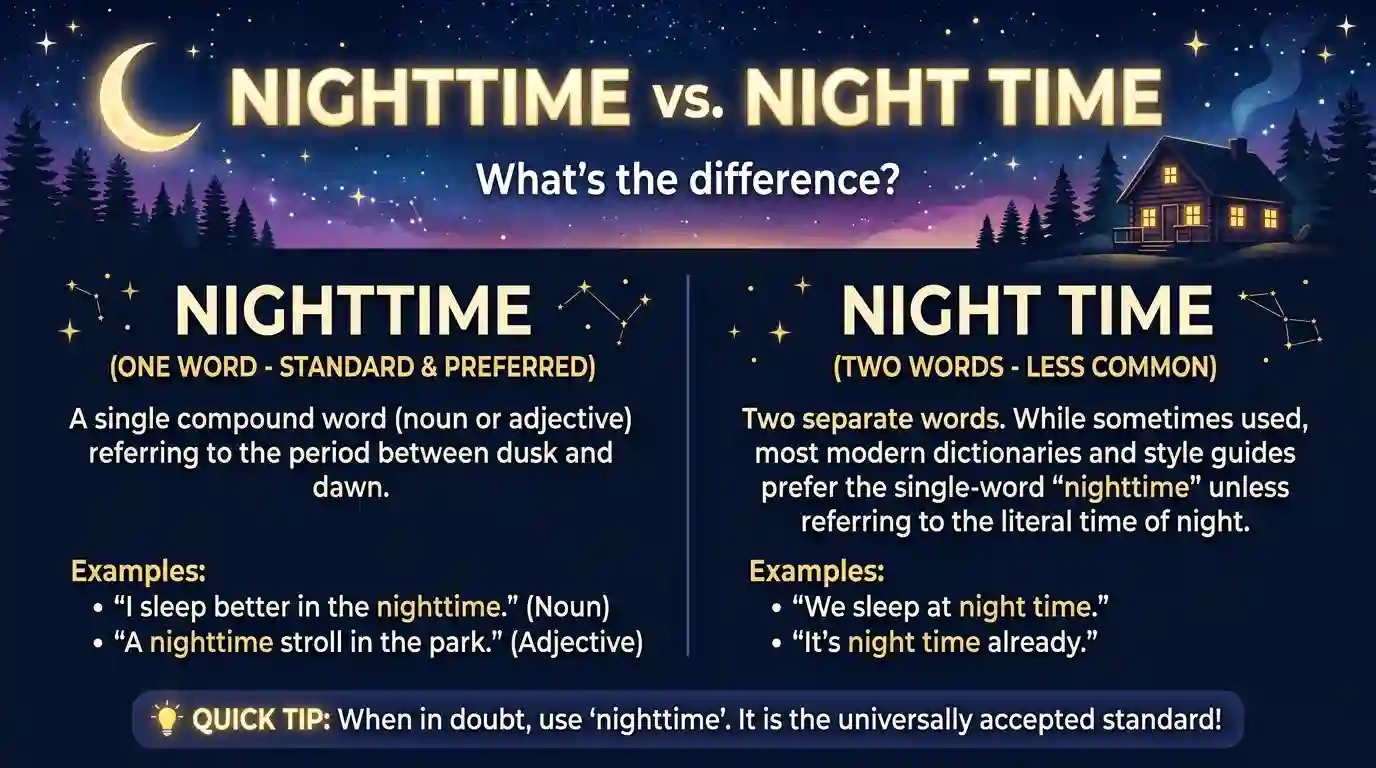
Nighttime vs night time is mainly a question of standard usage rather than two different meanings. Nighttime is the standard one-word form in modern English, while night time can appear when the writer is treating the phrase more literally as “the time at night,” but it is much less common as a general noun.
Nighttime vs Night Time: What Each Term Means
When comparing nighttime vs night time, both forms point to the hours or period associated with night, so the difference is mostly grammatical and stylistic. The closed form has become the established compound noun in ordinary modern writing.
Nighttime
Nighttime is a noun that refers to the period when it is night, especially the hours after dark and before morning. It can also work as an adjective before another noun.
For example, “The park is quiet at nighttime” uses the word as a noun, while “nighttime traffic” uses it attributively. This flexible use makes the closed spelling especially convenient in everyday English.
Night Time
Night time is the open form, with night modifying time. It is understandable and can occasionally be found in writing, but it is not usually the preferred spelling when you simply mean the general period of night.
An open construction can make sense when a writer wants to emphasize the literal idea of a particular time occurring at night. In most ordinary sentences, however, the established compound nighttime will sound more natural.
The Core Rule, Explained Once
The central rule behind nighttime vs night time is simple: when nighttime functions as the established noun or adjective meaning “relating to or occurring during the night,” write it as one word.
English contains many compounds that began as separate words and gradually became closed forms through frequent use. Nighttime follows that familiar pattern. Modern dictionaries and edited prose generally recognize it as a standard compound, so the one-word spelling is the safest choice for general writing.
There is no special grammar rule saying that night and time can never appear separately. English can place nouns together in an open phrase when the intended meaning calls for it. The practical distinction is therefore not about pronunciation or a major difference in meaning; it is about whether you are using the established compound or constructing a literal phrase.
For polished articles, emails, schoolwork, professional copy, and everyday messages, choosing nighttime avoids unnecessary uncertainty. If you are describing a specific time during the night, a different construction may be even clearer, such as “time at night,” “late at night,” or “during the night.”
Examples in Context
These examples show how nighttime vs night time works across different real-life settings, with the preferred closed form appearing naturally in most situations.
- Health: The child follows a calm nighttime routine before bed.
- Travel: The mountain road becomes difficult to navigate during nighttime hours.
- Technology: The phone automatically switches to nighttime settings after dark.
- Shopping: The store offers special nighttime discounts on selected items.
- Work: Security staff make regular nighttime checks around the building.
- Weather: Nighttime temperatures are expected to fall below freezing.
- Pets: Our cat becomes much more active during the nighttime.
- School: The astronomy club planned a nighttime observation session.
- Photography: The camera performs well in nighttime conditions.
- Travel planning: We avoided driving at nighttime because of heavy fog.
Common Mistakes
The most frequent errors in nighttime vs night time involve treating the open form as equally standard in every context or assuming that spacing changes the meaning. These corrections show where a polished writer would normally choose the closed compound.
- Wrong: The night time temperature dropped sharply.
Right: The nighttime temperature dropped sharply.
Use the established compound when nighttime modifies another noun. - Wrong: I prefer working during night time.
Right: I prefer working during nighttime.
The one-word form is the conventional choice for the general period of night. - Wrong: The app has a special night time mode.
Right: The app has a special nighttime mode.
As an adjective describing a mode, the closed compound reads more naturally. - Wrong: Night time routines can improve sleep habits.
Right: Nighttime routines can improve sleep habits.
The compound works smoothly before the noun routines. - Wrong: We took a night time train through the countryside.
Right: We took a nighttime train through the countryside.
In edited general prose, the closed form is the cleaner choice.
Tricky or Edge Cases
There are a few situations where the open wording may appear without being a serious grammatical error. Context matters, especially when a writer is deliberately focusing on time as a concept rather than using the established compound.
For instance, “What time at night should we call?” sounds natural when the question concerns a particular hour. Likewise, “the best time during the night” can be used when the writer wants to identify a specific point or period within the night. These alternatives are often clearer than forcing night time into a sentence simply because the writer is unsure about the spelling.
How to Remember It
A useful memory trick is to treat nighttime vs night time as a compound-word question: if you mean the general period of night, picture nighttime as one complete word. The same visual habit helps when it appears before another noun, as in nighttime routine or nighttime temperature. If you mean a particular hour, switch to a clearer phrase such as “time at night.”
Which Is More Correct or More Common?
For standard modern English, nighttime is the stronger default. It is the conventional closed compound and works comfortably as both a noun and an adjective.
That does not mean every appearance of night time is incomprehensible or automatically an error. English contains many noun combinations whose spacing varies across contexts, and open forms can survive in particular styles or constructions. Still, a general writer who uses night time where nighttime is intended may look less polished than a writer who uses the established compound.
This is therefore best understood as a usage preference with a clear standard choice, rather than a major difference in grammar. If you are writing for a website, publication, school assignment, business audience, or broad readership, nighttime is the safest and most natural option.
Quick Reference Table
This table gives you a fast way to choose the form when you are editing a sentence.
| Form | Typical use | Example |
| nighttime | General period of night | I enjoy reading at nighttime. |
| nighttime | Before a noun | We created a nighttime schedule. |
| night time | Literal/open phrasing in limited contexts | The discussion focused on what time at night the event should begin. |
| time at night | Specific hour or period | What time at night does the shop close? |
FAQs
These common questions cover the spelling, grammar, and practical usage points writers most often wonder about.
Is “nighttime” one word or two?
The standard form is nighttime, written as one word. It is the preferred spelling when referring generally to the period of night or something associated with that period.
Is “night time” grammatically wrong?
Not necessarily, but it is usually not the best general-purpose spelling. In most edited contexts, nighttime is the more established and natural choice.
Should I write “nighttime routine” or “night time routine”?
Write nighttime routine in standard general prose. Here, nighttime functions as a compound adjective describing the routine.
Is “nighttime” formal English?
Yes. Nighttime is a standard English word and is appropriate in both everyday and formal writing. Its use is not limited to casual conversation.
What is the difference between “nighttime” and “at night”?
They can refer to closely related ideas, but they have different grammatical roles. Nighttime is a noun or adjective, while at night is a prepositional phrase used to describe when something happens.
Conclusion
The safest answer to nighttime vs night time is to choose nighttime when you mean the general period of night or something associated with it. The one-word form is established, versatile, and widely suitable for edited English, whether you are describing a routine, temperature, schedule, or activity. Although the open form may occasionally appear, it is rarely necessary when the intended meaning is simply “during or relating to the night.” Once you recognize nighttime as the standard compound, choosing the correct spelling becomes a quick editing decision rather than a recurring source of doubt.
One more spelling question, answered: unaccessible vs inaccessible.
[…] The main difference between “What Happen or What Happened” is the verb tense. English uses different verb forms to show when an action or event takes place. […]