Don't miss our holiday offer - up to 50% OFF!

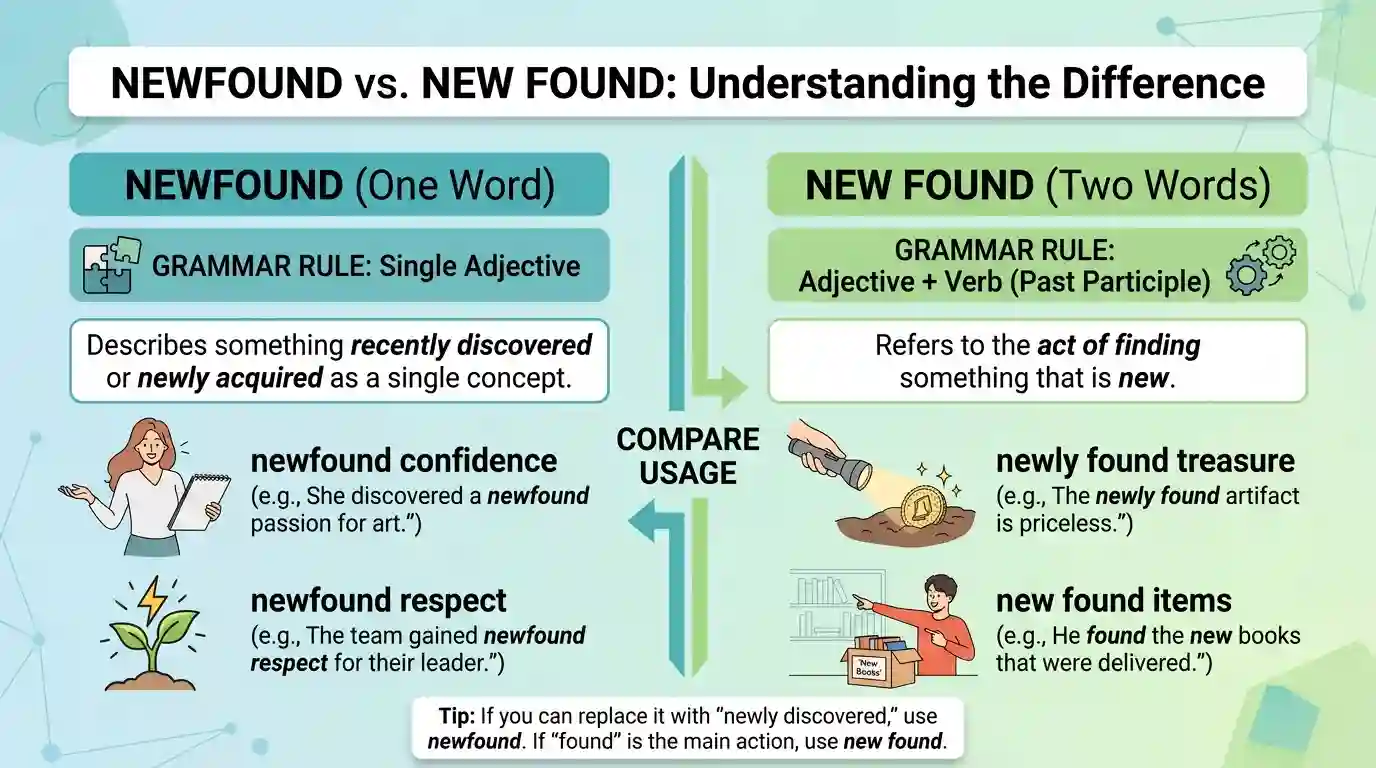
Newfound vs New Found: Easy Rules to Know the Difference

A new job can bring a newfound confidence, while a traveler may have found new places along the way. These expressions look almost identical, but their grammar and meaning are different. Understanding newfound vs new found becomes much easier once you know whether you are describing a newly gained quality or simply saying that something was discovered.
Quick Answer
The main difference between newfound and new found is grammatical: newfound is normally an adjective meaning “recently acquired or developed,” while new found is usually a combination of the adjective “new” and the past participle “found,” meaning something was discovered and was new. In most cases, if you mean “recently gained,” use the single word newfound.
What Each Term Means
The two forms may look like spelling variations, but they perform different jobs in a sentence. Their meanings become clearer when you consider what the word is describing and how the sentence is constructed.
Newfound
Newfound is an adjective meaning recently gained, discovered, developed, or experienced. It commonly describes an attitude, feeling, ability, interest, confidence, appreciation, or quality that has appeared or become stronger recently.
For example, someone who successfully finishes a difficult course might have newfound confidence. A person who starts gardening could develop a newfound interest in plants. In both cases, the quality already exists, but it is relatively recent.
The word is generally written as one word when it functions as an adjective.
New Found
New found consists of two separate words: new and found. Here, found is the past participle of the verb find, while new describes the thing that was discovered.
Consider a sentence such as “The researchers examined a new-found species.” The intended meaning is that the species was newly discovered. However, in modern standard English, writers will often prefer newly found or newfound, depending on the exact meaning they want.
The two-word form therefore requires more attention to sentence structure. It should not automatically replace the established adjective newfound.
The Core Rule, Explained Once
The easiest way to understand newfound vs new found is to ask whether you are describing a recently acquired quality or describing something that was found and is new. Newfound acts as a single adjective and usually comes before a noun: newfound freedom, newfound respect, or newfound enthusiasm. The separate words new found belong to a different grammatical construction in which found retains its connection to the verb find. Because English commonly uses newly found for the meaning “recently discovered,” forcing new found into places where newfound is intended can make the sentence sound awkward or nonstandard.
There is also a useful semantic distinction. Newfound often focuses on a change in someone’s experience or possession: a person has gained something that was not previously present. By contrast, a phrase involving found can focus on the event of discovery itself.
Compare these ideas:
- newfound patience = patience recently developed
- newfound enthusiasm = enthusiasm recently acquired
- newly found document = a document that has recently been discovered
This distinction helps you choose the appropriate form without relying only on how the words look.
Examples in Context
These newfound vs new found examples cover different real-life settings so you can see how the forms work naturally in context.
- Work: After leading the project successfully, Maya showed newfound confidence during meetings.
- Travel: The hikers returned from the mountains with a newfound appreciation for quiet places.
- Relationships: Their honest conversation created a newfound sense of trust between them.
- Education: The science class sparked a newfound curiosity about astronomy.
- Fitness: Completing the race gave Daniel newfound motivation to keep training.
- Technology: The engineer discovered a newly found vulnerability during the security review.
- Shopping: The collector displayed a newfound interest in vintage watches.
- Nature: Scientists studied a newly found specimen recovered from the cave.
- Personal growth: After moving abroad, Elena developed a newfound independence.
- History: The museum announced a newly found letter connected to the artist.
Common Mistakes
These mistakes usually happen when writers treat the two forms as interchangeable. The quickest correction is to identify whether the sentence describes a newly acquired quality or an actual discovery.
- Wrong: The experience gave him new found confidence.
Right: The experience gave him newfound confidence.
Why: Confidence is a quality that was recently developed, so the established adjective is one word. - Wrong: She felt new found appreciation for classical music.
Right: She felt newfound appreciation for classical music.
Why: The phrase describes a recently developed feeling. - Wrong: The team examined a newfound artifact discovered beneath the floor.
Right: The team examined a newly found artifact discovered beneath the floor.
Why: The intended meaning is that the artifact was recently discovered. - Wrong: His new found determination helped him finish the challenge.
Right: His newfound determination helped him finish the challenge.
Why: Determination is a newly acquired personal quality. - Wrong: Researchers reported a newfound manuscript yesterday.
Right: Researchers reported a newly found manuscript yesterday.
Why: The context emphasizes the recent discovery rather than a newly developed quality.
Tricky or Edge Cases
There are a few situations where the distinction becomes less obvious because newfound can also carry a sense of something being newly discovered. Context determines whether the word is functioning as the established adjective or whether the writer is emphasizing an act of finding.
Newfound discovery can sometimes sound redundant because newfound already suggests something recently discovered or acquired. In polished writing, a more precise alternative may be recent discovery, newly discovered item, or simply new discovery, depending on the intended meaning.
Hyphenation can also create confusion. Expressions containing new and found may appear as new-found in some older, literary, or editorial styles. Modern usage generally favors newfound when the word is functioning as the established adjective and newly found when the writer means “recently discovered.”
How to Remember It
Think of newfound as something that has become part of your experience: newfound confidence, newfound freedom, or newfound respect. If you can replace the expression with “recently gained” or “recently developed,” the single-word form is usually the natural choice. When you mean that somebody literally discovered something, try replacing the phrase with “recently discovered” or “newly discovered” instead.
A simple memory trick for newfound vs new found is: newfound = newly gained; newly found = recently discovered.
Which Is More Correct or More Common?
Newfound is the established standard form when the word functions as an adjective meaning recently acquired or developed. It is common in phrases involving emotions, attitudes, abilities, confidence, freedom, appreciation, and similar qualities.
The expression new found is not simply an alternative spelling of that adjective. In contexts where the meaning is “recently discovered,” newly found is often clearer because it makes the relationship with the verb find explicit.
You may encounter new-found in older publications or particular editorial traditions. That does not necessarily make every occurrence incorrect, but contemporary general-purpose writing usually benefits from choosing the form that communicates the intended meaning most directly.
Quick Reference Table
This table brings the main differences together so you can check the form quickly while editing or writing.
| Form | Grammar | Main meaning | Example |
|---|---|---|---|
| newfound | Adjective | Recently gained or developed | She has newfound confidence. |
| new found | Two-word construction | New + something that was found | The phrase may appear in specialized or older constructions. |
| new-found | Hyphenated form | Older or style-dependent variant | A new-found hope appeared in some older writing. |
| newly found | Adverb + participle | Recently discovered | They studied a newly found manuscript. |
FAQs
These common questions address the spelling, grammar, meaning, and practical usage issues that often cause confusion between the two forms.
Is newfound one word or two?
Newfound is normally written as one word when it means recently gained, developed, or experienced. For example, “She has newfound confidence” uses the standard adjective.
Is new found grammatically correct?
New found can occur when found functions as a past participle and new modifies the thing that was found, but it is not interchangeable with newfound. In many modern contexts, newly found is a clearer choice for the meaning “recently discovered.”
Should I write newfound confidence or new found confidence?
Write newfound confidence. The phrase describes confidence that has recently developed, so the established compound adjective is the natural form.
Is newfound the same as newly discovered?
Not always. Newfound can mean recently acquired, developed, or experienced, while newly discovered specifically emphasizes the act or result of discovering something.
Can newfound be used before a noun?
Yes. It is commonly used before nouns, as in newfound freedom, newfound interest, newfound respect, and newfound enthusiasm. It can also appear in other adjective positions depending on the sentence.
Conclusion
Understanding newfound vs new found comes down to recognizing the job each form performs in a sentence. Newfound is the standard one-word adjective for something recently gained, developed, or experienced, especially qualities such as confidence, freedom, appreciation, or interest. When the meaning centers on an object or fact that was recently discovered, newly found is often the clearer modern choice. Paying attention to that small grammatical difference can make your writing more precise and natural, especially in professional, academic, and edited English. Once you connect newfound with “recently gained” and newly found with “recently discovered,” choosing the right expression becomes much easier.
Word-formation puzzles are endless — unaccessible vs inaccessible tackles another.