Don't miss our holiday offer - up to 50% OFF!

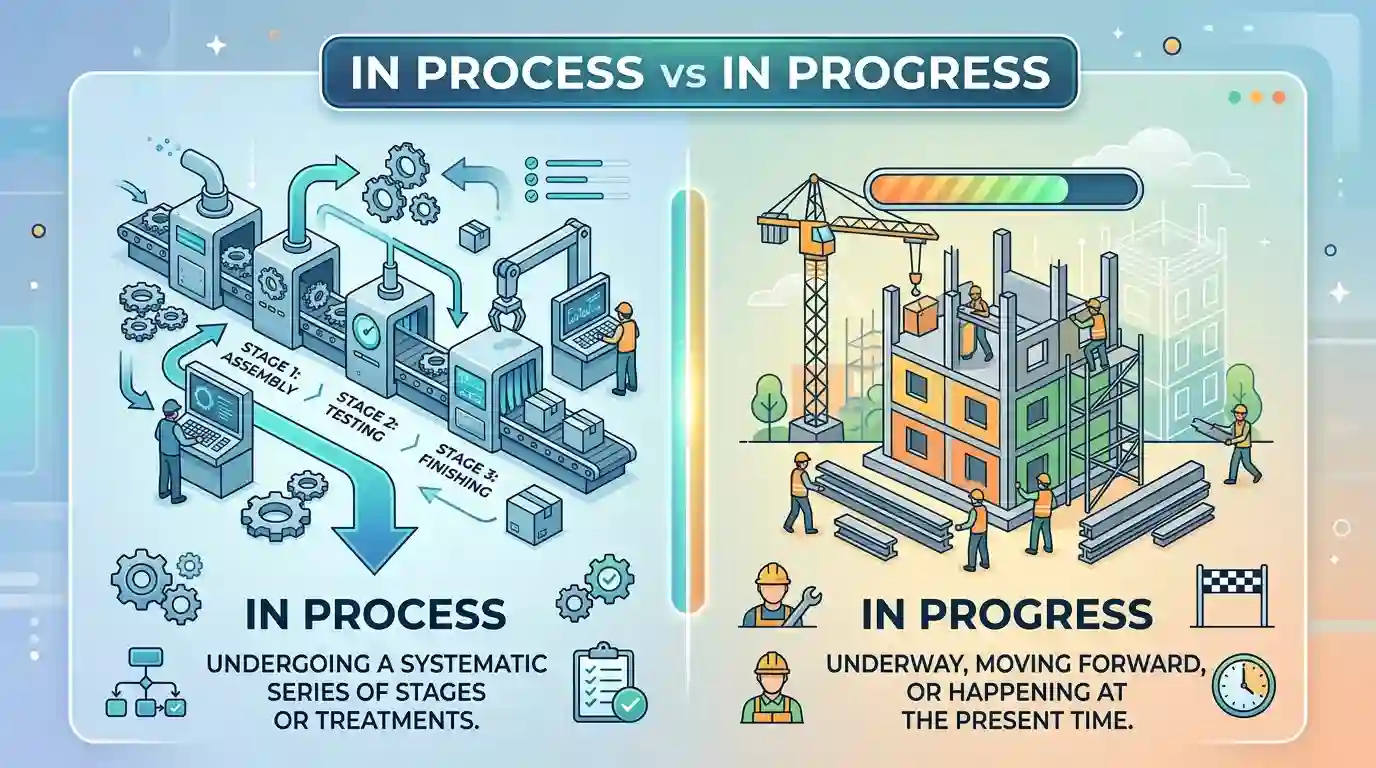
In Process vs In Progress: Easy Rules to Know the Difference

Introduction
A project manager says, “The website redesign is in progress,” while a colleague writes, “Your refund is in process.” Both phrases sound close enough to cause confusion, but they do not always describe the same stage or idea. Understanding in process vs in progress helps you choose the expression that fits the situation, especially in the workplace, customer service, and everyday writing.
Quick Answer
In process vs in progress is mainly a usage distinction rather than a simple grammar battle. “In progress” usually means that an activity or event has started and is continuing, while “in process” often means that something is being handled through a procedure or is underway within a particular process.
What Each Term Means
These expressions overlap, but their usual emphasis is different. In process vs in progress becomes easier to understand when you separate an ongoing activity from something moving through a defined procedure.
In Process
“In process” commonly describes something that has entered a process and has not yet reached its final stage. It appears frequently in business, administration, manufacturing, customer service, and other settings where a formal procedure is involved.
For example, a company might say that an application is in process, meaning staff are handling it according to the relevant procedure. The phrase can also describe something being developed or worked through, although “in progress” is often more natural for an ordinary activity.
In Progress
“In progress” describes an activity, task, event, or development that has begun but is not finished. It works naturally with projects, repairs, construction, discussions, examinations, and many other activities.
A sign reading “Roadwork in progress” tells people that the work is currently happening. Likewise, a teacher might say that grading is in progress when the task has started and continues toward completion.
The Core Rule for In Process vs In Progress
The key to in process vs in progress is the idea you want to emphasize. Use “in progress” when the main point is that an activity is currently happening or continuing. Use “in process” when the wording highlights a procedure, system, or sequence through which something is being handled.
There is considerable overlap, so context matters. “The investigation is in progress” presents the investigation as an ongoing activity. “The application is in process” presents the application as something moving through an administrative procedure. In many ordinary sentences, “in progress” sounds more idiomatic, whereas “in process” can sound more specialized or procedural.
Examples in Context
The following in process vs in progress examples cover different real-life settings so you can see how the emphasis changes from one sentence to another.
- Workplace: The quarterly audit is in progress, so the finance team is reviewing the records.
- Customer service: Your replacement request is in process and will move through several approval stages.
- Construction: The library renovation is in progress through the summer.
- School: The admissions office confirmed that my application is in process.
- Technology: The software update is in progress, and the device may restart when it finishes.
- Manufacturing: The custom order is in process at the production facility.
- Event: Registration is in progress for the afternoon workshop.
- Banking: The transfer is in process and has not reached the recipient yet.
- Travel: Boarding is in progress at Gate 18.
- Legal administration: The permit request is in process with the local office.
Common Mistakes
Most mistakes come from treating the two expressions as perfectly interchangeable or assuming that one is always wrong. Here are several patterns worth watching when applying in process vs in progress in everyday writing.
- Wrong: “The meeting is in process.”
Right: “The meeting is in progress.”
For a meeting that is currently happening, “in progress” is the more natural choice. - Wrong: “My visa application is in progress with the immigration office.”
Right: “My visa application is in process with the immigration office.”
The second version better highlights an official procedure. - Wrong: “The repair is in process.”
Right: “The repair is in progress.”
When you mean technicians are actively doing the repair, “in progress” is usually smoother. - Wrong: “The order is in progress at the factory.”
Right: “The order is in process at the factory.”
In a production setting, the latter can emphasize that the order is moving through a defined system. - Wrong: “The discussion is in process right now.”
Right: “The discussion is in progress right now.”
For an ongoing conversation or event, “in progress” is the standard everyday choice.
Tricky or Edge Cases
A few situations resist a neat either-or rule because speakers use “in process” and “in progress” differently across industries and varieties of English. These cases are worth recognizing rather than forcing every sentence into a rigid formula.
“In process” can sometimes mean simply “underway,” particularly in formal or technical writing. You may also encounter the phrase “in the process of,” which is a separate and extremely common construction: “She is in the process of changing careers.” The added “the” and “of” matter, so do not automatically treat that phrase as interchangeable with either shorter expression.
How to Remember It
Think of “progress” as movement toward completion and “process” as a system of steps. If you picture an activity happening on a timeline, “in progress” will often fit. If you picture paperwork, approvals, production stages, or an established procedure, “in process” may be the better match. When neither context requires a procedural emphasis, “in progress” is generally the safer everyday choice.
Which Is More Correct or More Common?
There is no universal rule saying that “in process” is grammatically wrong. Both expressions occur in standard English, but they have different patterns of use and naturalness. Looking at in process vs in progress as a question of context rather than a simple right-or-wrong choice gives you a more accurate picture.
“In progress” is much more broadly established for activities and events that are underway. “In process” is more closely associated with procedures, operations, formal handling, and certain technical or business contexts. In some cases, speakers may choose “in process” where another writer would choose “in progress,” without either choice creating a serious grammatical error.
If you are editing general-purpose English, consider the intended meaning first. A sentence about an event, task, or activity will often benefit from “in progress,” while a sentence about an item moving through a defined procedure may suit “in process.”
Quick Reference Table
This table puts the practical distinction in one place for quick review.
| Expression | Typical emphasis | Common contexts | Example |
|---|---|---|---|
| in progress | An activity or event is continuing | Projects, meetings, repairs, events | The inspection is in progress. |
| in process | Something is moving through a procedure | Applications, orders, approvals, administration | The request is in process. |
| in the process of | Someone or something is going through an action or change | Personal actions, transitions, formal descriptions | They are in the process of moving. |
FAQs
These questions address the points readers most often wonder about when choosing between the two expressions.
Is “in process” grammatically correct?
Yes. “In process” is a valid expression, especially when the context involves a procedure or a defined series of steps.
Is “in progress” more common than “in process”?
“In progress” is generally more common in broad everyday use, particularly for activities and events that are underway.
Can I use “in process” for a project?
You can, but “in progress” will usually sound more natural when you simply mean that the project has started and is not finished.
What is the difference between “in process” and “in the process of”?
“In process” can describe something being handled within a process, while “in the process of” normally introduces an action or change that someone or something is undertaking.
Should I say “work in process” or “work in progress”?
“Work in progress” is the familiar expression for work that has begun but is not complete. “Work in process” can appear in specialized contexts, especially when referring to production or accounting terminology.
Conclusion
Once you see the difference in emphasis, in process vs in progress becomes much easier to handle. “In progress” normally presents an activity or event as ongoing, while “in process” often draws attention to a procedure or system that is handling something. Neither phrase needs to be treated as an automatic error, but context and idiomatic usage should guide the choice. With that distinction in mind, you can write more naturally and avoid one of those small wording choices that can make otherwise clear English sound awkward.