Don't miss our holiday offer - up to 50% OFF!

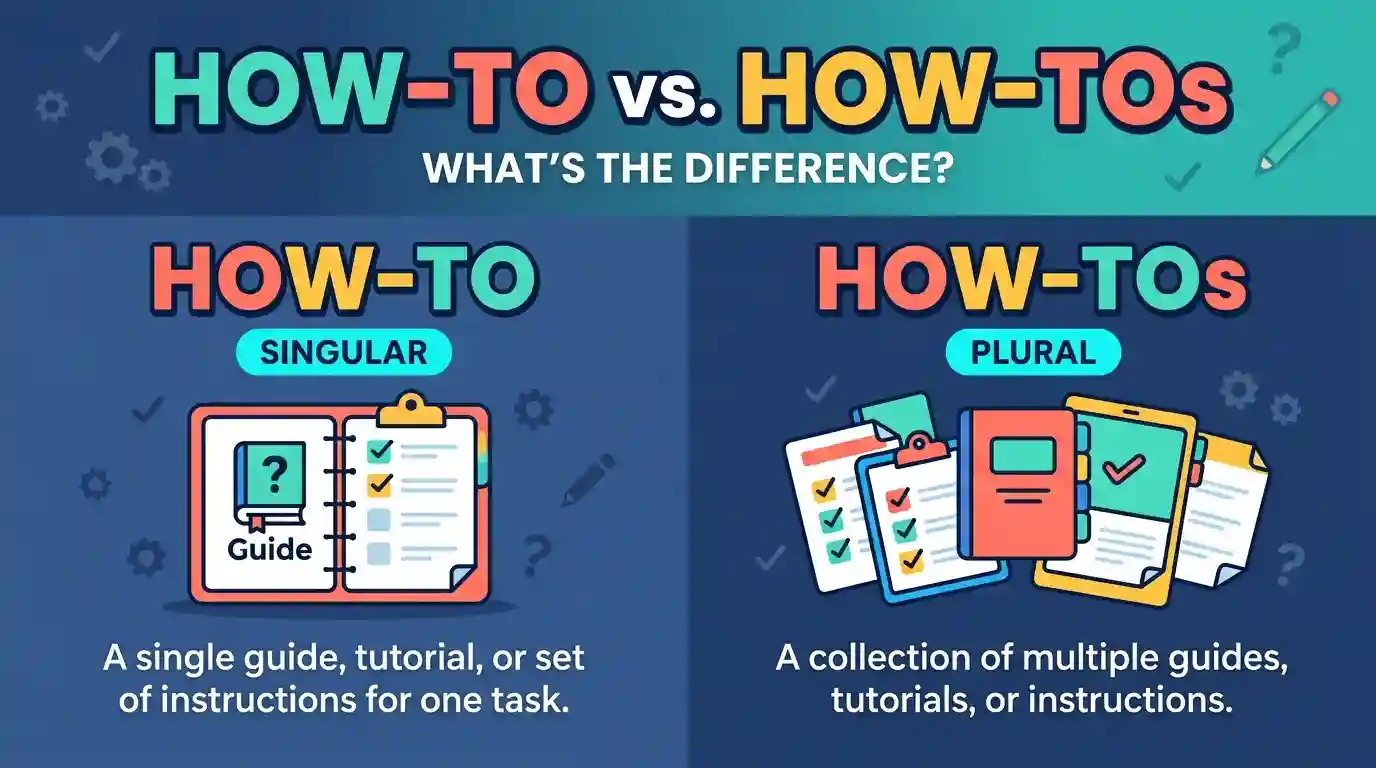
How To vs How Tos: Meaning, Grammar, and Examples

Have you ever paused while writing a blog title and wondered whether to use “how to” or “how tos”? The difference can seem minor, but choosing the right form makes your writing look polished and professional. Understanding how to vs. how tos helps you distinguish between a phrase that introduces instructions and a noun that refers to instructional guides. Once you understand how each expression works, you can use both confidently in articles, emails, headlines, and everyday writing.
Quick Answer
The difference between how to and how-tos comes down to grammatical function: “how to” introduces instructions or explains a method, while “how-tos” is the plural noun for instructional guides. For example, “how to bake bread” introduces a process, whereas “three how-tos for beginners” refers to three separate guides. Although writers sometimes use “how tos” without a hyphen, “how-tos” is a common, clear choice for the plural noun.
What Each Term Means
Although these expressions contain the same words, they perform different jobs in a sentence. Recognizing their grammatical roles helps you choose the right form without guessing.
What Does “How To” Mean?
“How to” introduces an explanation of a method, process, or procedure. It commonly appears before a base-form verb and tells readers what they will learn to do.
Examples include:
- How to repair a bicycle tire.
- She explained how to organize a small kitchen.
- The website teaches readers how to improve their writing.
In each example, “how to” introduces an action or a way of accomplishing something. The phrase frequently appears in questions, article titles, tutorials, and instructional content.
For instance, “How to Start a Vegetable Garden” tells readers that the article will explain the steps involved in starting a garden. The phrase does not function as a plural noun; it introduces the subject or method being explained.
What Does “How-To” Mean?
“How-to” can function as a noun or an adjective, depending on the sentence. As a noun, it refers to an instructional article, guide, or explanation. As an adjective, it describes something designed to teach a procedure.
Consider these examples:
- Noun: I found a helpful how-to about installing shelves.
- Adjective: The magazine published a how-to guide for new homeowners.
The noun “how-to” identifies an instructional resource, while the adjective describes the type of guide. When referring to more than one instructional resource, writers commonly use the plural “how-tos.”
The Core Rule, Explained Once
The central distinction in how to vs how tos is the difference between a grammatical phrase and a countable noun. “How to” introduces an action or method, often followed by a verb in its base form, such as “write,” “cook,” or “install.” It can appear in a question, an infinitive construction, or a sentence that explains a process.
For example, “Maya learned how to swim” describes what Maya learned to do. The phrase introduces the action of swimming rather than naming a separate document or guide.
By contrast, “how-to” names an instructional resource when used as a noun. Since such resources can be counted, the plural form is “how-tos.” A bookstore might advertise “five how-tos for home improvement,” meaning five individual instructional guides.
Hyphenation makes the noun easier to recognize, especially when it appears in a headline or a list. However, English style guides and publishers do not always handle compound expressions identically. Some contexts use “how tos” without a hyphen, so consistency with your publication’s preferred style matters.
One additional distinction is worth remembering: the phrase “how to” can also appear inside a noun phrase, such as “a lesson on how to use a spreadsheet.” Its presence does not automatically make the entire expression a noun meaning “guide.” The surrounding sentence determines the grammatical function.
Examples in Context
These examples show how how-to vs. how tos works across different settings, including education, technology, shopping, and professional communication.
- Blog title: “How to Choose the Right Running Shoes” introduces a process readers can follow.
- Online course: The instructor demonstrated how to create a presentation using simple design tools.
- Office conversation: Daniel asked how to submit his travel expenses before Friday.
- Library catalog: The librarian recommended several how-tos for learning digital photography.
- Magazine description: The latest issue features practical how-tos for decorating a rental apartment.
- Technology website: Visitors can browse how-tos covering password security and device maintenance.
- School assignment: The teacher asked students to explain how to calculate the area of a triangle.
- Marketing email: Our new collection includes three how-tos for choosing thoughtful anniversary gifts.
- Cooking website: Priya searched for instructions on how to prepare fresh pasta at home.
- Community workshop: Volunteers distributed printed how-tos about composting and reducing household waste.
Common Mistakes
Writers can avoid several frequent errors by checking whether they are describing an action, naming a guide, or modifying another noun. The following mistakes illustrate situations where a small grammatical adjustment improves clarity.
- Incorrect: The website explains five how-tos for beginners.
Correct: The website explains five how-tos for beginners.
Reason: Use the plural noun when referring to several instructional guides. - Incorrect: I learned how-to prepare a formal presentation.
Correct: I learned how to prepare a formal presentation.
Reason: The phrase introducing the action does not need a hyphen in this sentence. - Incorrect: She downloaded three how-to about gardening.
Correct: She downloaded three how-tos about gardening.
Reason: A countable noun needs its plural form when referring to multiple guides. - Incorrect: This how-to article explains how-to replace a faucet.
Correct: This how-to article explains how to replace a faucet.
Reason: The first expression describes the article, while the second introduces the procedure. - Incorrect: The editor published several how-to’s for new employees.
Correct: The editor published several how-tos for new employees.
Reason: An apostrophe is not normally needed to form the plural of this noun.
Tricky or Edge Cases
A few situations require more attention because the correct form depends on the expression’s position and purpose. These cases are particularly relevant to editors, bloggers, and anyone writing instructional content.
“How-To” Before Another Noun
When the expression describes a type of resource, the hyphen helps connect the words. For example, “a how-to article” identifies an article that teaches a method. You would not normally write “a how to article” in edited prose when you intend this compound modifier.
Plural Possessives
A sentence may need to show ownership rather than simply indicate multiple guides. For example, “The how-tos’ illustrations need updating” means that the illustrations belonging to the guides need revision. The apostrophe comes after the plural noun because it marks possession, not because it forms the plural.
Headings and Search Queries
Online headings sometimes omit punctuation to match a search phrase or maintain a particular house style. A headline such as “Best How Tos for New Gardeners” may appear without a hyphen, even though “Best How-Tos for New Gardeners” makes the compound noun more recognizable. Follow your website’s editorial conventions while keeping the intended meaning clear.
How to Remember It
A simple way to remember how to vs how tos is to ask whether you are describing an action or counting guides. If the words introduce something a person can do, write “how to,” as in “how to plan a budget.” If you mean several instructional resources, use “how-tos,” as in “four how-tos about budgeting.”
Think of the hyphen as a visual clue that turns the expression into a recognizable compound noun. This quick check can help you edit article headings, product descriptions, and instructional materials more accurately.
Which Is More Correct or More Common?
Neither expression is universally correct in every situation because they serve different grammatical purposes. “How to” is the appropriate choice when introducing an action or explaining a method. “How-to” and “how-tos” are suitable when naming an instructional resource and its plural form.
The hyphenated forms are especially useful in edited writing because they distinguish the compound noun from the phrase that introduces an action. Many publications use “how-to guide,” “how-to article,” and “how-tos” to maintain that distinction. Nevertheless, some dictionaries, websites, and editorial styles permit the open forms “how to” or “how tos” when the intended meaning is clear.
For formal articles, educational materials, and professional websites, consistency is more valuable than switching between spellings without a reason. If your publication has a style guide, follow it. Otherwise, using “how-to” for the singular noun and “how-tos” for the plural is a practical, easily understood convention.
Quick Reference Table
Use this table to compare the main forms, their functions, and examples at a glance.
| Form | Grammatical function | Example |
| How to | Introduces an action or method | Learn how to edit photographs. |
| How-to | Singular noun | I read a how-to on bicycle maintenance. |
| How-to | Adjective | She wrote a how-to manual. |
| How-tos | Plural noun | The site offers several how-tos. |
| How tos | Alternative open spelling in some styles | The page lists useful how tos. |
| How-to’s | Usually incorrect as a simple plural | Write “how-tos” instead. |
FAQs
These frequently asked questions address common concerns about spelling, punctuation, plural forms, and the use of these expressions in online writing.
Is “how tos” one word or two?
“How tos” is written as two words, but the plural noun is commonly styled “how-tos” with a hyphen. The best choice depends on your publication’s preferred spelling convention.
What is the plural of “how-to”?
The usual plural is “how-tos.” For example, “The website publishes how-tos about home repairs” refers to several instructional guides.
Should “how to” have a hyphen?
Not when it introduces an action, as in “how to bake a cake.” A hyphen is generally appropriate when “how-to” functions as a compound noun or adjective, as in “a how-to guide.”
Is “how-to guide” grammatically correct?
Yes. “How-to” acts as a compound modifier describing the type of guide. The expression is widely understood in instructional writing, online publishing, and educational content.
Which spelling should I use in an SEO title?
Choose the form that accurately reflects the intended meaning and reads naturally. If your title refers to several instructional articles, “how-tos” is a clear option; if it introduces a procedure, use “how to.”
Conclusion
Understanding how to vs how tos makes it easier to write accurate headlines, helpful tutorials, and polished instructional content. The phrase “how to” introduces an action or method, while “how-to” can name an instructional resource and “how-tos” commonly identifies multiple resources. Although some publications use open spellings, the hyphenated noun forms provide a useful distinction for readers. Before publishing your next article, check the role each expression plays in the sentence and apply the same spelling convention throughout your content.