Don't miss our holiday offer - up to 50% OFF!

Froze vs Frozen: Easy Rules to Know the Difference

When a drink is left in the freezer overnight, you might say the water froze. But if you describe the water afterward, you would say it is frozen. That small change causes a surprisingly common grammar mix-up, which is why understanding froze vs frozen helps writers choose the right verb form.
Quick Answer
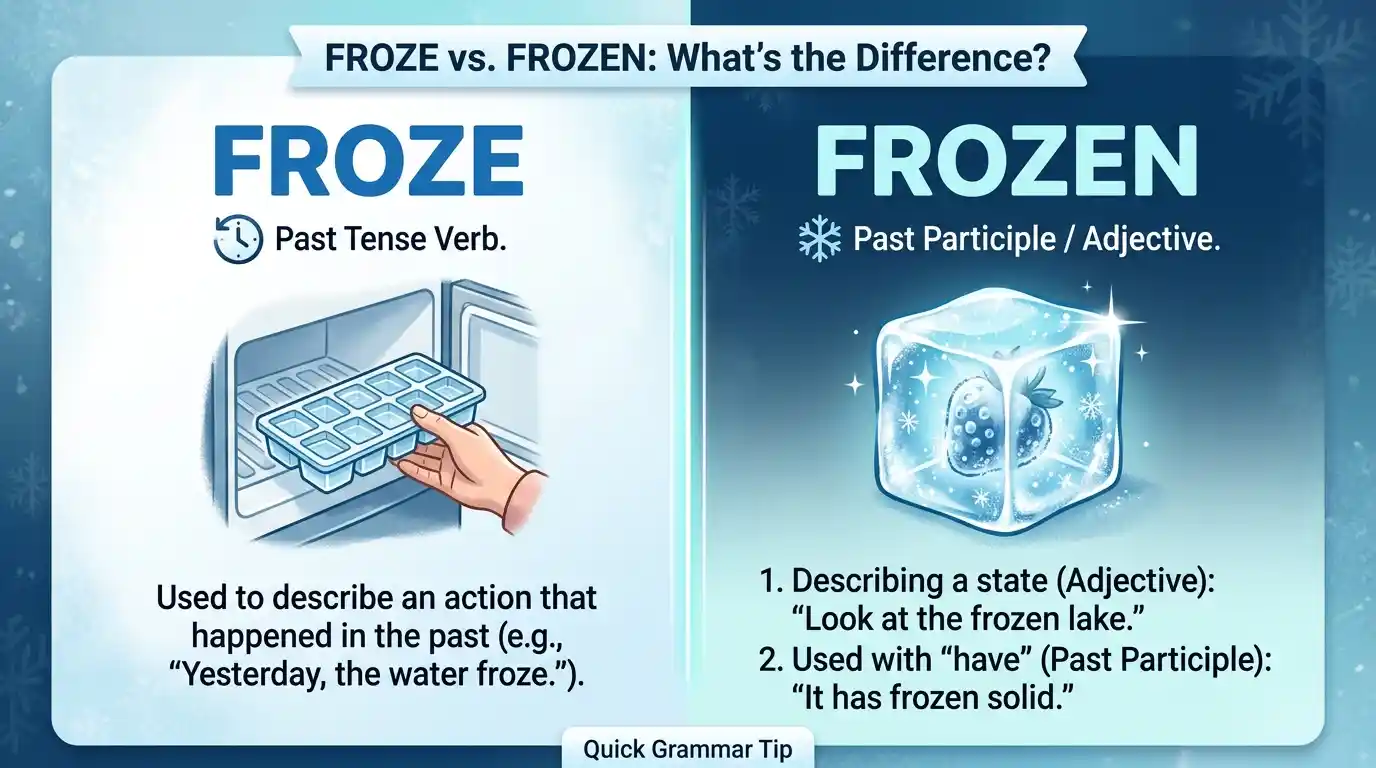
The simplest rule for froze vs frozen is this: froze is the simple past tense of freeze, while frozen is the past participle. Use froze for a completed past action without a helping verb, and use frozen with forms of have or be when the grammar calls for a participle.
What Each Term Means
The two forms come from the same irregular verb, but they perform different jobs in a sentence. When comparing froze vs frozen, knowing what each form does makes the choice much easier.
Froze
Froze is the simple past form of freeze. It describes something that became frozen or stopped because of cold at a definite or understood point in the past.
For example: “The lake froze during the first week of January.” The action happened in the past, so froze works by itself as the main verb.
Frozen
Frozen is the past participle of freeze. It normally appears with a helping verb, such as has, have, had, is, are, was, or were, depending on the construction.
For example: “The lake has frozen over.” Here, has supplies the grammatical support that allows frozen to function as a participle. Frozen can also work as an adjective: “The vegetables were frozen.”
The Core Rule, Explained Once
The key distinction in froze vs frozen is not about whether something is cold. It is about verb form and sentence structure. Freeze is an irregular verb: its base form is freeze, its simple past is froze, and its past participle is frozen.
Use froze when the sentence needs a simple past verb: “The pond froze overnight.” Use frozen when another verb has already taken the tense, as in “The pond has frozen overnight.” In passive constructions, frozen can follow a form of be: “The pipes were frozen.”
This pattern is the same one you see with other irregular verbs. We say “She wrote the letter,” but “She has written the letter.” Likewise, we say “The machine froze,” but “The machine has frozen.”
Examples in Context
These examples of froze vs frozen cover different real-life settings so you can see how the correct form changes with the sentence structure.
- Weather: The puddles froze before sunrise.
- Cooking: The leftover soup was frozen in small containers.
- Technology: My laptop froze while I was editing a video.
- Travel: The mountain road had frozen after several hours below zero.
- Shopping: The berries were already frozen when I bought them.
- School: The science class observed how the mixture froze.
- Plumbing: The pipes had frozen during the cold snap.
- Conversation: He froze when the teacher called on him.
- Gardening: The young plants were frozen by the unexpected frost.
- Sports: The goalkeeper froze for a moment after the whistle.
Common Mistakes
These are the mistakes writers most often make when choosing between the two forms; comparing froze vs frozen is especially useful when a helping verb changes what the sentence requires.
- Wrong: “The water has froze.” Right: “The water has frozen.” After has, the past participle is required.
- Wrong: “The engine frozen yesterday.” Right: “The engine froze yesterday.” A simple past sentence needs the past-tense form.
- Wrong: “The screen has froze again.” Right: “The screen has frozen again.” Has must be followed by frozen in the present perfect.
- Wrong: “The pipes froze for three days” when the intended meaning is a continuing state. Better: “The pipes were frozen for three days.” The second version describes their condition rather than the event of becoming frozen.
- Wrong: “The river has froze over.” Right: “The river has frozen over.” The perfect construction takes the participle.
Tricky or Edge Cases
A few cases deserve extra attention because frozen can behave like an adjective, while froze remains a verb form. This can make two sentences describe closely related situations while using different grammar.
Consider “The door was frozen shut.” Here, frozen describes the door’s condition. Compare that with “The door froze shut overnight,” where froze presents the freezing as a past event. Both can be grammatical, but the emphasis differs.
Another edge case is the figurative meaning of freeze. A person can freeze from fear, surprise, or indecision, and the same verb forms still apply. “She froze when she heard the alarm” uses the simple past, while “She has frozen during similar situations before” uses the past participle.
How to Remember It
A useful memory trick for froze vs frozen is to pair froze with yesterday and frozen with has, have, had, or be. If you can say “It froze,” you are looking at the simple past. If the sentence begins with “has frozen,” “had frozen,” or “was frozen,” the participle is doing a different grammatical job.
Which Is More Correct or More Common?
Neither form is inherently more correct. Froze and frozen are both standard English forms of freeze, but comparing froze vs frozen shows why they cannot normally be swapped: they serve different grammatical roles.
Froze is common when you are telling a past event: a device stopped responding, a pond became covered with ice, or someone suddenly stopped moving. Frozen appears frequently in perfect constructions, passive sentences, and adjective-like descriptions.
The important question is therefore not which word sounds more formal. Ask what the sentence needs: a simple past verb or a past participle. That structural test works in both American and British English.
Quick Reference Table
This table gives you a compact way to check the form before you publish or submit a sentence.
| Form | Grammatical role | Typical use | Example |
| freeze | Base form | Present tense, infinitive, commands | “Water can freeze quickly.” |
| froze | Simple past | A completed past event | “The pond froze overnight.” |
| frozen | Past participle | Perfect, passive, or adjective use | “The pond has frozen over.” |
| frozen | Adjective | A state or condition | “The pond is frozen.” |
FAQs
These quick questions cover the points people commonly search for when deciding which form belongs in a sentence.
Is “froze” past tense or past participle?
Froze is the simple past tense of freeze. The past participle is frozen.
Is it “has froze” or “has frozen”?
“Has frozen” is the standard form because has requires the past participle. For example, “The lake has frozen over.”
Can “frozen” be used without a helping verb?
Yes. Frozen can function as an adjective, as in “The food is frozen,” and it can also appear in certain participial phrases.
Is “froze” ever used with “has”?
In standard English, no. Use frozen after has, have, or had when forming the perfect tenses.
What is the past tense of “freeze”?
The simple past is froze, while the past participle is frozen. The three principal forms are freeze, froze, frozen.
Conclusion
Understanding froze vs frozen becomes much easier once you separate simple past from past participle. Use froze for a completed past action when no auxiliary verb is carrying the tense, and use frozen after the appropriate helping verb or when it functions as an adjective. That distinction also helps you avoid common forms such as “has froze,” which should be “has frozen.” With a quick check of the verb structure, you can choose the right form confidently in everyday writing.
For more verb-tense clarity, what happen or what happened is worth a read.