Don't miss our holiday offer - up to 50% OFF!

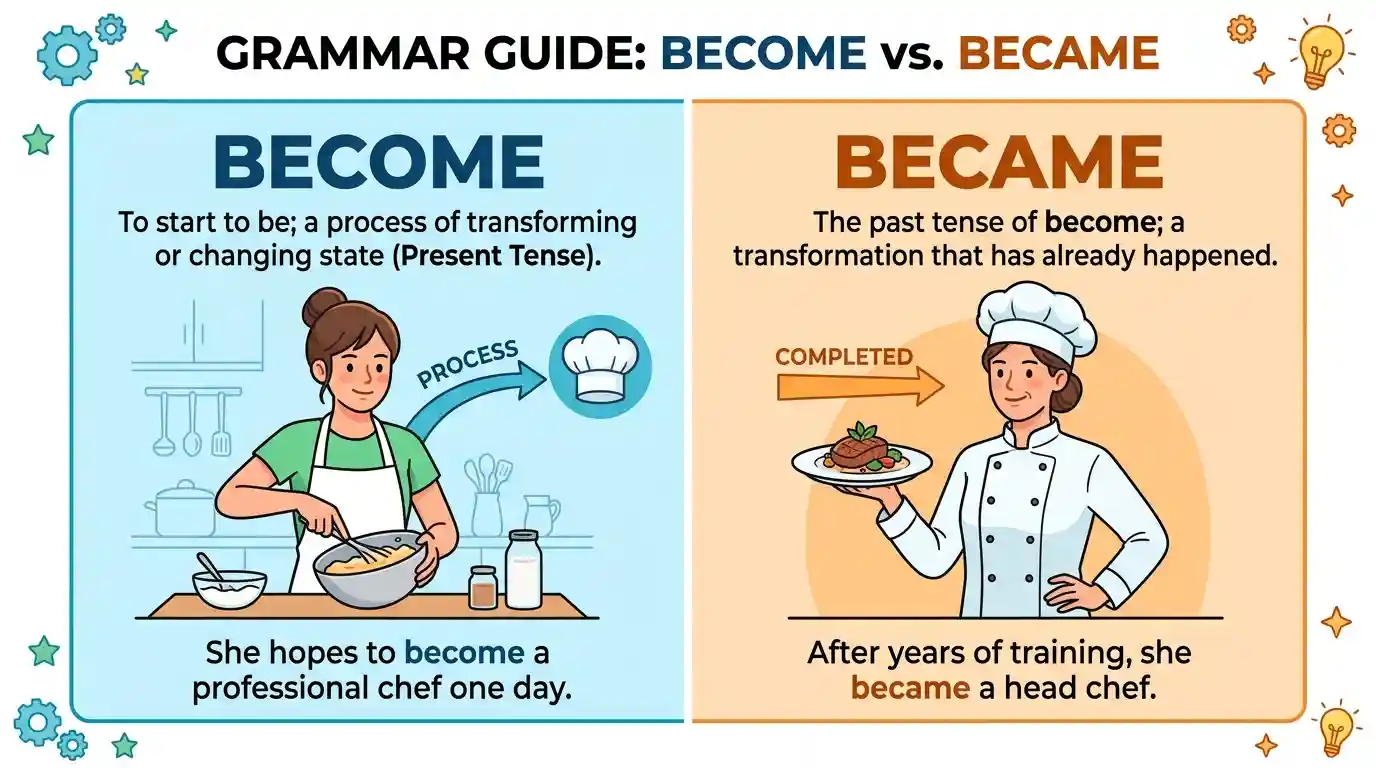
Become vs Became: How to Use Each Word Correctly

Imagine writing, “She became tired after the hike,” and then wondering whether “She become tired” might work too. The confusion usually comes from the fact that become and became are forms of the same verb, but they do different grammatical jobs. Understanding become vs became is mainly about recognizing the tense and the verb structure around it.
Quick Answer
Become vs became comes down to verb form and tense. Become is the base form, used after modal verbs, to-infinitives, and certain auxiliary structures, while became is the simple past form used for a completed change in the past.
Become vs Became: What Each Term Means
The two words come from the same verb, but their forms signal different grammatical situations. To understand become vs became, look at what appears before the verb and when the change happens.
Become
Become is the base form of the verb. It can describe a general possibility or future-oriented situation after words such as will, can, may, or might, and it also appears after to: “to become.” It is also the past participle form in the sequence “have become,” although the form itself remains become.
Became
Became is the simple past form of become. It describes a change that happened at a definite or understood point in the past: “The small shop became popular after the renovation.” It does not normally follow modal verbs or “to.”
The Core Rule, Explained Once
Become vs became is easiest to understand when you identify the grammatical structure first rather than choosing the word by sound. Use became when the verb itself carries simple past tense. Use become when another word carries the tense or when the infinitive/base form is required.
After a modal verb, the base form follows: “The plan might become expensive.” The modal might carries the grammatical meaning, so become stays in its base form. The same pattern appears with will, would, can, could, should, and may.
After to, use become: “He hopes to become a pilot.” Here, to introduces an infinitive, so became would be incorrect.
With have, has, or had, use become because the construction needs the past participle: “They have become close friends.” This is an important distinction because become is not limited to present or future meaning; its grammatical role depends on the structure around it.
When you are simply describing a completed past change without an auxiliary, use became: “The room became quiet when the teacher arrived.” The past tense sits directly on became.
Examples in Context
These become vs became examples move through different real-life settings so you can see how the form changes with the surrounding grammar.
- Work: After years of training, Maya became a project manager.
- Travel: The mountain road can become dangerous after sunset.
- Technology: The old laptop became unreliable during the final semester.
- Relationships: They hope to become better listeners.
- Shopping: The jacket became cheaper during the weekend sale.
- Education: A student may become more confident with regular practice.
- Weather: The pavement became slippery after the sudden storm.
- Career: He will become eligible for the position next year.
- Community: The quiet café has become a popular meeting place.
- Personal goals: Lena became more patient after working with young children.
Common Mistakes
Become vs became errors usually happen when writers overlook the auxiliary or infinitive that controls the verb form. These four patterns are especially worth watching.
- Wrong: “She will became the team leader.”
Right: “She will become the team leader.”
Reason: will is followed by the base form. - Wrong: “He wants to became a chef.”
Right: “He wants to become a chef.”
Reason: to introduces the infinitive. - Wrong: “The neighborhood become quieter last winter.”
Right: “The neighborhood became quieter last winter.”
Reason: a simple past statement needs the past form. - Wrong: “They have became close.”
Right: “They have become close.”
Reason: have requires the past participle, which is become.
Tricky or Edge Cases
A few structures can make the choice less obvious, especially because become has more than one grammatical role. These cases are not exceptions to the main rule; they simply show why looking at the entire verb phrase matters.
One useful contrast is “had become” versus “became.” “By midnight, the streets had become empty” uses the past perfect because the change happened before another past event or reference point. “By midnight, the streets became empty” uses the simple past and presents the change as a past event without the same past-perfect relationship.
Another point is that become has an unusual set of forms: become, became, become. The first and third forms look identical, but they are not interchangeable. In “She has become calmer,” become is a past participle; in “She will become calmer,” it is the base form.
How to Remember Become vs Became
Think of became as the form that carries past tense by itself. If another verb or structure is already doing the grammatical work—such as will, can, might, have, has, had, or to—look for become instead. A quick mental test is to remove the surrounding word: if the sentence needs a standalone past-tense verb, became may be the right choice.
Which Is More Correct or More Common?
Become vs became is a genuine grammar distinction, not a difference between formal and informal English. Neither word is universally “more correct”; each is correct in the grammatical environment that requires it.
In everyday English, became appears often when people narrate completed changes: “The child became restless,” “The weather became colder,” or “The store became crowded.” Become is equally common, but it frequently appears inside larger verb phrases, especially with modals, infinitives, and perfect constructions.
The most common mistake is not choosing a less natural word but putting the right word in the wrong structure. For example, “will became” and “to became” sound wrong because English grammar requires the base form after those structures. Likewise, “has became” fails because the perfect construction needs the past participle.
Quick Reference Table
Use this table as a fast way to check which form belongs in a sentence.
| Structure | Correct Form | Example |
| Simple past | became | The water became cloudy. |
| After will | become | The water will become clear. |
| After a modal | become | The water might become cloudy. |
| After to | become | The water needs to become cleaner. |
| After have/has | become | The water has become warmer. |
| After had | become | The water had become unusually warm. |
FAQs
These questions cover the quick usage issues that often come up when choosing between the two forms.
Is become present tense?
Become is the base form rather than a simple present form in every context. It is used as the present-tense form with I, you, we, and they, and it also appears after modals and in infinitives.
Is became past tense?
Yes. Became is the simple past form of become and is used when a change is presented as a past event.
Should I say “will become” or “will became”?
Say “will become.” After will, English requires the base form of the main verb.
Is “have became” correct?
No. The correct phrase is “have become,” because have requires the past participle in a perfect construction.
Can become refer to the past?
Yes. In “has become” or “had become,” the word refers to a change connected to the past while functioning as a past participle.
Conclusion
Learning become vs became becomes much easier once you stop treating them as competing words and start seeing them as different forms of the same verb. Became carries simple past tense on its own, while become appears as the base form after structures such as will, can, and to, and as the past participle after have, has, or had. This distinction helps you avoid common errors such as “will became” and “has became.” With a quick look at the words surrounding the verb, you can choose the correct form confidently in everyday writing and speech.
Tense confusion doesn’t stop here — what happen or what happened settles another common mix-up.
[…] vs inpatient — one letter, two completely different meanings. Still wrestling with past tenses? Become vs became covers another tricky pair. Get the tense right and the question practically writes […]