Don't miss our holiday offer - up to 50% OFF!
Unaccessible vs Inaccessible: Simple English Grammar Rules

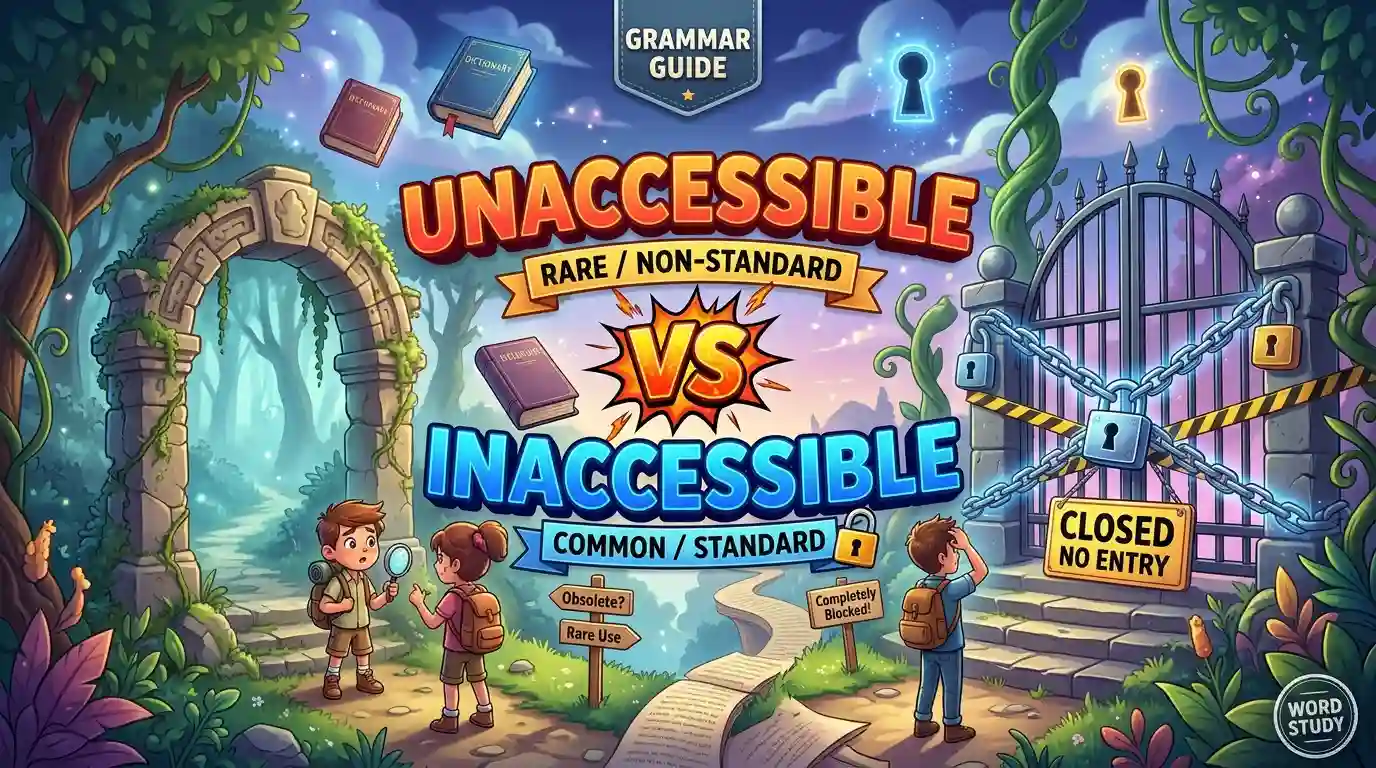
Have you ever tried to describe a place, website, or service that you cannot reach? You might wonder whether to call it unaccessible or inaccessible. Both words may look correct, but English usage has a clear preference. Understanding unaccessible vs inaccessible will help you choose the right word, avoid common writing mistakes, and communicate more naturally.
Quick Answer
Inaccessible is the correct and widely accepted word for something that cannot be reached, entered, used, or understood. Although unaccessible appears occasionally, it is uncommon and generally considered nonstandard. For everyday writing, professional communication, and academic work, always choose inaccessible.
What Each Term Means
Both terms are linked to the idea of access. However, their meanings and acceptance in modern English are not equal. Let’s look at each word separately to understand how writers use them.
What Does Inaccessible Mean?
Inaccessible is an adjective that describes something that cannot be reached, entered, obtained, used, or understood easily.
It often refers to physical places, digital services, information, and opportunities. The word can also describe something difficult for ordinary people to understand.
Here are a few examples:
- The mountain village became inaccessible after heavy snowfall.
- The online library is currently inaccessible to students.
- Some scientific papers contain inaccessible language.
- The private beach is inaccessible to the general public.
In each case, the word describes a barrier that prevents someone from reaching or using something.
What Does Unaccessible Mean?
Unaccessible is an uncommon variant that some people use with the same intended meaning as inaccessible. However, it is not the standard choice in modern English.
You may occasionally find this spelling in older texts, informal writing, or material written by people who are unfamiliar with standard usage.
For example:
- The remote cabin was described as unaccessible.
- The old website remained unaccessible to visitors.
Although readers may understand these sentences, inaccessible would be the better choice in both cases.
Unaccessible vs Inaccessible: The Core Rule, Explained Once
The main difference between these words is not a change in meaning. It is a difference in standard usage and acceptance. English has several prefixes that create negative meanings, including un- and in-. However, these prefixes cannot always be exchanged freely.
The prefix in- often means “not” or “without.” When added to accessible, it creates inaccessible, meaning not accessible. This is the established form recognized in standard modern English.
The prefix un- also expresses a negative meaning. However, adding it to a word does not automatically create a standard English adjective. Some combinations sound natural, such as unhappy and unfair, while others are uncommon or nonstandard.
This is why unaccessible is not generally recommended, even though its meaning seems logical.
Consider these related words:
| Standard Word | Meaning |
| Inactive | Not active |
| Incomplete | Not complete |
| Inaccurate | Not accurate |
| Inadequate | Not sufficient |
| Inaccessible | Not accessible |
Notice that English often preserves particular prefix combinations through established usage. Learning these forms is more reliable than creating new words by attaching a negative prefix.
Another useful point is that inaccessible does not always mean physically impossible to reach. It can also describe something that is restricted, difficult to obtain, or beyond someone’s understanding.
For example, a complicated legal document might be inaccessible to readers without legal knowledge. The document exists, but its language creates a barrier.
Examples in Context
The following examples show how unaccessible vs inaccessible works across different real-life situations, including technology, education, travel, business, and everyday communication.
- Travel: Heavy rain made the forest road inaccessible to local drivers.
- Technology: The banking application became inaccessible during scheduled maintenance.
- Education: Several research journals are inaccessible to students without paid subscriptions.
- Workplace: The manager’s office is inaccessible without an appointment.
- Shopping: The upper shelf was inaccessible to the young child.
- Weather: Strong winds left the coastal airport inaccessible for several hours.
- Business: The company provides affordable services to customers who previously found professional support inaccessible.
- Relationships: His distant attitude made him seem emotionally inaccessible to his friends.
- Technology: The software’s advanced settings are inaccessible to users with limited permissions.
- Public services: The damaged bridge made the village clinic inaccessible to emergency vehicles.
These examples demonstrate that the same adjective works in many situations. The barrier may be physical, technical, financial, emotional, or related to knowledge.
Common Mistakes
Writers sometimes choose the wrong spelling because both forms seem reasonable. Understanding unaccessible vs inaccessible can help you avoid these five common mistakes.
- Using an uncommon spelling in formal writing
- Wrong: The building is unaccessible to visitors.
- Right: The building is inaccessible to visitors.
- Reason: Inaccessible is the established standard form.
- Assuming both prefixes work with every adjective
- Wrong: The information is unaccessible.
- Right: The information is inaccessible.
- Reason: Negative prefixes follow established word patterns rather than one universal rule.
- Using inaccessible only for physical places
- Wrong: The difficult instructions cannot be inaccessible.
- Right: The instructions are inaccessible to beginners.
- Reason: The adjective can describe information that is difficult to understand.
- Thinking inaccessible always means permanently unavailable
- Wrong: The server is inaccessible, so it will never work again.
- Right: The server is inaccessible while technicians complete repairs.
- Reason: Access can be temporarily restricted.
- Changing the spelling in different parts of one document
- Wrong: The first paragraph uses inaccessible, while the second uses unaccessible.
- Right: Use inaccessible consistently throughout the document.
- Reason: Consistent spelling makes professional writing clearer.
Tricky or Edge Cases
Although the preferred spelling is straightforward, a few related expressions can create confusion. Knowing these differences will help you use the adjective more precisely.
Unaccessible vs Inaccessible
These words are related, but they do not always mean the same thing.
- Inaccessible: Something cannot be reached, entered, or accessed.
- Unavailable: Something cannot be obtained or used at a particular time.
Example: The online course is unavailable because the provider has discontinued it. By contrast, a course may be inaccessible because users cannot log in.
Inaccessible vs. Unreachable
Both words can describe something that cannot be reached. However, unreachable is often used for people, destinations, or communication.
Example: The customer was unreachable by phone, while the office building was inaccessible because of road construction.
Inaccessible vs. incomprehensible
These adjectives can overlap when discussing difficult information, but their meanings differ.
Inaccessible means difficult to access or understand. Incomprehensible means impossible or extremely difficult to understand.
For example, a research paper may be inaccessible because it requires a paid subscription. Its technical language may also be incomprehensible to beginners.
How to Remember It
A simple way to remember unaccessible vs inaccessible is to connect inaccessible with the familiar word access.
When something cannot be accessed, entered, reached, or understood, use inaccessible.
You can also remember this short sentence:
“Access is not possible, so the place is inaccessible.”
Keep this spelling in mind whenever you write emails, reports, school assignments, or website content. It will help you avoid an unnecessary spelling mistake.
Which Is More Correct or More Common?
Inaccessible is clearly the more correct and common choice in contemporary standard English. It is the form used in established dictionaries, professional publications, academic writing, and everyday communication.
Unaccessible is not completely unknown. It has appeared in some historical and less formal usage. However, its limited use does not make it an equally accepted alternative.
This is mainly a matter of standard word formation and established usage rather than a meaningful difference in definition. Both forms may communicate the idea of something being difficult or impossible to access, but readers generally expect inaccessible.
If you are writing an article, preparing a business report, editing a website, or completing an academic assignment, choose inaccessible. There is little reason to use the less familiar variant when the standard form is clear and widely understood.
Quick Reference Table
This table gives you a simple comparison to help you remember the correct spelling and meaning.
| Feature | Inaccessible | Unaccessible |
| Part of speech | Adjective | Intended adjective |
| Meaning | Not accessible | Not accessible |
| Standard usage | Yes | Generally nonstandard |
| Common in modern English | Yes | No |
| Suitable for formal writing | Yes | Not recommended |
| Physical access | Yes | Intended meaning |
| Digital access | Yes | Intended meaning |
| Best choice | Recommended | Avoid |
The key takeaway is simple: use inaccessible whenever you want to describe something that cannot be reached, entered, obtained, or understood.
FAQs
1. Is unaccessible a real English word?
Unaccessible has appeared in English, but it is uncommon and generally considered nonstandard in modern usage. Inaccessible is the preferred spelling.
2. Is inaccessible the correct spelling?
Yes. Inaccessible is the standard and widely accepted spelling. Use it in professional emails, academic papers, articles, and everyday writing.
3. What is the difference between unaccessible vs inaccessible?
Both forms are intended to describe something that cannot be accessed. However, inaccessible is the established standard form, while unaccessible is an uncommon variant.
4. What is the opposite of inaccessible?
The most direct opposite is accessible. It describes something that can be reached, entered, obtained, or understood without significant difficulty.
5. Can inaccessible describe a person?
Yes. It can describe someone difficult to approach, communicate with, or connect with emotionally. For example, “The director seemed inaccessible to new employees.”
Conclusion
Understanding unaccessible vs inaccessible is a simple way to improve your English spelling and writing skills. Although both forms may appear to express the same idea, inaccessible is the established and widely accepted choice in modern English. It works for physical locations, websites, information, services, and even emotional connections.
Whenever you need to describe something that cannot be reached, entered, or understood, choose inaccessible. Learning small spelling distinctions like this can make your writing clearer, more natural, and more professional. Keep practicing with real examples, and choosing the correct word will soon become second nature.
[…] these two words look similar, they do not have the same status in modern English. Understanding their meanings and […]
[…] main difference between goodbye vs good bye comes down to modern spelling conventions and word development. The original […]