Don't miss our holiday offer - up to 50% OFF!

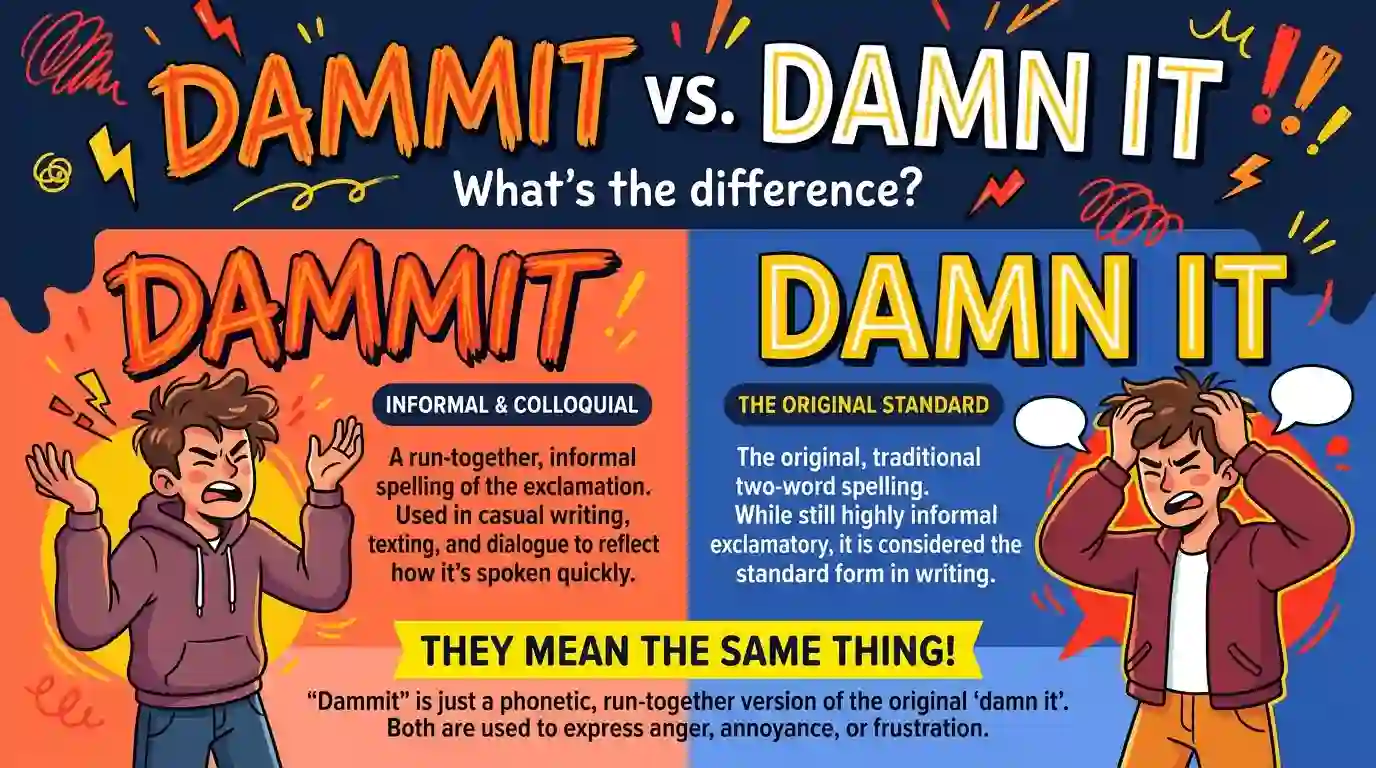
Dammit vs Damn It: Simple Rules to Know the Difference

Have you ever typed an angry message, stopped to question your spelling, and wondered whether to write “dammit” or “damn it”? Both forms appear in everyday English, especially when someone feels frustrated, surprised, or disappointed. The difference between dammit vs damn it comes down to spelling, usage, and writing style rather than a major difference in meaning. Understanding when to use each form can help you write more naturally, whether you are sending a casual text, writing dialogue, or editing an informal blog post.
Quick Answer
Both dammit and damn it express frustration, anger, or disappointment, and they are generally interchangeable in informal English. “Damn it” is the traditional two-word expression, while “dammit” is a widely recognized one-word spelling that reflects how the phrase sounds in everyday speech. Neither form is appropriate for every audience because both are considered mild profanity.
What Each Term Means
Although the spellings look different, both forms communicate a similar emotional reaction. The choice usually depends on personal preference, tone, and the conventions of the writing you are producing.
What Does “Dammit” Mean?
“Dammit” is an informal interjection used to express irritation, anger, impatience, or disappointment. It often appears when something goes wrong or when a person wants to emphasize a strong reaction.
For example, someone might say, “Dammit, I forgot to save the document!” The word captures an immediate emotional response without requiring a longer explanation.
The one-word spelling is common in casual messages, dialogue, online conversations, and informal creative writing. Because it resembles the pronunciation of the expression, it can make dialogue feel spontaneous and conversational.
What Does “Damn It” Mean?
“Damn it” is the traditional two-word form of the expression. The word “damn” conveys condemnation or frustration, while “it” refers to the situation, object, or circumstance causing the speaker’s reaction.
Consider someone who discovers that a train has been canceled: “Damn it, now I’ll miss the connection.” The expression communicates annoyance at an unwanted outcome.
Writers also use “damn it” in dialogue, personal correspondence, and informal prose. Although the two-word spelling can look more conventional, it is not automatically more formal or more polite than “dammit.”
The Core Rule, Explained Once
The main distinction in dammit vs damn it is orthographic: one spelling combines the expression into a single word, while the other preserves two separate words. Both communicate essentially the same exclamation, so you do not need to learn two different grammatical meanings.
“Damn it” consists of the word “damn” followed by the pronoun “it.” In ordinary grammatical contexts, these words can function separately, as in “I didn’t mean to damn it,” although that sentence has a different meaning from the familiar exclamation. In the exclamatory phrase, the expression has developed a conventional use that communicates an emotional reaction rather than a literal statement about condemning something.
“Dammit,” by contrast, functions as a single interjection. It does not require you to analyze a separate pronoun when you use it as an expression of frustration.
Neither spelling changes the basic emotional message. The choice is primarily about conventional spelling and writing style, not tense, subject-verb agreement, or sentence structure.
Punctuation depends on how the expression fits into the sentence. You can place a comma after it when it introduces a complete statement, use an exclamation mark for stronger emotion, or include it in dialogue with punctuation appropriate to the surrounding sentence.
For example:
- “Dammit, the package arrived late.”
- “Damn it! I left my keys inside.”
- “Oh, dammit, I missed the notification.”
These sentences use different punctuation to convey different rhythms and levels of frustration. The spelling alone does not determine the intensity of the emotion.
Examples in Context
The following dammit vs damn it examples cover different everyday situations, showing how both spellings work in conversation, messages, and informal writing.
- Text message: “Dammit, my phone battery died before I could reply.”
- Travel: “Damn it, we took the wrong exit.”
- Work: “Dammit, I sent the unfinished report.”
- Shopping: “Damn it, the store is already closed.”
- School: “Dammit, I studied the wrong chapter.”
- Technology: “Damn it! The software crashed again.”
- Relationships: “Dammit, I should have listened to your advice.”
- Weather: “Damn it, the rain started just before our picnic.”
- Cooking: “Dammit, I added too much salt.”
- Sports: “Damn it, that shot nearly went in!”
Each example communicates frustration without changing the underlying meaning of the expression. The variation in spelling simply reflects different writing preferences.
Common Mistakes
When choosing between these spellings, writers sometimes confuse spelling conventions, punctuation, and levels of formality. These are the mistakes worth avoiding.
- Treating “dammit” as an entirely different expression.
Incorrect assumption: “Dammit” means anger, but “damn it” means disappointment.
Correct understanding: Both forms can express anger, frustration, or disappointment; context determines the precise emotion. - Assuming “dammit” is always a spelling error.
Incorrect: “Dammit is never acceptable English.”
Correct: “Dammit” is an established informal spelling, although “damn it” remains a conventional alternative. - Believing “damn it” is automatically more polite.
Incorrect assumption: “Damn it” is suitable for every professional situation.
Correct understanding: Both expressions contain profanity, so neither is ideal when a neutral or courteous tone is necessary. - Using the expression in formal writing without considering the audience.
Incorrect: “Dammit, the quarterly figures require another review,” in a formal business report.
Better: “Unfortunately, the quarterly figures require another review.”
A neutral alternative keeps the message professional without weakening its meaning. - Adding unnecessary punctuation.
Incorrect: “Damn, it! The printer stopped.”
Better: “Damn it! The printer stopped.”
Keep the expression together when using the conventional exclamation, unless the surrounding sentence gives the words a different grammatical function.
Tricky or Edge Cases
Most uses are straightforward, but a few situations deserve closer attention because spelling, grammar, and tone can overlap.
One tricky case occurs when “damn” is used as a verb rather than as part of an exclamation. In “Some critics damn the proposal,” the word is a verb meaning to condemn or strongly criticize. In “Damn it, the proposal failed,” the phrase expresses frustration instead. The intended meaning determines whether the words form an ordinary grammatical construction or a conventional exclamation.
Another situation arises in fiction. An author might choose “dammit” for a character whose dialogue is quick and impulsive, while another character might say “damn it” to match the author’s preferred spelling style. Either choice can work, provided the dialogue remains consistent with the character and the overall tone.
Finally, some editors and style guides may prefer particular spellings in published work. If you are writing for a publication, follow its style guide rather than assuming one form is universally required.
How to Remember It
A simple way to remember dammit vs damn it is to think of the difference as one word versus two words, not one meaning versus another. Choose “dammit” when you prefer a compact, conversational spelling, and choose “damn it” when you want the traditional two-word form. If you are unsure, “damn it” is a practical default for general informal writing. For professional or sensitive situations, consider replacing either form with “unfortunately,” “that’s frustrating,” or “what a shame.”
Which Is More Correct or More Common?
Neither spelling is universally correct to the exclusion of the other. “Damn it” preserves the two-word structure of the traditional expression, while “dammit” is an established informal spelling recognized in modern English usage. Their meanings overlap substantially, and both appear in written dialogue and everyday communication.
The more suitable choice depends on your purpose. In a casual conversation, a text message, or a piece of informal fiction, either form can sound natural. In edited writing, the publication’s style preferences may determine which spelling to use.
It is also worth separating correctness from appropriateness. A spelling can be accepted in informal English while still being unsuitable for a particular audience. Since both expressions are mildly profane, a workplace email, academic paper, or formal announcement will usually benefit from more neutral wording.
Quick Reference Table
Use this table to compare the spelling, meaning, and most suitable contexts at a glance.
| Feature | Dammit | Damn It |
| Spelling | One word | Two words |
| General meaning | Frustration, anger, or disappointment | Frustration, anger, or disappointment |
| Grammatical use | Informal interjection | Conventional exclamation |
| Tone | Casual and conversational | Casual and conversational |
| Typical contexts | Texts, dialogue, informal posts | Dialogue, messages, informal prose |
| Formal suitability | Generally unsuitable | Generally unsuitable |
| Is it acceptable? | Yes, in informal usage | Yes, in informal usage |
FAQs
These frequently asked questions address spelling, grammar, pronunciation, and the situations in which either expression is appropriate.
Is “dammit” one word or two?
“Dammit” is written as one word. It is an established informal spelling of the exclamation commonly written as “damn it.”
Is “damn it” grammatically correct?
Yes. “Damn it” is a conventional two-word expression used to communicate frustration or anger. It is widely understood in informal speech and writing.
Do “dammit” and “damn it” mean the same thing?
Generally, yes. Both expressions communicate similar feelings, although the exact emotion depends on the situation, punctuation, and tone.
Which spelling should I use in an essay?
For a formal academic essay, it is usually better to avoid both expressions and use a neutral alternative. If you are analyzing dialogue or quoting a source, preserve the original wording when appropriate.
Is “dammit” considered a swear word?
Yes, it is generally considered mild profanity because it derives from “damn.” The strength of the expression varies with context, audience, and cultural expectations.
Conclusion
Understanding dammit vs damn it is easier when you focus on spelling and context rather than searching for a major difference in meaning. Both forms express frustration, anger, or disappointment, and neither is automatically more correct in every situation. “Dammit” offers a compact, informal spelling, while “damn it” preserves the traditional two-word form. Before choosing either one, consider your audience, the tone of your writing, and any style rules you need to follow. With that simple approach, you can make a confident choice and communicate your intended emotion without distracting readers from your message.
Spelling it right matters — disfunction vs dysfunction is another common misspelling, explained.