Don't miss our holiday offer - up to 50% OFF!

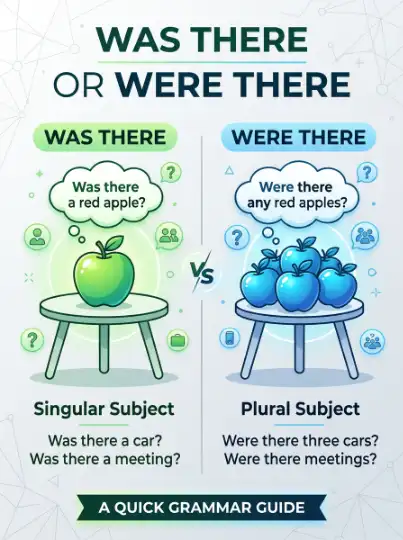
Was There or Were There? Easy Grammar Rules and Examples

If you are writing a question about something that existed, appeared, or happened in a particular place, you may pause over the verb: “Was there a problem?” or “Were there problems?” The choice can feel small, but it depends on the noun that follows there. Understanding was there or were there makes questions and statements sound natural and grammatically precise.
Quick Answer
Was there or were there is decided by the noun that comes after there. Use “was there” with a singular noun or an uncountable noun, and use “were there” with a plural noun.
What Each Term Means
When considering was there or were there, the two forms express the same basic idea: asking or stating whether something existed, occurred, or was present. The difference comes from subject-verb agreement, not from a change in meaning between was and were themselves.
Was there
“Was there” is used when the noun that follows is singular or uncountable. For example, “Was there a delay?” asks about one delay, while “Was there enough coffee?” uses an uncountable noun.
Were there
“Were there” is used when the noun that follows is plural. “Were there any delays?” refers to multiple possible delays, while “Were there enough chairs?” refers to more than one chair.
The Core Rule, Explained Once
The central rule behind was there or were there is simple: the verb agrees with the noun whose existence or presence is being discussed. In a question, there comes before the noun, but that unusual word order does not change the agreement. A singular countable noun takes was; a plural countable noun takes were; an uncountable noun normally takes was.
Compare these patterns: “There was a message,” “There were three messages,” “There was some confusion,” and “There were several questions.” The same agreement remains when the sentence becomes a question: “Was there a message?”, “Were there three messages?”, “Was there some confusion?”, and “Were there several questions?”
This also explains why the words after there matter more than nearby nouns. In “Was there a box of old letters?” the subject is box, which is singular, so was is correct. In “Were there boxes of old letters?” boxes is plural, so were is needed. Do not let a following phrase such as “of old letters” distract you from the main noun.
Examples in Context
The was there or were there examples below move through different real-life settings so you can see how the choice works in natural sentences.
- Travel: Was there a seat available near the window?
- Workplace: Were there any updates from the design team?
- Shopping: Was there enough stock for everyone?
- School: Were there several students absent today?
- Weather: Was there heavy rain overnight?
- Technology: Were there any problems with the software update?
- Home: Was there a strange noise downstairs?
- Restaurant: Were there enough tables for the larger group?
- Relationships: Was there a misunderstanding between them?
- Events: Were there fireworks after the concert?
Common Mistakes
A few errors appear repeatedly because the noun comes after the verb. These quick wrong-and-right pairs show what to watch for.
- Wrong: “Were there a problem with the printer?”
Right: “Was there a problem with the printer?”
Reason: Problem is singular. - Wrong: “Was there several reasons for the change?”
Right: “Were there several reasons for the change?”
Reason: Reasons is plural. - Wrong: “Were there enough information in the report?”
Right: “Was there enough information in the report?”
Reason: Information is normally uncountable in English. - Wrong: “Was there two tickets left?”
Right: “Were there two tickets left?”
Reason: Tickets is plural. - Wrong: “Were there much traffic on the road?”
Right: “Was there much traffic on the road?”
Reason: Traffic is an uncountable noun.
Tricky or Edge Cases
Most sentences follow the basic agreement rule, but a few situations can make the correct form less obvious. These cases are especially useful when a sentence contains measurements, collective expressions, or an intervening phrase.
With measurements and amounts
Amounts can behave differently depending on whether the speaker treats them as one total amount or as separate countable units. “Was there five minutes left?” is common in informal speech when five minutes is viewed as one remaining period, while “Were there five minutes between the two calls?” treats the minutes as separate units. In careful writing, choose the form that matches the grammatical structure and intended meaning.
With a phrase between there and the noun
A long phrase can hide the noun that controls the verb. In “Were there, among the documents on the desk, several missing pages?” the key noun is pages. When editing, mentally remove the extra phrase and check the sentence as “Were there several missing pages?”
With uncountable nouns
Words such as advice, furniture, equipment, information, and traffic usually take singular agreement in standard English. That means you write “Was there any useful advice?” rather than treating advice as a plural noun. If you need a plural form, use a countable expression such as “pieces of advice.”
How to Remember It
A useful way to remember was there or were there is to ignore there for a moment and look directly at the noun that follows. If you could say “one problem,” think was; if you could say “two problems,” think were. For uncountable nouns such as information or traffic, use was in standard English. When in doubt, mentally rewrite the question as a statement: “There was a problem” or “There were problems.”
Which Is More Correct or More Common?
When deciding between was there or were there, neither form is generally more correct than the other. Both are standard constructions; the correct choice depends on whether the noun being introduced is singular, uncountable, or plural.
In everyday English, both forms are extremely common because speakers regularly ask about the existence or presence of people, objects, events, and conditions. The distinction is grammatical rather than a matter of formality. You may encounter either construction in casual conversation, professional writing, academic prose, and ordinary questions.
One useful point is that informal speech sometimes contains agreement patterns that differ from edited standard English, especially with quantities and measurements. Those patterns do not change the basic rule taught in standard grammar: identify the noun being introduced and make the verb agree with it.
Quick Reference Table
The table below gives a compact way to check the form before you use it in a sentence.
| Noun type | Correct form | Example |
| Singular countable noun | Was there | Was there a reason? |
| Plural countable noun | Were there | Were there several reasons? |
| Uncountable noun | Was there | Was there enough evidence? |
| Singular noun with an intervening phrase | Was there | Was there, despite the delay, a solution? |
| Plural noun with an intervening phrase | Were there | Were there, despite the delay, several solutions? |
FAQs
These questions cover common search-style points that often cause hesitation when choosing between the two forms.
Is “was there” singular?
Yes. “Was there” normally introduces a singular countable noun or an uncountable noun, such as “Was there a mistake?” or “Was there enough water?”
Is “were there” plural?
Yes. “Were there” normally introduces a plural noun, as in “Were there any mistakes?” or “Were there enough bottles?”
Do you say “was there” or “were there” with people?
Use the form that matches the number of people. “Was there one person at the entrance?” is singular, while “Were there several people at the entrance?” is plural.
Do you say “was there any” or “were there any”?
It depends on the noun after any. Use “was there any” with an uncountable or singular noun, such as “Was there any information?” Use “were there any” with a plural noun, such as “Were there any messages?”
Is “were there” always correct for more than one thing?
For ordinary plural nouns, yes. If the noun refers to more than one separate item, person, or event, “were there” is the standard choice.
Conclusion
Choosing was there or were there becomes much easier once you stop focusing on the word there and identify the noun that follows it. Singular and uncountable nouns generally take was, while plural nouns take were. This small agreement check can prevent a surprisingly common grammar mistake and make questions sound more polished.
With a little practice, you can recognize the correct form quickly in conversation, editing, and formal writing. Whenever the choice feels uncertain, find the noun after there, decide whether it is singular, plural, or uncountable, and let that noun guide your verb choice.
Verb forms in questions trip up even confident writers — what happen or what happened is another to master.