Don't miss our holiday offer - up to 50% OFF!

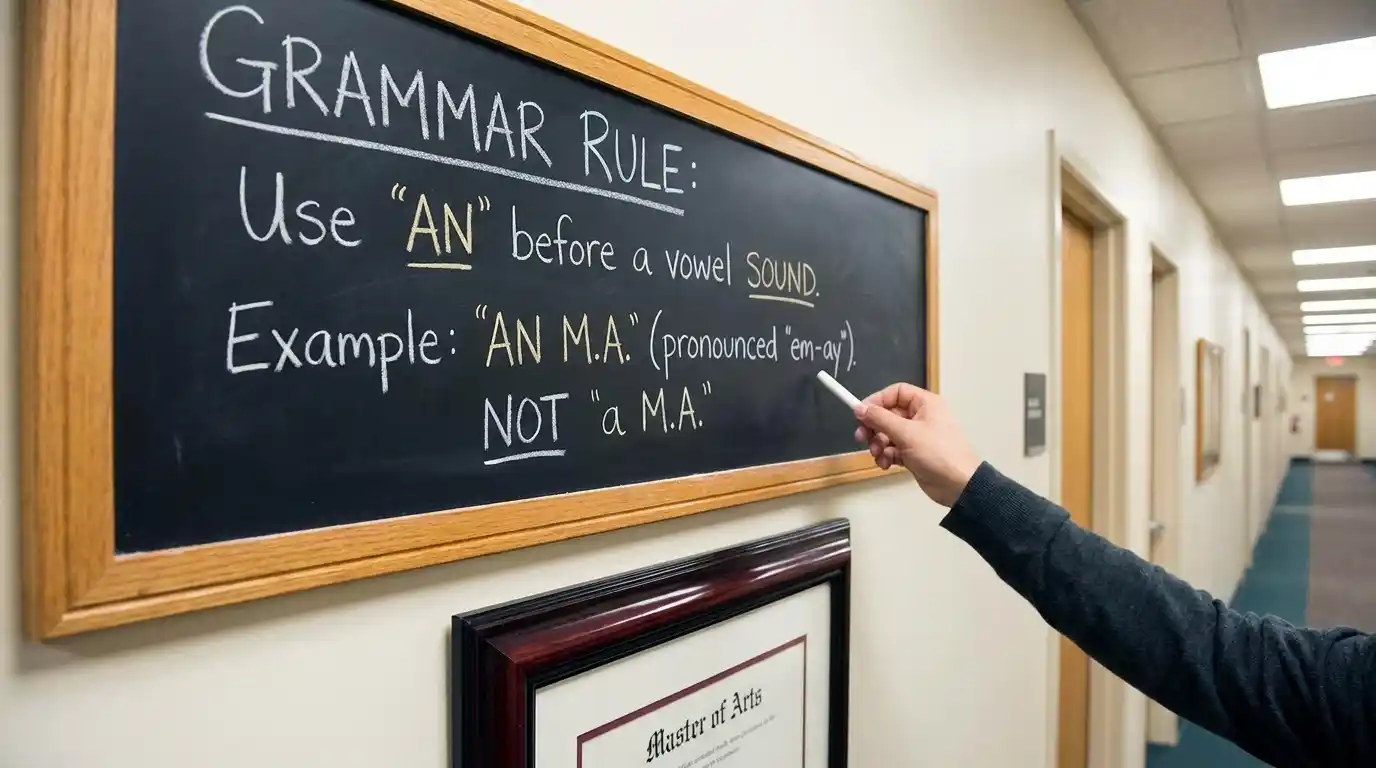
A Ma or An Ma: Simple Rules to Get It Right Every Time

When you are describing a degree, “MA” can create a tiny grammar question: should you write “a MA” or “an MA”? The answer becomes much easier once you focus on pronunciation rather than the letter itself. If you have ever searched for a ma or an ma while writing a résumé, school application, or professional bio, you are dealing with a standard article-choice question.
Quick Answer
Use “an MA” when MA is pronounced with the letter-name sound “em,” because that begins with a vowel sound. For the same reason, a ma or an ma is settled by sound: “an MA” is the standard form when you mean a Master of Arts degree.
What Each Term Means
The choice becomes clearer when you separate the article from the abbreviation. For a ma or an ma, the important difference is not the written letter but the way the abbreviation is pronounced.
A MA
“A MA” is generally not the standard choice when MA is pronounced “em-ay.” The initial spoken sound is a vowel sound, so the article should be “an.”
An MA
“An MA” is the normal form when MA is read aloud as “em-ay.” You might see it in sentences such as “She earned an MA in history” or “He is completing an MA in linguistics.”
The Core Rule, Explained Once
The key to an MA or an ma is the sound that comes immediately after the article, not the written letter that appears first. Use “a” before a consonant sound and “an” before a vowel sound. Because the abbreviation MA is normally pronounced “em-ay,” its first spoken sound is a vowel sound, so “an” fits naturally.
This is the same principle used with many initialisms. We say “an MBA” because MBA begins with the spoken sound “em,” while we say “a BA” because BA begins with the sound “bee.” The spelling may look unusual, but the spoken form controls the article.
The rule also explains why changing the full phrase can change the article. “Master of Arts” begins with the consonant sound /m/, so “a Master of Arts degree” is correct. When the abbreviation is spoken as “em-ay,” however, “an MA” is appropriate.
Examples in Context
These examples for an MA or an MA cover education, careers, applications, and everyday writing so you can see how the choice works in different real-life settings.
- University bio: She holds an MA in English literature.
- Résumé: Completed an MA in environmental studies in 2025.
- Job interview: I decided to pursue an MA after earning my bachelor’s degree.
- Academic profile: Daniel is working toward an MA in history.
- Application form: The program requires applicants to have an MA or equivalent qualification.
- Professional website: Our editor has an MA in communications.
- Conversation: She mentioned that she plans to earn an MA next year.
- School brochure: Students with an MA may apply for the advanced teaching track.
- Academic writing: The researcher completed an MA before beginning doctoral study.
- Career discussion: Her MA helped her qualify for the position.
Common Mistakes
A few errors appear repeatedly because writers look at the spelling instead of hearing the abbreviation. When checking a ma or an ma, these are the mistakes most worth watching for.
- Wrong: “She earned a MA in psychology.”
Right: “She earned an MA in psychology.”
Reason: MA is pronounced “em-ay,” beginning with a vowel sound. - Wrong: “He has an Master of Arts degree.”
Right: “He has a Master of Arts degree.”
Reason: The full phrase begins with the consonant sound /m/. - Wrong: “I completed an MA” when the writer means “my MA.”
Right: “I completed my MA.”
Reason: A possessive determiner such as “my” already fills the determiner position. - Wrong: “She is studying for a MA.”
Right: “She is studying for an MA.”
Reason: The abbreviation is still pronounced “em-ay” regardless of the surrounding sentence. - Wrong: “He earned an M.A.” is treated differently from “an MA.”
Right: Both can take “an” when the abbreviation is pronounced “em-ay.”
Reason: Periods in the abbreviation do not change its initial sound.
Tricky or Edge Cases
There are a few situations where the usual pattern needs closer attention, especially when an abbreviation is pronounced differently from its letters. The safest approach is to say the abbreviation aloud before choosing the article.
If a speaker uses “MA” as a word with a different pronunciation in a particular context, the article can follow that actual pronunciation. Likewise, style guides may differ on whether academic abbreviations use periods, but punctuation does not normally change the article choice.
How to Remember It
For an MA or an MA, forget the first written letter for a moment and say the abbreviation aloud. “MA” sounds like “em-ay,” and “em” begins with a vowel sound, so “an MA” is the form to remember. A quick test is to imagine the abbreviation spoken naturally: if you would hear “em,” choose “an.”
Which Is More Correct or More Common?
When discussing a ma or an ma, “an MA” is the standard grammatical choice when MA means Master of Arts and is pronounced “em-ay.” “A MA” is generally considered incorrect in that use because the article does not match the initial sound of the abbreviation.
This is not mainly a difference between American and British English. It is a pronunciation-based article rule that applies broadly to standard English. The main variation you may encounter concerns abbreviation style, such as “MA” versus “M.A.,” rather than the choice between “a” and “an.”
Quick Reference Table
Use this table as a quick way to review the article choice and the reason behind it.
| Form | Correct? | Why |
| an MA | Yes | “MA” begins with the vowel sound “em.” |
| a MA | Usually no | The spoken abbreviation does not begin with a consonant sound. |
| a Master of Arts | Yes | “Master” begins with the consonant sound /m/. |
| an M.A. | Yes | The punctuation does not change the pronunciation. |
| my MA | Yes | “My” already functions as the determiner. |
FAQs
These common questions cover the points writers most often wonder about when using academic abbreviations with indefinite articles.
Is it “a MA” or “an MA”?
It is “an MA” when MA means Master of Arts and is pronounced “em-ay.” The choice follows the vowel sound at the beginning of the spoken abbreviation.
Why do we say “an MA”?
We use “an” because the spoken name of the letter M begins with the vowel sound /ɛ/. The rule is based on pronunciation rather than the visual appearance of the abbreviation.
Is “a Master of Arts” correct?
Yes. The full expression begins with “Master,” which starts with a consonant sound, so “a Master of Arts” is correct.
Should I write “an MA” or “an M.A.”?
Both can take “an” when the abbreviation is pronounced “em-ay.” Whether periods are used is mainly a matter of style or the conventions of a particular institution or publication.
Can I say “an MA degree”?
Yes. “An MA degree” is grammatically fine, although in some contexts simply “an MA” is more concise because the abbreviation already refers to the degree.
Conclusion
The question of a MA or an MA becomes straightforward once you listen to the abbreviation instead of judging it by its first written letter. “MA” is normally pronounced “em-ay,” so “an MA” is the standard choice, while the full phrase takes “a Master of Arts.” This small distinction can make résumés, academic applications, biographies, and professional writing sound polished and natural. Once you remember that English articles follow sounds, not letters on the page, similar abbreviation questions become much easier to solve.