Don't miss our holiday offer - up to 50% OFF!

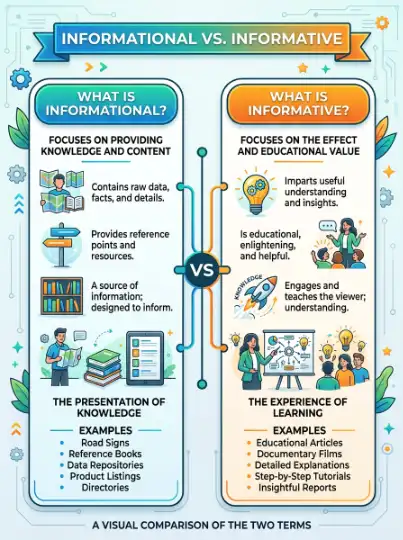
Informational vs. Informative: How Are They Different

Imagine reading a website menu that says “informational brochure” and then seeing a colleague describe the same brochure as “informative.” Both words sound right, but they do not always emphasize the same thing. Understanding informational vs informative becomes easier once you focus on what the word describes: the purpose or nature of information, or the useful effect that information has on the reader.
Quick Answer
Informational usually describes something designed to provide information, especially as a category, purpose, or type of content. Informative describes something that gives useful, interesting, or meaningful knowledge; informational vs informative is therefore a distinction of emphasis rather than a strict grammatical opposition.
What Each Term Means
The two adjectives overlap heavily, but their usual emphasis is slightly different. One often identifies something as being concerned with information, while the other highlights how much useful knowledge it provides.
Informational
Informational commonly means “related to information” or “intended to provide information.” It frequently appears when describing content, materials, pages, resources, or signs whose main function is to explain facts or give guidance.
For example, an informational brochure may explain public services, while an informational website may provide instructions, background details, or practical resources. The word often works as a label for the purpose or type of something.
Informative
Informative means “providing useful or interesting information.” It often describes the experience or quality of a piece of communication: a lecture can be informative, a conversation can be informative, and a documentary can be informative because the audience learns something valuable from it.
The word can also carry a mild positive sense because calling something informative often suggests that it taught you something worthwhile. However, informative does not necessarily mean entertaining; something can be informative even when it is serious, technical, or difficult.
Informational vs Informative: The Core Rule, Explained Once
In informational vs informative, the clearest distinction is between purpose or category and the quality of the information provided. Informational tends to answer “What kind of thing is this?” or “What is it intended to do?” Informative tends to answer “What did I learn from it?” or “Was the information useful and enlightening?”
That distinction is a tendency, not an absolute grammatical rule. Many nouns can take either adjective, and the best choice depends on the meaning you want to foreground.
Informational is especially natural before nouns such as “website,” “material,” “guide,” “page,” “brochure,” and “content” when you are classifying the item or describing its purpose. Informative works naturally with words such as “talk,” “article,” “discussion,” “book,” “documentary,” and “presentation” when the focus is on the knowledge gained.
The difference becomes clearer when you imagine two people discussing the same resource. One person might call it informational because it was created to supply facts. Another might call it informative because they personally learned something useful from it. Both descriptions can make sense because they highlight different aspects of the same thing.
Examples in Context
The following informational vs. informative examples cover different everyday settings so you can see how the emphasis changes from one sentence to another.
- Workplace: The company created an informational handbook for new employees.
- Travel: The museum guide was highly informative, especially for first-time visitors.
- Shopping: The product page contains informational details about materials and dimensions.
- Education: Her science presentation was clear and informative.
- Technology: The support center has an informational page explaining account settings.
- News: The interview was surprisingly informative, giving viewers several useful details.
- Public services: An informational sign explains where passengers should collect their tickets.
- Home improvement: We watched an informative video about repairing a leaking faucet.
- School: The library provides informational resources for students researching local history.
- Health education: The workshop was practical and informative, leaving attendees with several new facts.
These examples also show why the two adjectives should not be treated as simple substitutes. The surrounding noun, the purpose of the description, and the writer’s intended emphasis all influence which word sounds most natural.
Common Mistakes
The most common errors occur when writers assume the two adjectives are completely interchangeable or believe that one is always correct. In informational vs. informative, context matters more than applying a rigid either-or rule.
- Wrong: “The website was very informational.”
Better: “The website was very informative.”
When praising how much useful knowledge the site gave you, informative is usually the more natural choice. - Less natural: “We need an informative sign telling visitors where to enter.”
Better: “We need an informational sign telling visitors where to enter.”
Here, the sign is being described by its function. - Less natural: “The lecture was informational and taught me several new facts.”
Better: “The lecture was informative and taught me several new facts.”
Informative fits naturally when the focus is on what the audience learned. - Less natural: “The brochure is informative material for emergency procedures.”
Better: “The brochure is informational material for emergency procedures.”
Informational works well when classifying the material by purpose. - Incorrect assumption: “Informational means the same thing as interesting.”
Better understanding: Informative means providing useful or meaningful information.
Neither adjective automatically means entertaining, exciting, or engaging.
Tricky or Edge Cases
Some sentences can reasonably use either adjective, particularly when the thing being described both provides information and has a clear information-based purpose. In these cases, the surrounding noun and the writer’s intended emphasis matter more than a rigid substitution rule.
For example, “informational article” can classify an article as a type of content, while “informative article” can praise the article for teaching the reader something useful. Neither construction is automatically wrong.
The same flexibility appears with words such as “guide,” “website,” “video,” and “book.” A writer may choose informational to focus on the resource’s function or informative to emphasize the knowledge it delivers.
How to Remember It
A simple way to remember informational vs informative is to connect informational with “information-focused” and informative with “useful information provided.” If you are labeling the purpose or type of a resource, informational often fits naturally. If you are describing how useful or enlightening the resource was, informative is usually the better choice.
Think of the endings as a small memory clue: “-al” can help you associate informational with a category or relationship to information, while “-ive” can remind you of something that actively provides a useful result. This is only a memory aid, not a grammatical formula.
Which Is More Correct or More Common?
There is no universal rule saying that one adjective is grammatically correct while the other is incorrect. Both are standard English words, and their meanings overlap enough that dictionaries and ordinary usage allow them in many similar contexts.
The practical difference between informational and informative is one of emphasis. Informational often sounds more classificatory or functional, especially in phrases used for websites, resources, materials, pages, and signs. Informative is especially common when people evaluate communication by saying that a talk, article, book, documentary, or conversation taught them something.
In some contexts, usage also varies by field. Technical, business, educational, and web-related writing may use informational frequently to identify a type or purpose of content, while everyday speakers may choose informative when giving a positive description of something they learned from.
So, if you are asking which word is automatically “more correct,” the answer depends on the sentence. The useful question is not which adjective wins, but what meaning you want the reader to notice.
Quick Reference Table
This table puts the main contrast into a compact form for quick review.
| Word | Main emphasis | Common use | Example |
| Informational | Purpose, category, or relation to information | Websites, signs, pages, resources, materials | an informational brochure |
| Informative | Useful or meaningful knowledge provided | Talks, articles, books, videos, discussions | an informative lecture |
| Both | Providing or involving information | Many forms of communication | an informational/informative article |
FAQs
These quick questions address common search-style concerns about choosing between the two adjectives in everyday English.
Is informational a real word?
Yes. Informational is a standard adjective meaning related to information or intended to provide information.
Is informative a better word than informational?
Neither is universally better. Informative often sounds more natural when praising the usefulness of information, while informational is useful for describing a resource by its information-related purpose or category.
Can I say “informational article”?
Yes. “Informational article” is a natural phrase when you mean an article intended to provide facts, explanations, or guidance. “Informative article” is also possible when emphasizing how useful or enlightening the article is.
Is an informational website the same as an informative website?
They can describe the same website, but the emphasis can differ. An informational website commonly identifies a site whose purpose is to provide information, whereas an informative website can emphasize the value or usefulness of what visitors learn there.
What is the easiest way to remember the difference?
Think of informational as “information-focused” and informative as “useful information provided.” That quick distinction will usually help you choose the more natural word without treating the two as completely separate categories.
Conclusion
Understanding informational vs informative is mainly about noticing what you want the adjective to emphasize. Informational is often useful for identifying the purpose, type, or information-based function of a resource, while informative commonly highlights the useful knowledge someone gains from it.
Because the meanings overlap, both words can be correct in some contexts, so the surrounding noun and intended message should guide the choice. A brochure can be informational because it exists to provide facts, while a lecture can be informative because it leaves the audience with valuable knowledge.
Once you start asking whether you are classifying a resource or describing what someone learned from it, choosing between these two adjectives becomes much more straightforward. That small distinction can make everyday writing sound more precise, natural, and confident.
Adjective pairs are endlessly confusing — impatient vs inpatient sorts out another one.
[…] real-life settings, including work, school, travel, shopping, and healthcare. Notice how the meaning changes with the […]
[…] These words are related, but they do not always mean the same thing. […]
[…] spelling in English. It can express a degree, introduce a result, or emphasize a point. Soo is an informal spelling often used in texting to show extra emotion, excitement, or emphasis. Use so in professional and […]