Don't miss our holiday offer - up to 50% OFF!

Smooth vs. Smoothe: The Simple Spelling Rule You Need to Know

You type a quick message, pause over a word, and wonder whether the extra “e” belongs there. That small hesitation is exactly why smooth vs smoothe causes confusion: the two forms look like they could be standard alternatives, but modern English treats them very differently. Once you know which spelling belongs in ordinary writing, the choice becomes much easier.
Quick Answer
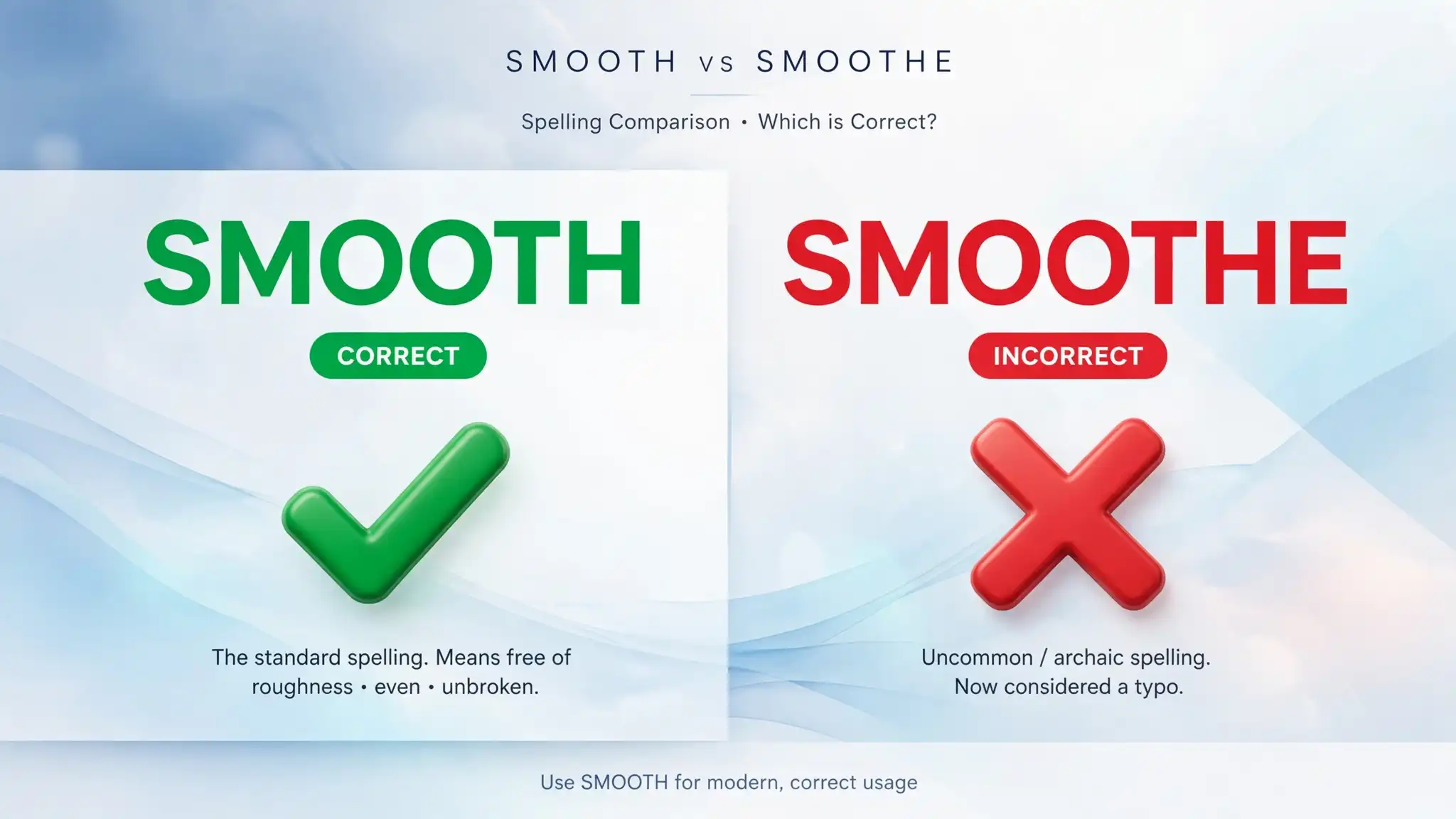
In modern standard English, smooth is the correct spelling in ordinary use, whether you mean the adjective, noun, or verb. Smoothe is an obsolete or very uncommon historical variant, so smooth vs smoothe is not normally a choice between two equally acceptable modern spellings.
Smooth vs Smoothe: What Each Term Means
Before looking at the spelling rule, it helps to separate the word’s modern meaning from the unusual form that sometimes appears in older texts. In smooth vs smoothe, the distinction is mainly about standard contemporary usage rather than two different meanings.
Smooth
Smooth is a common English word with several grammatical roles. As an adjective, it can describe a surface without roughness (“smooth stone”), a process without problems (“a smooth transition”), or a person’s polished manner (“a smooth speaker”). It can also be a verb meaning to make something even or less rough, as in “smooth the fabric,” and a noun in expressions such as “the smooth of the water.”
Smoothe
Smoothe is an old or obsolete spelling that may appear in historical writing, older dictionaries, or texts that deliberately preserve archaic language. It is not the spelling you should normally choose for present-day emails, schoolwork, articles, business writing, or everyday conversation.
The Core Rule, Explained Once
The central rule in smooth vs smoothe is straightforward: modern standard English uses smooth as the established spelling, while the form with the extra final e is not the normal contemporary form. In other words, the extra letter does not create a modern grammatical distinction.
That matters because English sometimes does use spelling changes to mark different forms of a word. For example, a verb may change its ending when a suffix is added, or a final silent e may disappear in certain constructions. That pattern does not apply here. You do not need to decide between smooth and smoothe based on whether the word is functioning as an adjective or a verb.
The same modern spelling works across common uses: smooth skin, a smooth ride, smooth the edges, smooth things over, and a smooth surface. If you are writing for a contemporary audience, smooth is the reliable choice.
There is also a useful historical point. Older English spelling was less standardized than modern English, and variant forms could circulate more freely. That helps explain why a reader may encounter smoothe in an old source without that spelling being appropriate for modern prose.
Examples in Context
The examples below show how smooth vs smoothe works across different real-life settings, from workplace writing to travel, technology, and everyday conversation.
- Work email: We hope the handover will be smooth and well organized.
- Home improvement: Use fine sandpaper to smooth the wooden edge before painting.
- Travel: The train ride was surprisingly smooth despite the heavy rain.
- Technology: The latest update should make the app smooth and responsive.
- Cooking: Stir the sauce until the texture becomes smooth and creamy.
- Relationships: She tried to smooth over the disagreement before dinner.
- Fashion: The silk scarf felt smooth against her skin.
- School: The presentation went smooth from beginning to end.
- Customer service: The representative helped smooth out the delivery problem.
- Historical writing: A reader may find smoothe in an older text, but it is not the usual modern spelling.
Common Mistakes
Most errors in smooth vs smoothe happen when writers assume that the extra e must signal a different grammatical form. Here are the mistakes worth watching for.
- Wrong: The road was very smoothe after repairs.
Right: The road was very smooth after repairs.
The modern adjective is spelled without the final e. - Wrong: Please smoothe the icing with a spatula.
Right: Please smooth the icing with a spatula.
The verb uses the same standard spelling as the adjective. - Wrong: We need a smoothe transition between the two sections.
Right: We need a smooth transition between the two sections.
Adding an e does not make a special form for formal or abstract uses. - Wrong: The editor asked me to smoothe out the wording.
Right: The editor asked me to smooth out the wording.
Phrasal uses keep the standard spelling. - Wrong: Smooth and smoothe are equally common modern spellings.
Right: Smooth is the normal contemporary form.
The second spelling has historical or archaic associations rather than being a standard modern alternative.
Tricky or Edge Cases
There is one genuine edge case: historical or deliberately archaic writing. If you are quoting an old document, reproducing an original title, studying historical spelling, or discussing language history, you may encounter smoothe. In that setting, preserving the original spelling can be appropriate, but that is different from choosing it for ordinary modern prose.
A related issue is edited text that intentionally retains older spelling for stylistic effect. A novelist, historian, or museum publication might use an archaic form to create a period atmosphere. The unusual spelling in such a context should not be treated as evidence that modern readers are expected to use it.
How to Remember It
For smooth vs smoothe, think of the modern word as the shorter, standard form: smooth. If you are writing a normal sentence and find yourself tempted to add an extra e, stop and ask whether you are actually reproducing historical wording. For everyday English, smooth is the form to reach for, whether you are describing a surface, a process, or an action.
Which Is More Correct or More Common?
In smooth vs smoothe, smooth is the established spelling and overwhelmingly the form readers expect. It works as an adjective, verb, and noun, so there is no modern need to switch to smoothe when the grammatical role changes.
That makes this less of a traditional “which word means what?” distinction and more of a modern-versus-historical spelling issue. A dictionary, historical quotation, or archival source may preserve the older-looking form, but ordinary edited English generally uses smooth.
If you are writing an essay, website article, workplace message, product description, or social post, choosing smooth avoids an unnecessary spelling distraction. Readers are far more likely to recognize it immediately as the standard contemporary form.
Quick Reference Table
Use this table as a fast check when you are editing a sentence and want to confirm which spelling belongs in modern English.
| Form | Modern status | Typical use | Example |
| smooth | Standard and common | Adjective, verb, noun | The fabric feels smooth. |
| smoothe | Archaic/obsolete or very uncommon | Historical or deliberately old-fashioned writing | The old document uses smoothe. |
FAQs
These quick questions cover the situations in which writers are most likely to hesitate over the spelling.
Is “smoothe” a correct word?
Smoothe can be found as an older or obsolete variant, but it is not the normal spelling in contemporary standard English. For modern writing, use smooth.
Is “smooth” a verb?
Yes. Smooth can be a verb meaning to make something even, flat, less rough, or more orderly. It can also appear in phrases such as “smooth over” and “smooth out.”
Why does “smoothe” appear in some dictionaries or old books?
Historical English had more spelling variation than modern edited English. Older sources may therefore preserve forms that are no longer standard in everyday writing.
Should I use “smoothe” in formal writing?
Generally, no. Formal modern writing calls for smooth unless you are intentionally quoting, reproducing, or discussing an older spelling.
Does “smooth” change spelling when it is a verb?
No. The base spelling remains smooth when used as a verb. Context changes its grammatical function, not the basic modern spelling.
Conclusion
Understanding smooth vs smoothe becomes much easier once you stop treating the two forms as equal modern alternatives. Smooth is the standard contemporary spelling and works across the word’s common adjective, verb, and noun uses, while smoothe belongs mainly to historical or deliberately archaic contexts. Knowing that distinction can prevent a small spelling choice from distracting readers or making otherwise polished writing look dated. The next time the extra e seems tempting, choose the established modern form and keep your sentence clean and confident.
One more spelling showdown, settled: unaccessible vs inaccessible.